







KEY POINTS
- President Santiago Peña announced his resignation hours before lawmakers were due to advance impeachment proceedings against him.
- The collapse of digital lender Ueno disrupted access to millions of accounts and unsettled financial markets.
- Ueno had about three million customers and managed approximately $850 million in public funds.
- Opposition lawmakers accused Peña of conflicts of interest and protecting the lender from scrutiny. He denied wrongdoing.
MAIN STORY
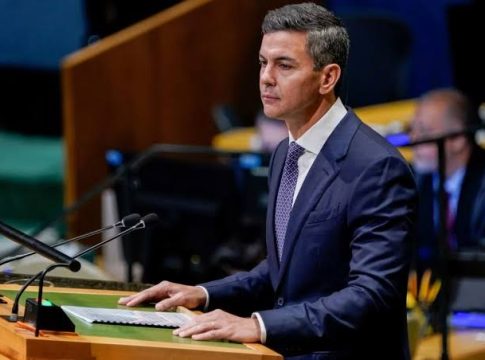
Paraguayan President Santiago Peña has announced his resignation following the collapse of digital lender Ueno, a crisis that has disrupted access to millions of bank accounts and raised concerns about the country’s financial system.
Peña made the announcement on Thursday, hours before lawmakers were expected to advance impeachment proceedings against him. His decision came after he lost support within his conservative Colorado Party.
In a statement posted on social media, the president said he would appear before the Senate proceedings to defend himself and account for his actions.
He said his participation was not driven by personal pride but by the need to explain his conduct to the Paraguayan people.
Peña also called for a swift resolution of the crisis, particularly the difficulties faced by customers who could no longer access their accounts.
“Clarifying the facts and resolving the payments are obligations that must advance at the same time,” he said.
His announcement unsettled financial markets. Sovereign bond prices fell, while the guarani weakened beyond 6,500 to the dollar before closing at 6,490, representing a decline of nearly five per cent during the day.
THE ISSUES
The crisis began earlier in the week when Paraguay’s central bank intervened in Ueno after finding that the rapidly expanding digital lender had breached minimum solvency requirements.
The intervention has had consequences beyond the bank’s customers. Ueno grew from a small financial technology company into a mid-sized bank serving about three million people in a country with a population of 6.5 million.
It also managed approximately $850 million in public funds, including money belonging to state institutions and pension schemes. Its collapse has therefore raised concerns about the safety of public funds and the ability of customers to access their savings, payments and benefits.
The fallout has also affected the country’s financial authorities. The central bank governor resigned, while arrest warrants were issued for eight Ueno executives, who later surrendered to authorities.
Opposition lawmakers have accused Peña of conflicts of interest, misuse of pension funds and shielding the bank from scrutiny. The president has denied wrongdoing, arguing that the matter is a regulatory issue that should be handled by the courts.
The accusations have focused partly on Peña’s previous links to Grupo Vazquez, the business group that owned Ueno until March 2025. Peña, who was elected in 2023, said he sold his stake in the group in March 2025 and had no improper involvement in the bank’s affairs.
WHAT’S NEXT
Peña’s resignation announcement comes as the country faces pressure to restore access to customers’ funds and establish what led to Ueno’s failure.
Vice President Pedro Alliana, who is next in line to assume the presidency, has distanced himself from Peña in recent days. He has also announced that he is suspending his own presidential ambitions until the financial crisis is resolved.
The immediate challenge for the authorities is to address customers’ access to their money while the investigations into the lender and its executives continue.
BOTTOM LINE
Ueno’s collapse has become a test of Paraguay’s financial oversight and political leadership. With millions of customers affected and public funds involved, the government faces pressure to establish accountability and restore confidence in the banking system.