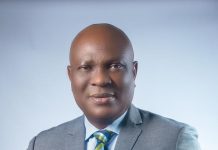
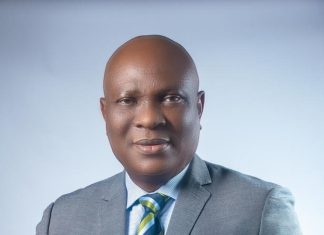
Access Bank has announced the appointment of Mr. Abba Mamman Tor Habib, as Non-Executive Director. Mr. Habib is a thorough bred banking professional with 20 years banking experience. 15 of which were spent with Guaranty Trust Bank Plc where he voluntarily retired in 2008 as an Executive Director. His experience in Guaranty Trust Bank spanned across Corporate Banking and Risk Management. Mr. Habib has since 2008 been the Managing Director of Gremcoh Services Limited his family owned agriculture and real estate enterprise.
He holds a First Class Bachelor of Science degree in Agric Economics from University of Maiduguri (1986) and Master of Science in Banking and Finance from Bayero University Kano (1997). Mr Habib has attended several Executive Development programmes in leading institutions including African Development Bank, Harvard, IMD, D.C Gardner London and Insead. His appointment is subject to the approval of the Central Bank of Nigeria and the Bank’s shareholders.
Commenting on the appointment, Mrs. Mosun Belo-Olusoga the Chairman of Access Bank said: “We are very delighted to welcome Abba on the Board of Access Bank. He brings on board a very rich professional and board level experience relevant to our Bank and our industry. These skills will no doubt support our Bank’s quest to become the World’s Most Respected African Bank.”
With this appointment, Access Bank’s board is made up of 15 Directors, 7 of which are Executive while 8 are Non-Executive, 2 of whom are Independents.
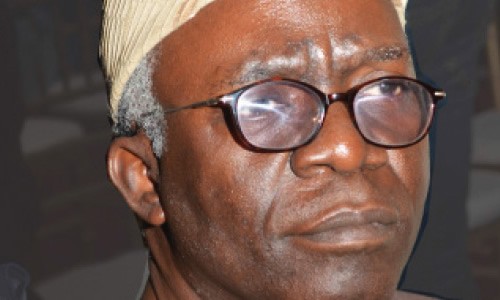
The Federal Government of Nigerian was not winning the war on corruption in spite of the overwhelming evidence available to it, human rights lawyer, Femi Falana, has said.
Delivering the keynote speech at a round table on “Winning the War Against Corruption” in Lagos, Mr. Falana said, the government was yet to understand that the anti-corruption battle could not be won through regular courts.
“Apart from the class solidarity usually extended to politically exposed persons by judges in all capitalist societies, the situation is compounded in Nigeria by judicial corruption and professional misconduct on the part of senior lawyers involved in the defense of corruption cases,” said Mr. Falana, also a Senior Advocate of Nigeria (SAN).
“Owing to lack of coordination in the trial of politically exposed persons, corruption is fighting back. Painfully, the federal government is on the defensive as it has failed to counter the deliberate manipulation of the criminal justice system by the indicted looters of the public treasury.”
Mr. Falana, who was represented by Wahab Shittu, accused the regular courts of subjecting corruption and drug related cases to frivolous adjournments, rather than hearing them day by day as stipulated by the Administration of Criminal Justice Act 2015.
“As if that is not enough, the suspects are being granted bail in their own recognizance or other ridiculously liberal terms by trial judges notwithstanding the gravity of the offences allegedly committed by them.
“Some other judges are granting interlocutory or perpetual injunctions to restrain the anti-graft agencies and the police from arresting, investigating and prosecuting politically exposed persons.
“The ban on granting of stay of proceedings by the Administration of Criminal Justice Act, 2015, is not being observed by the courts.”
Mr. Falana also said most of the ongoing corruption cases would not be concluded before 2019.
“Even if the defendants are convicted, the cases will be pursued up to the Supreme Court,” he said.
“If the current trend continues, some of the cases will not be concluded in the next 10 years., therefore, the federal government should review the anti-corruption policy with a view to setting up a Special Anti-Corruption Court to try all economic and financial crimes including corruption”, he advised.
The lawyer canvassed for the establishment of Special Courts to specifically handle cases of corruption, terrorism, drug trafficking, human trafficking, advanced fee fraud, and other economic crimes.
“At the end of the four years of the Buhari administration, the success of the anti-corruption policy will not be measured by the number of arrests or investigations carried out by the anti-graft agencies,” Mr. Falana said.
Adding that, “If the status quo remains unchanged, the Nigerian people and the international community will blame the administration for its inability to secure the conviction of corrupt politically exposed persons with all the evidence at its disposal.”
“Therefore, a special court ought to be established to deal specifically with economic and financial crimes as well as electoral offences. Otherwise, the anti-corruption policy of the federal government will not achieve its desired objectives,” he suggested.
President Muhammadu Buhari during a ceremonial parade in Abuja to mark the 2016 police week said, recruitment of 10,000 personnel by the Nigerian Police (NPF) would help address the challenges of unemployment in the country.
Represented by the Minister of Interior, Abdulrahman Dambazau, the president said the initiative would also address the manpower gap in the police.
He advised the NPF management to put national interest in mind when conducting the recruitment exercise in line with the reform agenda of the ministry of interior.
The President averred that community policing had become more imperative considering the current security challenges in the country.
He also disclosed that the government had funded the procurement of over 1,000 patrol vehicles and other logistics to strengthen operational capacity of the police and strengthened its technical intelligence capacity in order to address the challenges of highly organised crimes.
“No nation thrives without security, and neither can a nation lay claim to security without an efficient policing service.
“This administration shall continue to support initiatives that will guarantee the reform and modernisation of the Nigeria Police.
Earlier, the Inspector-General of Police, Solomon Arase, said that with the support of the citizens, the police was determined to fight criminals who continued to threaten the peace and security of the nation.
He said that the ‘Week’ was aimed at restoring the lost glory of the Force.
“In essence, the Police Week is a celebration of our history as well as an opportunity for the Force to reconnect with the people for a more effective policing,” he said.
The chief of defense staff, other service chiefs, diplomats and traditional rulers were among others that witnessed the parade.
Oando Plc informed the Nigerian Stock Exchange (NSE) that it was unable to file its 2015 corporate results before the March 31 deadline as required by the exchange’s rules since there was a need to refer it to the Financial Reporting Council of Nigeria (FRC) before it would be made public.
In a statement to the NSE, the management said it would like to advise shareholders, key stakeholders and the wider investors community that it was unable to complete the 2015 audit and issue the audited accounts before the March 31 deadline, as required by exchange rules.
The statement said OandO had worked diligently with its external auditor to ensure a swift conclusion of the audit process, “however, after reviewing the financials, EY indicated that the Accounts may likely need to be referred to the Financial Reporting Council of Nigeria (“FRC”) pursuant to Rule 5 of the recently publicised FRC Rules.”
The management said, “We expect the process to be concluded on or before 31 May, 2016, however this is dependent on the completion of the external review process as referred to above. The company’s management would also like to bring to the attention of its shareholders and the investor community that the accounts of the company at FYE 2015 will be in line with its Q3 2015 performance.”
The statement further said, “The expected decline is attributable to the industry’s downturn, prevalent economic headwinds, as well as fiscal and monetary restrictions driven by a challenging macro environment. While we are actively restructuring the business to adapt to this difficult period, we are optimistic and steadfast in our commitment to return to profitability in 2016.”
OandO Plc was a strong player in the downstream sector and among the major petroleum product marketers in Nigeria and its also quoted on the floor of the Lagos bourse.
Are you in love with an Igbo girl and planning to marry her? Then this is for you!
Igbo girls, a sect of Nigerian girls from the south-eastern parts of the country, are one of the most beautiful and intelligent women in the world. However, they have other unique quirks which impact their marriages considerably.
For those who have fallen in love with Igbo girls and are unaware of these other things that come with being eternally linked to them, Jovago.com, Africa’s No1 online hotel booking site, has put together a little list to help you understand your wife to be. Please keep in mind that list is applicable to most Igbo girls, but not all, like everything else, there are exceptions to the rule.
They value the presence of their family
Igbo girls have deep regard for family and so usually want to have members of their family around most of the time. Her relationship with her parents, siblings and even extended family is close knit and she will not compromise or cut them off in a hurry.
Any guy marrying an Igbo girl has to keep in mind that their home will always be packed with family members gossiping, quarrelling and laughing. Even if you decided to live far away from family, be rest assured that she will keep sending random things back home, will get home-sick a lot and so, will be in constant communication with her family.
They will speak their language to the children
While most Igbo girls are well-groomed and can speak English without the detection of a local accent, they are usually well-versed in their dialect and are proud to speak it at any time. Even when they marry from other tribes or country, they do not neglect their dialect for their husbands or a foreign one.
Their children most usually speak this mother-tongue first before learning that of their husband or any other language. So also, they tend to pass down unique Igbo traits and traditions to their children even if they are married into other tribes.
They will take care of you with love
Igbo girls are beautiful and intelligent, but most of all, they are very caring, hardworking and industrious.
They are generally strong women and while the husband plays the head of the home and brings home the bread, she most likely ends up being the foundation of the house: takes care of the kids, the budget, the food, the home generally. She will not hesitate to take up several jobs to support her husband and family, and she will still fulfill her wifely duty to keep everyone happy.
They are very religious
Igbos are very religious people and their preferred religion is Christianity. Most Igbo girls are brought up in strict religious homes and as such, they have the fear of God and the belief in His supremacy instilled in them.
Even when they get emancipated from their parents, they still carry those values with them into their marriage and homes. Be prepared to go to church every Sunday, and observe religious holidays and church programmes once married to an Igbo girl, they hardly compromise on this or convert to other religions.
Their local delicacies will fill out the home menu
Igbos have a large variety of delicious dishes and their women are trained to know these recipes from an early age. They also have a love for their local meals and so they find it difficult to change their diet to food from other areas.
No doubt after marriage, especially if they are married to someone from another country or tribe, they can make the necessary compromise and eat other dishes, but be rest assures that they will not throw their home food completely away. They find ways to cajole their new family into accepting their local dishes and this is usually easy as Igbo meals are usually delicious and the girls are great cooks.
Federal Government of Nigeria has approved the sum of N350 billion payment to contractors handling various infrastructure development projects in the country, most of whom had abandoned the projects for almost three years due to lack of fund.
Secretary to the Government of the Federation (SGF), Mr. Babachir Lawal who disclosed the approved sum at the opening of the second National Conference on Public Procurement (NACOPP) said, the payment was a relieve to the contractor would were expected to mobilise to site immediately.
Mr. Lawal opined that the payment would encourage the contractors to discharge their obligations to the development of infrastructure, but warned that every kobo expended must be guided by the Procurement Act.
He pointed out that the present administration had promised ‘change’ to Nigerians and would deliver it, he also gave an assurance that the dividends of democracy would soon be seen by Nigerians.
“I am convinced that when the dividends of democracy flourish, all will benefit. We are confident that the state stands to benefit from the procurement system that is transparent, efficient, competitive and accountable”, he said.
Meanwhile, the acting Director General of Bureau of Public Procurement (BPP), Mr. Ahmed Abdu, revealed that 25 states had set up procurement agencies through the inspiration of BPP.
He confirmed support the agency received from World Bank, African Development Bank (AfDB) and other foreign organisations in the discharge of its duties.
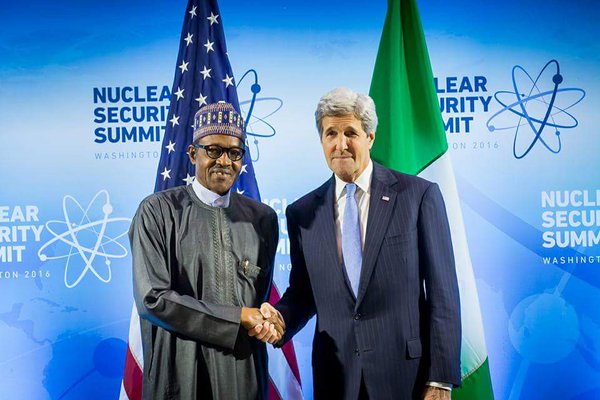
President Mohammed Buhari and John Kerry, U.S. Secretary of State
Government of the United State of America would invest 600 million dollars as development assistance to Nigeria in 2016, the Secretary of State, John Kerry has said.
American embassy through a statement issued by its Public Affairs Unit said John Kerry was quoted as saying this at a bilateral meeting between Nigerian and U.S. officials in Washington D.C.
The U.S. Secretary of State said, “our development assistance this year will top 600 million dollars”.
“We are working closely with your leaders, the leaders of your health ministry, to halt the misery that is spread by HIV/AIDS, by malaria, and by TB,” he said.
Mr. Kerry then lauded President Muhammadu Buhari’s actions in the area of security and the attempt to diversify the economy.
He said, “The U.S. is very encouraged by President Buhari’s commitment to diversify the Nigerian economy in order to make it less dependent on a single commodity for export earnings, and that means we need to develop sustainability.
“Sustainable growth depends on a climate that is welcoming to investment and respectful of the environment and of workers’ rights,” he said.
He added that the U.S. Power Africa Initiative was aimed at strengthening the energy sector, where shortage in electricity frustrated the population and impeded growth.
Mr. Kerry said that the U.S. Young African Leaders Programme which many Nigerians participate in, was preparing the next generation to take the reins of responsibility.
He noted that the U.S. was working with Nigeria to fight illiteracy, especially in the Northern part of the country.
“We are working together to fight illiteracy, especially in the country’s north, where the lack of opportunity has been holding people back and Boko Haram murdered thousands and disrupted million lives.”
The statement quoted Nigeria’s Foreign Minister, Geoffrey Onyeama, as commending the U.S. support to Nigeria.
Mr. Onyeama said the President Muhammadu Buhari-led administration had put in place measures to diversify the nation’s economy.
“We’re really looking to diversify into areas such as agriculture, solid minerals and other extraction industries.
‘’We have to promote our manufacturing sector and look at sustainable economic growth.
“For sustainable economic growth, we appreciate that we have to also develop a manufacturing base,” he said.
The foreign minister said Nigeria was also placing emphasis on Foreign Direct Investment which he said was key to the economy and stressed the need for Nigeria to do a lot more to make it an attractive place for business.
A South African court has ordered President Jacob Zuma to pay back some of the $16 million of state money spent upgrading his private home, in a stinging rebuke that hits the scandal-plagued leader financially and politically.
The unanimous ruling by the 11-judge constitutional court, a central pillar of the democracy established at the end of apartheid, also said Zuma had failed to “uphold, defend and respect” the constitution by ignoring Public Protector Thuli Madonsela’s findings on his sprawling residence at Nkandla in rural KwaZulu-Natal.
In 2014, Madonsela, a constitutionally mandated anti-corruption watchdog, identified a swimming pool, cattle enclosure, chicken run, amphitheater and visitor centre as non-security items that Zuma must pay for.
Chief Justice Mogoeng Mogoeng gave the Treasury 60 days in which to determine their “reasonable cost”, after which Zuma would have a further 45 days to pay. Early estimates of the costs were 10 million rand ($680,000), Madonsela said.
Besides hurting Zuma, the ruling is a vindication for the soft-spoken but steely lawyer described by Mogoeng as “the embodiment of the Biblical David” fighting against the Goliath of state corruption.
“The office of the Public Protector is one of the true crusaders and champions of anti-corruption and clean governance,” Mogoeng said. “Hers are indeed very wide powers that leave no lever of government power above scrutiny.”
In a short statement, Zuma’s office said it respected the ruling and would determine the appropriate action in due course.
Madonsela said the ruling should help restore the shaken faith of South Africans and others, including investors, in the state of democracy in the continent’s most advanced economy.
“The judgment was something that many of us as lawyers will cherish for the rest of our lives,” she said. “I always said that our democracy is built to last. When part of the system fails, you can’t say the entire system has failed.”
The uncompromising nature of his verdict – Mogoeng said it carried a “profound lesson” for South Africa – piles more pressure on Zuma, whose second term in office is due to end in 2019.
Zuma was also ordered to pay costs.
Standing outside the court in downtown Johannesburg, opposition leader Mmusi Maimane told reporters Zuma should be removed from office and said he would table a parliamentary motion to have him impeached.
Zuma, a 73-year-old polygamous Zulu traditionalist, has been under intense fire since December when his abrupt sacking of Finance Minister Nhlanhla Nene sent the rand into a tail-spin.
The rand firmed to a near-four month high against the dollar as Mogoeng delivered his ruling.
The African National Congress (ANC) called an emergency meeting of its ‘Top Six’ leaders – who include Zuma – to discuss the “serious nature” of the court’s findings.
Its majority in parliament would most certainly give Zuma political cover against any attempt to impeach him, but the judicial rebuke may embolden anti-Zuma factions within the ruling party to mount a challenge.
“It’s a major decision that is going to have a significant impact on our political environment,” said Gary van Staden, political analyst at NKC African Economics.
“In most other places in the world it would be terminal for President Zuma but we will have to wait and see how the balance of forces are playing out in the ANC.”
Much of the court ruling focused on whether Madonsela’s 2014 findings and recommendations on Nkandla were legally binding.
Mogoeng made it very clear they were, saying it would be pointless if the public protector’s findings could be ignored “willy nilly”.
Over the last two years, Zuma has refused to comply, instead ordering parallel investigations by the public works and police ministries that exonerated him, based on declarations that included calling the swimming pool a fire-fighting reservoir.
As president, Zuma’s annual salary is 2.7 million rand ($183,000). If any payments are made on his behalf, they would be liable for income tax at 41 percent.
Last month, Zuma’s legal team admitted they were worried about political fallout from the case in mid-year provincial elections, urging the court not to wander too far from its explicitly legal mandate.
“This is a delicate time in a dangerous year,” his lawyer, Jeremy Gauntlett, told the court. “It will be wrong if this court makes a ruling which may result in a call for impeachment.”
Adama Simila wears a knife tied to his belt by a piece of rope, his only protection against Boko Haram, the Nigerian Islamist insurgents who have repeatedly targeted his home town in remote northern Cameroon.
While the threat once came from heavily armed, battle-hardened jihadists crossing from neighbouring Nigeria, today Simila knows he is more likely to die at the hands of a teenage girl strapped with explosives.
“We’re here to look out for suicide bombers,” said the 31-year-old, a member of a local civilian defence force in the town of Kerawa.
After watching its influence spread during a six-year campaign that has killed around 15,000 people according to the U.S. military, Nigeria has now united with its neighbours to stamp out Boko Haram.
A regional offensive last year drove the insurgents from most of their traditional strongholds, denying them their dream of an Islamic emirate in northeastern Nigeria. An 8,700-strong regional force of troops from Benin, Cameroon, Chad, Niger, and Nigeria is seeking to finish the job.
Now, increasingly on the back foot, Boko Haram is retaliating with a deadly guerrilla campaign against civilians, and ordinary people like Simila have become the last line of defence.
“I’m not scared. They are people, we are also people. We must die to live,” said Simila, who was at the Kerawa market in September when two girls detonated themselves, killing 19 people and injuring 143 others. A nearly identical bombing at the same market followed in January.
Outside Nigeria, Cameroon has been hardest hit by Boko Haram, which now operates out of bases in the Mandara Mountains, Sambisa Forest and Lake Chad — areas straddling the borders between Cameroon, Nigeria, Chad and Niger.
Since August 2014, the sect has carried out 336 attacks in Cameroon, according to the Cameroonian army, which has lost 57 of its own men while defending the north.
Of 34 recorded suicide bombings killing 174 people, 80 percent were carried out by girls and young women aged 14 to 24 years.
Girls abused as sex slaves by the group are psychologically damaged and therefore more vulnerable, the army says. Boko Haram also uses girls because they are thought less likely to arouse suspicion, although that may be changing now.
“The goal now is to stop Boko Haram incursions into villages, stop them from planting IEDs (home-made bombs), and stop suicide bombings,” said Lieutenant-Colonel Felix Tetcha, a senior officer in the army’s operation against Boko Haram.
Cameroon has thrown vast resources into protecting the north.
In total nearly 10,000 of its troops are deployed against Boko Haram. The army’s Rapid Intervention Brigade (BIR), comprised of its most professional, best equipped soldiers, patrols a high-risk 400-km (250-mile) stretch of the border with Nigeria.
The U.S. military backs them with equipment, training and intelligence gathered from American drones flown out of a base in the town of Garoua. A Reuters reporter saw a small American military camp inside another BIR base in nearby Maroua.
Still, the terrain is mountainous and Boko Haram has rigged many roads with explosives designed to kill soldiers. Army officers are convinced that some fighters from Boko Haram, which pledged allegiance to Islamic State last year, have been trained at IS camps in Libya.
Armed incursions by Boko Haram fighters have dropped. But the army does not have enough soldiers to deploy in every town in northern Cameroon, and suicide bombers strike regularly, often several times in a single week.
“The border is under control, but it’s still very porous,” said Lieutenant-Colonel Emile Nlaté Ebalé, head of operations and logistics for the BIR’s mission in the north.
Faced with such an asymmetrical threat, Cameroon’s army has turned to so-called vigilance committees for help.
As the blazing midday sun beat down on Kerawa, Bouba Ahmada walked along a dry, scrub-lined creek bed, an ancient flintlock musket slung around his neck.
“Here is Cameroon, over there is Nigeria,” he said, gesturing towards the abandoned homes just across the dusty expanse. “It’s empty. Only Boko Haram stays there.”
Made up of men and boys armed with machetes, home-made rifles or bows and arrows, these self-defense forces have the blessing of the local government.
They accompany the army on patrols and intelligence gathering missions, question travelers, and denounce to the military anyone deemed suspect.
Last week they intercepted two female suicide bombers and handed them over to the army before they were able to detonate.
“We are not 100 percent dependent on this information, but this information is crucial,” said Lieutenant-Colonel Tetcha, who is not only defending Cameroon but also a growing number of Nigerians.
Close to the border sits the U.N.-run Minawao camp, home to nearly 57,000 refugees who have fled Boko Haram in Nigeria.
“Everybody suffers in this place,” said James Zapania, a 24-year-old camp resident from Gwoza, Nigeria. “We’re not worried about Boko Haram coming here, we’re worried about food.”
Refugees like Zapania often receive a chilly welcome from suspicious local villagers, many of whom view them as collaborators or even underground Boko Haram fighters.
According to one Cameroonian officer, the army has removed a number of individuals from Minawao for “activities that were not in line with the behaviour of a normal refugee”.
Suspicion is everywhere. And while Boko Haram infiltrators make up only a tiny portion of fleeing refugees, many, including the Cameroonian military, fear that desperation provides fertile ground for recruitment.
“We need to act quickly. There are young people with no work who could be vulnerable. When people are hungry, they are easily approached,” said Colonel Didier Badjeck, a Cameroonian military spokesman.
The Lagos State Commissioner for Environment, Dr Babatunde Adejare has revealed government’s plans to stop the restriction of peoples’ movement during the monthly environmental sanitation by end of 2016.
He said, “Governor Akinwunmi Ambode, in line with his responsive government policy, hopes to discontinue restriction of movement during the monthly environmental sanitation exercise.”
Dr. Adejare disclosed that the governor believed that as the fifth biggest economy in Africa, Lagos State should function round the clock, adding that the government could no longer afford to keep shutting down the mega city because of sanitation.
He revealed that the state had earlier issued a seven-day notice, effective from Thursday, to some markets across the state for violating environmental laws.
The markets were: Sura, Itafaji, Oke-Odo, Sangrouse, Bariga, Ajah Ultra-Modern, Agbalaka, Aiyetoro, Sabo and Ita-elewa in Ikorodu. They would be shut if traders failed to comply with relevant laws regarding sanitation.
He pointed out that in spite of continuous advocacy, enlightenment and appeals, some market leaders and traders had been violating the extant laws on the environment.
“The state will no longer allow a few bad eggs hiding under the guise of making a living to compromise the health and safety of the greater law-abiding majority who may unjustly suffer the likely outbreak of diseases and flooding of their homes,” he said.
Adejare further affirmed the government’s zero tolerance for street trading and all environmental abuses that would hinder the state’s cleanliness up to a level comparable with its peers anywhere in the world.
A Peoples Democratic Party’s (PDP) Senator and chairman of the Senate Committee on Niger Delta Affairs, Peter Nwaboshi has boasted that his party would replace Bukola Saraki as Senate President if members of the All Progressive Congress (APC) succeeded in their plans to ease him out of office.
Political watchers had posited that, some APC members were determined to punish Senator Bukola Saraki, who defied the party’s directive to step down for another party member as the senate president, but rather went through the back door to win the seat.
They averred that Bukola Saraki’s ongoing trial at the Code of Conduct Tribunal might have provided a window for them to unseat him.
Meanwhile Nwaboshi boasted, the PDP was ready to replicate the current system in the United States (U.S.) where the Republican Party was in charge of the parliament, while the Democrats controls executive.
He said, “Well, I wish All Progressives Congress (APC) the best of luck if they are making that wild goose chase, but I want you to mark what I’m saying, I was the first to address the press in Port Harcourt and I told them that Saraki was going to win the Senate Presidency, I gave them my reasons. Then, nobody ever thought that Saraki was going to win. People were saying that APC had decided. But it was clear to me that he was going to win and I had to address the press.”
Adding that,“If anybody is thinking that a PDP man is going to vote against a PDP candidate, he is telling you a lie. We have people and we know how to get the people from APC. We will win and that will be very interesting. What is happening in America is going to happen in Nigeria. America has a Republican Senate but the executive is led by Democrats. So, it’s happening in different parts of the world. I can tell you with what’s on the ground that we will produce the next Senate President.”
“The man (Saraki) is going to court and he is obeying the court order. Until it is proven that he is guilty, no amount of blackmail will make us shift our ground and our support for him. In any case, my party, the PDP, we have resolved in our meeting to support him. So, there is no basis for him to resign,” Nwaboshi concluded.
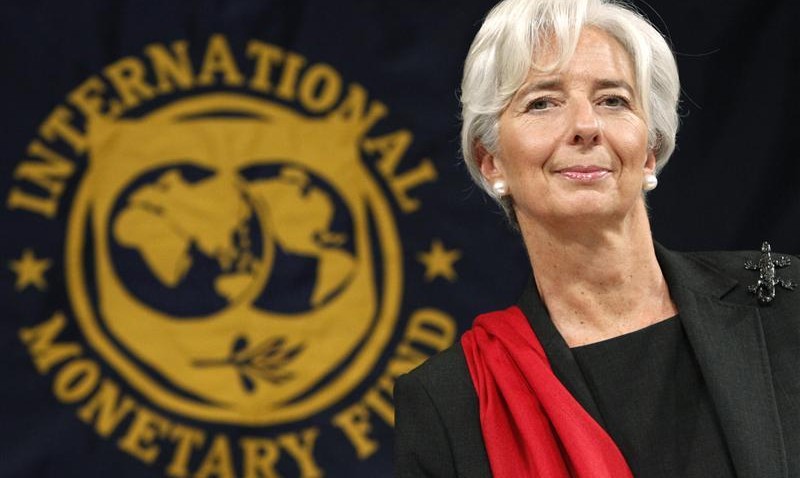
Christine Lagarde Announces Resignation as IMF Chief
The International Monetary Fund (IMF) has again dropped its 2016 forecast on Nigeria’s economic growth, saying the nation was faced with “substantial challenges” caused by low crude prices.
IMF officials, during a visit to the country in February, had forecast a 3.2 percent growth, but its annual review of Nigeria’s economic situation released on Thursday forecast 2.3 percent gross domestic product growth in 2016 from an estimated 2.7 percent in 2015.
“Key risks to the outlook include lower oil prices, shortfalls in non-oil revenues, a further deterioration in finances of state and local Governments, deepening disruptions in private sector activity due to constraints on access to foreign exchange, and resurgence in security concerns,” the IMF said in a statement.
It added that Nigeria’s general government deficit would grow further after doubling to 3.7 percent of GDP in 2015.
The IMF executive board said Nigeria needed to urgently implement policies to safeguard fiscal sustainability, reduce external imbalances and advance structural reforms that promote more inclusive growth.
“Directors emphasized the critical need to raise non-oil revenues to ensure fiscal sustainability while maintaining infrastructure and social spending,” the IMF said. “They urged a gradual increase in the VAT rate, further improvements in revenue administration, and a broadening of the tax base.”
Discussions between Nigeria and the World Bank are continuing on a possible loan or credit facility tied to policy reforms in the West African oil exporter, a spokesman for the Washington-based multilateral lender disclosed.
Forte Oil is an indigenous petroleum marketing company with structured operations and strategic policies to continuously improve product delivery to its customers. Forte Oil is renowned for her ability to offer her consumers a wide range of products from the oil value chain; PMS, diesel, aviation fuel, kerosene, commercial gas and a wide range of lubricants for various automobiles and machines. A major player in the downstream sector of the Nigerian oil and gas sector, Forte Oil prides itself on delivering prompt, quality and effective services to our customers nationwide.
We are recruiting for the position of:
Job Title: HCA Officer
Location: Lagos
Reports To: HCA Advisor
Job Band: TBA
Purpose Statement
To contribute to the implementation, coordination and provision of an efficient administrative support to the delivery of the Human Capital strategy which is aligned with the business objectives of Forte Oil.
Key Accountabilities
Provide Human Capital administrative support to all employees in the assigned business units.
Work with line managers to deliver agreed recruitment and training plans required by the assigned functions.
Monitor and verify that departmental records are stored in compliance with the company’s’ record management policy.
Provides support in ensuring that performance Objectives processes for all assigned business units’ employees are aligned with company objectives.
Implement Human Capital employee service function across all business units including but not limited to managing documentations on Medical, Leave administration, Confirmation, Records management etc.
Collate reports/feedback on Human Capital processes e.g. recruitment, data sheet information on monthly basis on new employee resumption, disciplinary hearings, re-designation, transfer, salary increase, exits, training plans etc.
Provide support through the use of the HRIS to significantly enhance the effectiveness of the Human Capital process.
Support functional units in ensuring units compliance to Human Capital policies and procedures.
Knowledge, Skills and Experience
The position requires an HR professional with a first degree in social science or similar field and at least 2 years work experience in a relevant role.
The incumbent needs to be able to think strategically and be able to find solutions to address the unique needs in the company.
The following skills are essential:
Ability to work with extremely confidential and sensitive data.
Good interpersonal and communication skills.
Good computer skills.
Active member of at least one relevant professional body.
Sound knowledge of oil and gas industry/downstream sector.
Working Relationships:
Internal: The Human Resources team, All assigned business units’ staff, Other internal colleagues in other functional areas across all locations
External: Service providers
Application Closing Date
7th April, 2016.
How to Apply
Interested and qualified candidates should send their CV’s with subject: ‘HCA Officer-FO/HCA/SD/0316 to: external.careers@forteoilplc.com
Red Media Africa (RED) is Africa’s leading omni-media company with a focus on the youth. We are a network of premium media companies including YNaija.com with a prominent development affiliate called The Future Project, owners of The Future Africa Awards & Summit.
At RED, our greatest advantage is our people. #Team RED has a relentless spirit, always pushing the boundaries of what is possible in Africa’s media space. A job at RED is unlike anything you’ve ever seen. You’ll be challenged. You’ll be inspired. You’ll do things you never thought you could. And you will be INCREDIBLY proud of yourself! If you are passionate about the media, how it can empower and drive the conversation, and how we can change the world.
If you’re ready to do the heavy lifting, work incredibly hard and for you it’s greatness or nothing, no matter how tough it gets? Well, we’re constantly looking for people like you! Join us, explore the unlimited possibilities. We are expanding our team again for some exciting new project and client. Hence, we are recruiting to fill the following positions below:
WTS Energy provides recruitment and manpower services for the global oil and gas and energy industries. We supply engineers and consultants to our clients’ projects and operations, and perform employment outsourcing services such as workforce management in oil and gas regions around the world. WTS Energy operates globally with offices in 14 countries and is operational in over 50 countries.
We are recruiting to fill the following vacant positions:
Etisalat’s vision is a world where people’s reach is not limited by matter or distance; a world where people will effortlessly stay in touch with family and friends; a world where businesses of all sizes can reach new markets without the limitations of distance and travel.
We are recruiting to fill the following vacant positions below:
For the first quarter of 2016, stock trading on the Nigerian Stock Exchange, NSE, slid by 13.2 per cent as market capitalization for the first quarter closed at N8.704 trillion against the N9.850 trillion it opened with in January.
This is even as the All Share Index, ASI, also shed 3,336.03 basis points to close at 25,306.22 compared to 28,642.25 basis points it recorded at the opening of trading for the year 2016, as the Year-to-Date (YTD) returns currently stands at -11.65 per cent.
At the end of close of trading activities yesterday, the market however recorded 0.64 per cent gain with the ASI closing at 25,306.22 basis points compared to 25,145.28 points recorded in the preceding trading day.
Similarly, Market Capitalisation added N55.4bn to close at N8.7 trillion compared to N45 billion lost previously to close at N8.69 trillion.
A total of 264 million shares amounting to N1.94 billion were exchanged at the market in 3,298 deals today, with top three traders recorded as FCMB which sold 44.4 million shares worth N38.1 million, Fidelity Bank with total sales of 34.8mn shares amounting to N46.24 million and Sterling Bank transactions of 32.43 million shares valued at N52.5 million.
The day’s index appreciation is attributed to the increase in share prices of Total Plc which rose by N7.32 to close at N153.82 per share, Mobil which also increased by N5.99 to close at N161.99 per share, Dangote Cement’s appreciation of N3.75 to close at N167.8 per share, Julius Berger Plc addition of N3.3 to close at N44.8 per share and 7up’s growth of N2 to close at N155 per share.
Top five financial decliners during the day’s transactions were SEPLAT which lost N10 to close at N300 per share, WAPCO dropped N2 to close at N77 per share and Okomuoil fell N1.57 to close at N29.85 per share. Guinness also lost N1.25 to close at N104.5 per share while Unilever declined by 25 kobo to close at N29 per share.
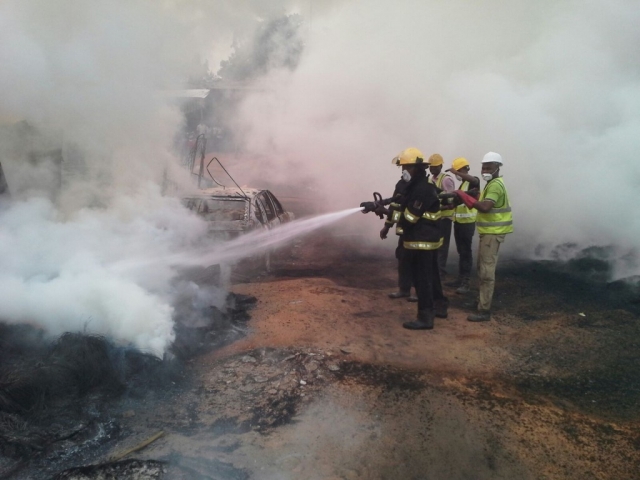
The National Association Nigerian Traders, NANTs, has revealed that the nation has lost over N5.3trillion to fire incidents in the last seventeen years .
The association’s National President, Ken Ukaoha, who disclosed the figures during a media interaction on the incessant fire outbreaks in Abuja on Thursday, March 31 , said it was worrisome that the nation had also recorded over 10 major market fires in the last three months.
Ukaoha pointed out that in all the instances, all state authorities could do was to offer sympathy visits and pronouncement of support, which never saw the light of the day.
He noted that it was ironical that government could be wooing foreign investors into the country all in a bid to improve Foreign Direct Investment (FDI) inflows, without sparing a thought about thousands of small businesses in the country that are being ruined by incessant fires.
The NANTs boss said:”It is rather sad and unfortunate that while successive Nigerian governments have continued to chase Foreign Direct Investments even with tax incentives and other attractions, the local traders who constitute the largest domestic investors in the country are neglected while their investments are left to wither away through fire.
“The consequence of this neglect is that Nigerian traders, and by extension the Nigerian economy has lost over N5.3trn to market fires between May 1999 and March 2016.”
“Yet, more annoying is that no government in power has either deemed it necessary to investigate or take actions to forestall further losses occasioned by market fires. Worst still is that the government that enjoys collection of taxes from the traders would never have ‘compensation’ in her dictionary for the affected traders when such market fires occur.”, Ukaoha added.
The Centre for the Study of Economies in Africa, CSEA, has projected a modest growth in Nigeria’s foreign reserves if the global oil market sees further recovery.
The policy research organization, which made the projection in its latest edition of its Nigeria Economic Update released Tuesday, hinged the positive outlook on the easing market conditions in the international crude market.
According to the Centre, while sundry measures being put in place by the government, including the directive to EFCC to investiage cases of forex speculation, to ensure improved management of the foreign exchange market and by implication, help to stem the decline in the value of the naira on account of speculative demand may not be unjustified, the imperative of having a well-designed framework cannot be under-estimated.
It stated: “While these temporary ad hoc measures can limit volatility in the forex market in the shortterm, a well-designed framework is required to manage the forex market within the medium and long term. Given the sustained increase in the price of crude oil in the period, the foreign reserve increased slightly by 0.14 percent ($35 million), from $27.84 billion to $27.88 billion.
“With easing market conditions in the international crude market, a modest growth in Nigeria’s foreign reserve is expected to continue, at least in the near term”, the CSEA added.