

Nestle Nigeria Plc with a presence in more than 130 countries and factories in more than 80 research centres
brings many global benefits. We believe in long term career development and appreciate how challenges and motivation will help you reach your potential. Nestle Nigeria Plc upholds the principle of Non- Discrimination and Equal Employment Opportunities in its recruitment processes.
Application are hereby required from suitably qualified candidates to fill the vacant position below at Flowergate Factory, Sagamu:
Job Title: Production Technician
Location: Sagamu, Ogun
Job Description
To operate and carry out autonomous maintenance on the production line under his responsibility to meet up with Safety, Quality and Output requirements.
Responsibilities
Carry outline operations in accordance to operating instructions and parameters.
Achieve required quantity of products and of right quality as per specifications.
Carry out autonomous maintenance, CIL of assets under his/her control.
Update necessary records of operations as at when due.
Comply with safety, health, environment and food safety and quality procedures
Other tasks as assigned by superior officers.
Requirements
OND/City & Guilds/NABTEB (Technical) in Electrical / Mechanical Engineering.
Minimum of five (5) credits including English language and Mathematics in SSCE/NECO or its equivalent.
Must have at least 1 year experience in a reputable manufacturing organisation.
Computer literacy.
Good communication skills (oral and written).
Good interpersonal skills.
Application Closing Date
3rd March, 2016.
How to Apply
Qualified and interested candidates should send their details in the “MS Excel format” below only to: flowergate.recruitment@ng.nestle.com (also attach your CV) on or before
Excel Format
Title | Surname | Other Names | Age (as at 1st Feb. 2016 | Basic Qualification (e.g SSCE/NECO) | No. of Credits |Other Qualification(s) e.g OND | Years of Experience | Phone No l
Note: Only short-listed candidates will be contacted.

Bourbon Interoil – As international leader in marine services, “Bourbon” offers to the most demanding oil & gas clients worldwide a full line of innovative, safe, high performance and new generation vessels and an expanded offer of offshore oil & gas services delivered by 11 000 experienced and competent employees across 45 countries. By joining “Bourbon” you will be “Under the flag of excellence”.
We are recruiting to fill the following positions below:
The Nigeria Interbank Settlement System, NIBSS, and banks in the country have spent over N400 million to provide incentives to promote adoption of electronic payment in the country.
Managing Director of NIBSS, Ade Shonubi disclosed this on Monday, February 22, while addressing a press conference on the forthcoming Efficiency Award organized by the company to reward and recognize outstanding stakeholders in the promotion of electronic payment.
He said: “The banks have spent over N400 million as incentives under electronic payment incentives scheme. “The electronic payment incentives scheme (EPIS) is an initiative of the Central Bank of Nigeria (CBN), Bankers Committee, and the banks in Nigeria to promote electronic payment in Nigeria.”
“There were series of activities around it that started over a year ago. One of the first thing is when we were refunding cash back to people, and at the end of the month, you receive some amount of money for using your PoS, and then we had adverts.”
Commenting on the impact of the electronic payment incentives scheme on the level of epayment transactions in the country, Shonubi said, “In the month of December we had 18 million transactions on our platform.”
“That is just for one month. On the average we do about 15 million transactions in a month. Before now it was much lower than that. So clearly the numbers are moving up.”
Manufacturers Association of Nigeria, MAN, has expressed worry that many of its member companies will close down production at the end of the first quarter of 2016 as a result of raw materials scarcity.
President of MAN, Frank Udemba Jacobs, said that since the introduction of foreign exchange restrictions policy by the apex bank almost eight months ago, their members find it difficult to import their raw materials.
“The recent policy statement of the Central Bank of Nigeria (CBN) has not really augured well for manufacturers. To an extent, we seem to agree with the reasons behind the decision of the CBN, mainly the dwindling crude oil price in the international market but sometimes, the policy seems to be like throwing the child out along with the bath water, in the sense that our members raw materials could not be purchased or sourced.
The policy denied them foreign exchange to import their raw materials and we are concerned that before the end of this quarter, it is possible that many of these companies will be out of business, because by then, they would have run out of their raw materials, most of them have come to make presentation to us that they are going to close down unless there is a change in the policy from the CBN,” he said.
According to him “the recent statement by the CBN that money deposit banks can now receive foreign exchange into domiciliary account of customers; it’s cheering news in the sense that some of the smaller industries might be able to transfer money in order to buy their raw materials.
“The decision also to stop the funding of the exchange is again a good decision, it’s a step in the right direction, we are hoping that that same funds that are saved should be channeled into the productive sector by allowing the real sector to get their foreign exchange to import their raw materials, that is one of their major challenges.”
“We are also faced with the challenge of change in government, because normally when government is changed like it happened in Nigeria last year, it takes a long time for new policy thrust of the new government to come out especially with the long delay in the appointment of the cabinet, all those things throw the economy into a state of uncertainty for a very long time and it becomes difficult for my members to predict the economy to be able to plan their businesses.
The Equity market activities closed on a negative note on Monday, February 22, as the Nigerian Stock Exchange, NSE All Share Index (NSE ASI) slid marginally by 0.04% to close at 24,423.37 points. Year-to-date (YTD), it depreciated by 14.73%.
Consequently, the Market Capitalization depreciated marginally by 0.04% to close at N8.399trn, compared with the appreciation of 0.70% recorded last Friday to close at N8.402trn.
The depreciation recorded in the share prices of UBA, Zenith Bank, Nigerian Breweries, GT Bank, and Oando were mainly responsible for the loss recorded in the Index.
The total value of stocks traded on the floors of The NSE today was N5.99bn, up by 547.31% from N925.39mn traded last Friday. The total volume of stocks traded was 3.45bn in 2,432 deals. Tiger Branded Consumer Goods Plc accounted for 67.95% of the total valued traded today.
The three most actively traded stocks were: Tiger Branded (3.28bn), Unity Kapital (37.70mn) and FCMB (31.25mn). The most actively traded sectors were: Consumer Goods (3.28bn), Financial Services (132.68mn) and Industrial Goods (15.19mn).
The federal government has proposed a total of N1, 281,127,089 in its 2016 budget to complete and furnish the abandoned Zik’s mausoleum which is the burial site of Nigeria’s first indigenous president, the late Nnamdi Azikiwe in Onitsha, Anambra State.
The mausoleum has reportedly remained in ruins for years now as works on it had stopped and as such, the Ministry of Power, Works and Housing has included to spend N1,143,575,058 in its 2016 budget, to complete the structure while N137, 552,031 would be used to furnish it.
The document containing the ministry’s budget proposal for the mausoleum and library complex was obtained from the internet webpage of the ministry of finance Monday in Abuja.
According to reports, the government of Anambra, Azikiwe’s home state had before now considered taking over the project from the federal government in view of its national significance and the iconic standing of Azikiwe.
The state governor, Willy Obiano, had repeatedly called on the federal government to show more commitment beyond what obtains to the project.
Works on the mausoleum which from the ministry’s description will have a library complex, was awarded in 1997 after Azikiwe died in 1996, but it has since remained unfinished.
Crude oil prices on Monday, February 22, climbed by over six per cent after the world’s oil consumer body, the International Energy Agency, IEA, said it expected United States shale production to fall in 2016 and 2017.
Reuters reported that a bounce in global stock markets and the after-effects of a fall in the US oil rig count last week also supported prices.
However, as the IEA’s forecast provided some glimmer of hope of a price recovery in the medium-term, it is the near-term that was of paramount importance to President Muhammadu Buhari when he departed for Saudi Arabia yesterday to meet with leaders of the kingdom in order to consolidate on the oil output freeze aimed at pushing up prices.
The world’s two largest oil producers, Saudi Arabia and Russia, agreed last week to keep oil output at January levels – the first cooperation among OPEC and Non-OPEC producers in 15 years – in order to boost prices.
The problem, however, is that the attempt to cap output could be scuttled by Iran, which has hurriedly increased output since US-led sanctions were lifted after it agreed to stop its nuclear programme.
Iran has “welcomed” the oil freeze, but made it abundantly clear that it would not cap output.
Its position also reflects the political tension in the Gulf between Sunni-led Saudi Arabia and its allies in the region, and Shia-led Iran.
Yesterday, however, US crude (WTI) futures rose above $31 a barrel, gaining $1.95, or 6.6 per cent, to $31.59 a barrel.
The March contract expires at the end of the session. US crude for April delivery traded at a higher volume and was at $33.46.
Also, international benchmark Brent was up $1.49 or 4.5 per cent at $34.50 a barrel.
IEA, the energy advisor to 26 industrialised countries, said in its medium-term outlook monday that US shale oil production was expected to fall by 600,000 barrels per day (bpd) this year and another 200,000 bpd in 2017.
This fed into data released late last week that showed US drilling rig numbers had fallen to the lowest level since December 2009.
The IEA also said in its report the global oil market would begin rebalancing in 2017.
“Today’s oil market conditions do not suggest that prices can recover sharply in the immediate future,” the agency said.
In the US, record crude stocks of 504.1 million barrels were also weighing on markets, countering a proposed production freeze at January levels by Russia and OPEC.
Russia and OPEC both pumped oil at near-record volumes last month, with Russia reaching another post-Soviet high of 10.88 million bpd.
OPEC member Iraq said yesterday it planned to raise oil output levels to more than 7 million bpd over the next five years, and to export 6 million bpd of that. Oil production in Iraq hit a record high of 4.775 million bpd in January.
Transactions on the Nigerian Stock market flagged off the week on a bearish trend with N4 billion loss.
The first trading day of the week indicated that the NSE All Share Index depreciated by 0.04 per cent to close at 24,432.37 basis points, compared with the 0.70 per cent appreciation recorded previously.
Market turnover closed positive as volume moved up by 2.92 per cent against 44.46 per cent uptick recorded in the previous session.
Tiger Brands Plc, Unity Capital Plc and FCMB Plc were the most active to boost market turnover. Tiger Brands Plc and Lafarge Africa Plc topped market value list.
Neimeth Pharmaceutical Plc led the list of active stocks that recorded impressive volume spike at the end of the trading session.
The International Energy Agency, IEA, on Monday, February 22, said that the oil market will begin rebalancing in 2017.
IEA in its medium-term report released on Monday noted that while oil prices should start to rise gradually once the market begins rebalancing, the availability of resources that can be quickly tapped will limit the scope of the price increase.
However, the report points to the risk of an oil price spike in the later part of the outlook period arising from insufficient investment.
“It is easy for consumers to be lulled into complacency by ample stocks and low prices today, but they should heed the writing on the wall: the historic investment cuts we are seeing raise the odds of unpleasant oil-security surprises in the not-too-distant-future,” IEA Executive Director Fatih Birol, said while launching the report.
The former chairman of the Nigerian Electricity Regulatory Commission, NERC, Sam Amadi has said that the last regulatory audit of the metering gap in Nigeria’s power sector showed that up to two million electricity consumers are yet to be provided with meters by the electricity distribution companies, Discos.
Amadi stated in an interview in Abuja that the metering audit by the NERC was done in December 2015 preparatory to the conclusion of the new tariff review.
He however noted that the gap can be bridged through multiple creative means, which include government subvention and private investments.
According to him, such subventions or investments in bridging the metering gap would have to be backed by the regulator.
Amadi said: “We still have like two million meters backlog by the last assessment. The metering gap can only be closed by investments mandated by the regulator, recovered through tariff but spread out over the years. But government can help now by making investments.”
The naira gathered strength at the parallel market on Monday, February 22, as an overflow of dollars chased the local currency.
The value of the naira had leaped to around N367 to the dollar causing panic in the money market and the economy at large.
Bureau de Change operators as well as street hawkers sold the greenback between N367 and N37. While the pounds sold at around N496 to N499. As at last week Friday, the value of the naira stood at N370 to the dollar and N500 to the British Pounds.
Also the official rate at the Central Bank of Nigeria (CBN) rose in value to N196.5 to the dollar, even as the external reserves of the country rose slightly for the first time this year. The reserves which had dropped to $27.789 billion rose slightly to $27.793 billion as at February 19, 2016.
Last week the value of the naira had dropped to an all time low of N398 to the dollar and N520 to the pounds.
he Forcados terminal has the capacity to export 400,000 barrels of crude oil per day.
According to a statement issued by the company, the force majeure was declared on Sunday, following the disruption in production caused by the spill on the Forcados Terminal subsea crude export pipeline the previous day.
The spokesman Precious Okolobo said the oil company is intensifying efforts on containment and oil recovery from the February 14, 2016 spill, while also finalising repair plans.
Four commercials banks were in 2015 sanctioned for non-reversal of ATM cash dispense error within the specified 48 hour timeframe given by the Central Bank of Nigeria, CBN.
However, Nigerian banks in the past year paid out almost N400 million as cashback on the use of point of sale terminals.
CBN Assistant Director, Payment Policy and Oversight, Banking and Payment System, Shola Agboola, who spoke with newsmen on Monday, February 22, at a press conference organized by the Nigeria Inter Bank Settlement System (NIBSS), noted that following the issuance of a circular directing banks to install and automize auto reversal, the apex bank had found four banks wanting.
“When we carried out our oversight function on the banks to ensure at they have done what they were asked to do, four banks were penalized and sanctions last year, he stated adding that “a situation whereby customers will have a problem, they go and complain and the bank will not attend to them can no longer continue.”
The cashback was introduced in 2014 as an incentive for customers to use their cards for payments and to drive the usage of PoS, customers are paid back 40 per cent of the 1.25 per cent that merchants are charged on POS usage.
Anambra State government has partnered with a courier and cargo company, ABX World, to facilitate the export of about $5.2billion worth of agro-allied products to European countries yearly.
ABX Anambra, World Chief Executive Officer Captain John Okakpu, who made this known, listed others in the deal as Arik Air and Skyway Aviation Handling Company (SAHCOL), adding that it would facilitate the packaging and air freighting to European countries.
Okakpu described the partnership as part of the state government’s efforts to lead the way in its commitment to developing agriculture. The gesture, he said, is capable of generating jobs, eliminating poverty and restoring investor’ confidence in the state.
He said the state had become a trailblazer in this regard, as “different state governments, realising their dwindling fortune in the wake of falling oil revenue, are now interested in the agro-allied exports.” He said Anambra State was leading the way through serious commitment to agriculture , adding that the state is far ahead of others in grassroots structure and technology deployment to aid farmers.
He said: “When we entered into agreement with them, we discovered that they have gone very far. For instance, the state has over 1400 corporative societies and they have gone to the extent of training most of the farmers and also the certification of the corporative societies.
“The next step was the geo-mapping of the area for easy identification of the farmlands from any part of the world. This is a sure step to curb the incessant rejection of agro-allied produce from Nigeria at the European and the rest of the world markets.
“The EU certified trainers were in Nigeria about three months ago. So, after that training and certification programme, the participants were guaranteed of three years contract to supply agro-allied produce to Europe and can use it for the rest part of the world.
“This is the real capacity building we are talking about. There is no other better way to fight poverty and encourage farmers than to provide markets for them.”
Okakpu added that they are working with other partners, Arik Air and SAHCOL to ensure that about 75 farm products of which Ugu-pumpkin leaf tops the list, are exported from Nigeria to Europe and rest of the world.
He expressed optimism that the project will create millions of jobs in the country as more states queue-in into it.
He said that ABX World will use its partnerships around the world to make a difference, “create agricultural revolution whereby we bring in the off-takers to take agricultural products as long as they meet the international standard and requirements.”
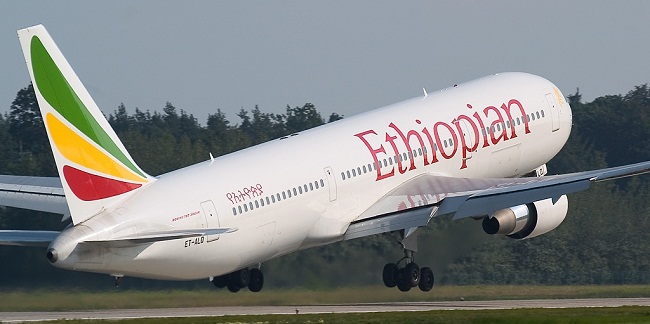
Ethiopian Airlines and Bombardier Commercial Aircraft have sealed a firm purchase agreement for two additional Q400 turboprop aircraft, that will bring the airline’s Q400 aircraft fleet to 19 aircraft.
The transaction is valued at approximately $63 million.
Group Chief Executive Officer, Ethiopian Airlines,Tewolde Gebremariam, said: “We are continuously working to have the right fleet with agility, optimal range, load and passenger comfort which is critical for us to keep our leadership position in the market.”
“The Q400 aircraft continues to be an integral part of our expansion strategy in Africa.Through our strategic partnerships with ASKY Airlines in Togo and Malawian Airlines in Malawi, the Q400 airliner has played a vital role in availing convenient connections, as well as increasing frequencies to support air travel growth in Africa and successfully create a missing link.”
”The Q400 aircraft is also our core fleet to our domestic and regional destinations, thereby ensuring excellent passenger experience, operational flexibility and economics. We continue to work with Bombardier to support and maintain the aircraft through our approved Q400 Authorised Service Facility and our Q400 aircraft simulator,”Gebremariam added.
It was also gathered that by the end of 2015, China’s non-financial direct investment to Nigeria was $1.55 billion.
Chinese Ambassador to Nigeria, Gu Xiaojie who spoke at the symposium of “China/Nigeria Diplomatic Relations at 45: Possibilities, Prosepct and Challenges” in Abuja at the weekend, said the trade volume between China and Nigeia almost doubled in the past few years.
The trade volume however is in favour of China, a development that has been a source of concern to the Federal Government.
“In the trade area, the trade volume between China and Nigeria almost doubled in the past few years. In 2015, our two countries were affected by the sluggish world economy, with trade volume between them last year standing at $14.94 billion, 17.2 per cent less than that of 2014.
“However, Nigeria remains the largest market for Chinese contracted projects and the second largest market for Chinese contracted projects and the second largest market for Chinese exports and the third largest trading partner in Africa.
“Nigeria is also a major destination for Chinese out-bound capital. By the end of 2015, China’s non-financial direct investment to Nigeria is $1.55 billion, 17.6 per cent more than that of 2014,” the envoy said.
He also said in the area of people-to-people communication and cultural exchange, China has established two confucius institutes and four Chinese language centres in Nigeria.
The envoy said China currently issues about 100 government scholarships, while another 400 Nigerian students funded by their family study in China.
The Chairman of Capital Oil and Gas, Ifeanyi Ubah on Sunday has said he has what it takes to restore the naira to 200 against the dollar in one month, if consulted by President Muhammadu Buhari.
Speaking with Channels Television, Ubah, however, dismissed the insinuation that the short fall in naira was as a result of the activities of the Bureau De Change, BDC, operators.
He said, “Look at the economy, look at the position of the naira today; some of us have ideas on how we can restore this.”
“It won’t take me one month, if Buhari gives me part of that consultancy, and naira would come back to 200.
“I can bet my life with it, naira would come back to N200. If you call me for that consultancy, I would put naira back to 200.”
“Look at the economy, look at the position of the naira today; some of us have ideas on how we can restore this,”
“Do you know how many Burea De Change people who food has been taken out of their families because of this? If you say they are the ones causing it, then where are you today?
When asked on how he intends to go about achieving such feat, Ubah said: “Don’t worry, that’s my business and business is secret.”
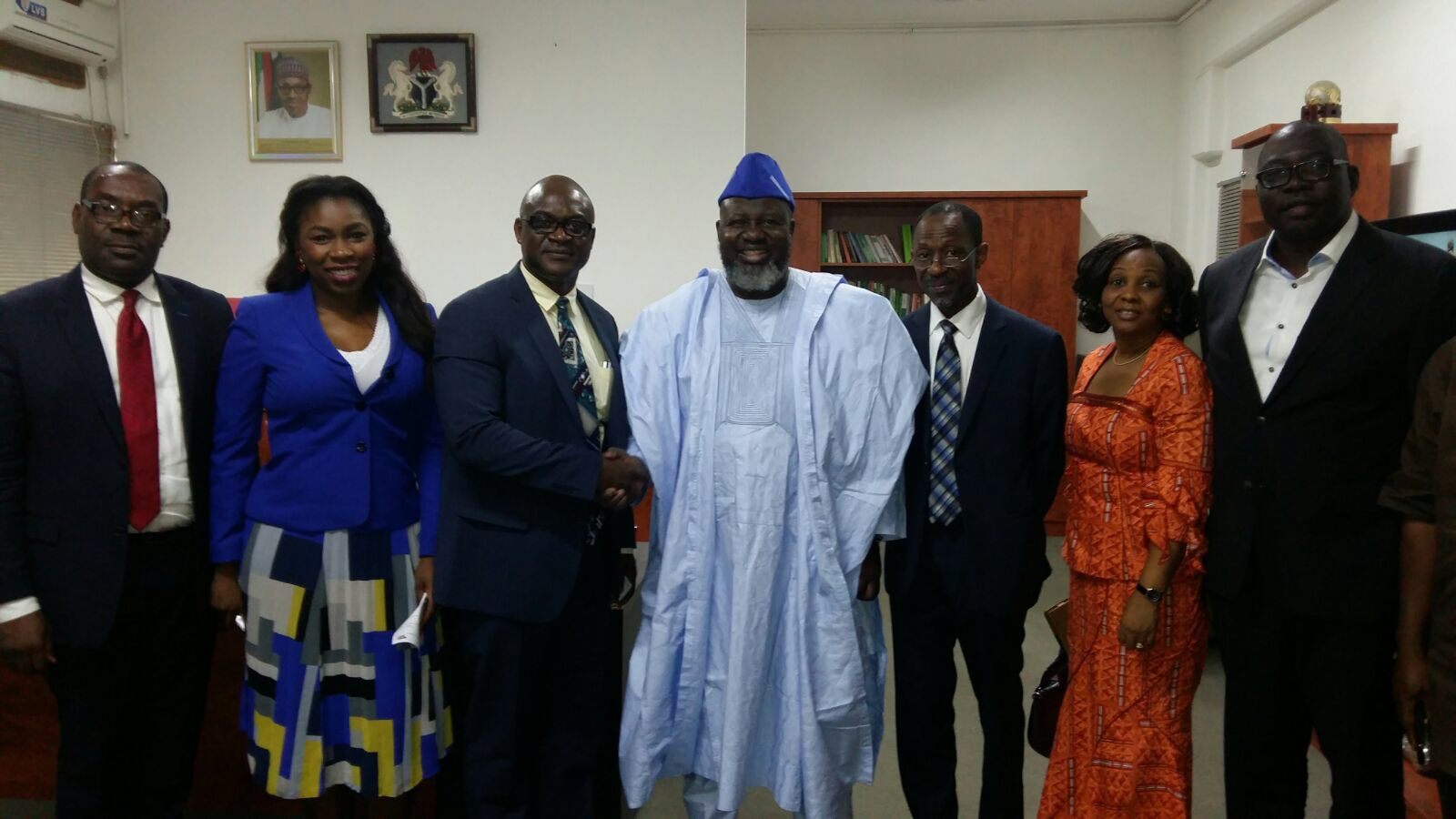
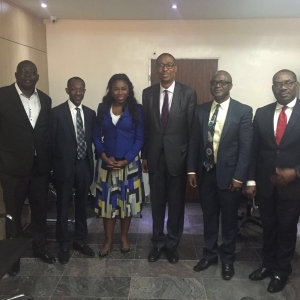
The Honourable Minister for Communication & Technology Barrister Abdur-Raheem Adebayo Shittu shaking hands with Dr. Uyi Stewart, Chief Scientist, IBM Research Africa laboratory (3rd from left); Taiwo Otiti, Country General Manager IBM West Africa (3rd from right) and other IBM executives during a courtesy visit of the IBM team to the Minister recently.
Can African nations innovate themselves out of their current macro-economic doldrums? Yes. No. Possibly. How?
Economists and development experts hardly agree on any matter. However, everyone involved in Africa’s ongoing development debate agrees that more than any other time in history, Africa’s struggling and fast growing economies now need more trade, more investments, more technology and a culture of innovation.
Increased collaboration and knowledge sharing between citizens, countries and companies will accelerate social and economic reengineering, even as policy and development experts must be wary of reinventing the wheel. They must quickly begin to tap new insights from available data, connect to the global information infrastructure and join forces with established institutions with a proven track record of achievements and transformative results.
IBM’s support for Africa’s businesses and governments date back to the 1920s, and in Nigeria since 1961 when the Federal Statistics Bureau in Lagos operated its first IBM equipment. In 1963, IBM provided the very first machines used by computer science departments in Nigerian universities. Last year IBM provided tertiary institutions in Nigeria and Ghana with high end servers and advanced software to enhance student training and curriculum development.
The company’s continued commitment to Africa is driven by a desire to support national and sub-national jurisdictions with leading edge technology solutions and services that will help upgrade current social and economic conditions, says Dr Uyi Stewart, Chief Scientist of the Nairobi, Kenya-based IBM Research Africa laboratory. “In all areas of human development, technology now exists to allow our people all over the continent to quit living in the past,” Stewart states.
Dr. Stewart made these salient points last week during meetings with government and business leaders in Nigeria’s administrative capital, Abuja and in Lagos, Nigeria’s commercial hub. “It is important that government lead the way by becoming more efficient in the delivery of services to citizens and this can only happen when technology begins to be at the core of decision making and public sector administration,” Dr. Stewart says.
Named last year as one of Africa’s top 50 most influential thought leaders by The Africa Report magazine, Nigerian-born Dr. Osamuyimen “Uyi’ Stewart is a distinguished IBM engineer and a leading inventor and innovator of repute. As Chief Scientist of IBM’s 13th global and first IBM research lab on African soil, he is responsible for ensuring that the work of the lab is deployed into resolving some of the continent’s most challenging development issues. His commitment to science and research form part of the company’s history of innovation.
The Honourable Minister for Trade & Investment Dr, Okechukwu Enelamah (3rd from right); Dr. Uyi Stewart, Chief Scientist, IBM Research Africa laboratory (2nd from right); Taiwo Otiti, Country General Manager, IBM West Africa (2nd from left) and other IBM executives during a courtesy visit of the IBM team to the Minister recently.
The global technology firm reportedly invests as much as $6bn on technology R&D annually; and it continues to shape the future of computing through cognitive computing and cloud platforms that will help clients drive transformation across multiple industries. In 2015, IBM topped the list of annual U.S. patent recipients, receiving 7,355 patents. The company’s inventors have received more than 88,000 U.S. patents during the past 23 years.
As much as 70% of the world’s data is currently managed on IBM systems. Often hailed as the silent engine behind the world’s ATM networks, 80% of Nigerian banks currently depend on IBM enterprise systems to drive their critical back-end and service delivery operations.
Dr. Stewart says IBM is equipped to support the Nigerian government’s drive to create a conducive environment for innovation, investment and entrepreneurial activity. Vice President Yemi Osinbajo has repeatedly said government is desirous of quickly improving Nigeria’s ease of doing business status and by extension stimulating a pro-business, pro-development milieu for trade and commerce.
Nigeria has dropped 75 places over the past decade to 169th out of 189 countries ranked in the World Bank’s Ease of Doing business 2016 report.
“Advanced data analytics, security and cloud computing technologies exist to resolve Nigeria’s ease of doing business challenges and ultimately make the Nigerian environment attractive to foreign direct and portfolio investments,” Stewart remarked during a meeting with the Honourable Minister for Trade & Investment, Dr. Okechukwu Enelamah.
The Honourable Minister for Communication & Technology, Barrister Abdur-Raheem Adebayo Shittu also hosted the IBM team in his office. He welcomed IBM’s initiatives and noted that public – private sector collaboration has been the cardinal focus of the ministry under his watch.
Dr. Stewart’s team which was led by Taiwo Otiti, Country General Manager, IBM West Africa, also met with Engr. Aliyu Aziz, Director-General of the Nigeria Identity Management Commission (NIMC); Senator Abdulfatai Buhari, Chairman, Senate Committee on Information Technology & Cybercrime and Mr. Uzoma Dozie, managing director, Diamond Bank Plc.
Africa is now home to two IBM research labs, located in Kenya and South Africa.
Nigeria, Kenya, Egypt, Morocco and South Africa also house IBM Client and Innovation Centers. These facilities form part of IBM’s global network of technology hubs which support local tech innovators and developers and help to bring commercially viable technology solutions to businesses, governments and society at large.
Last year, IBM generated more than 2,000 patents in areas related to cognitive computing and the company’s cloud computing and services portfolio. These investments will continue to drive transformation for IBM’s clients and business in years to come.
In one of technologies hottest areas of cognitive computing and artificial intelligence, IBM patented systems to help machines interpret motion-laden words allowing them converse in more natural ways, and to understand language by interacting with humans. IBM patents in 2015 also created machines that mimic the brain, handle information overload, give machines good judgment, and help machines understand emotion.
More than 8,500 IBM personnel residing in the U.S. and across 46 countries were responsible for IBM’s 2015 patent tally. IBM inventors who reside outside the U.S. contributed to more than 36% of the company’s 2015 patents.
#
The Top Ten list of 2015 U.S. patent recipients includes:
The National Broadcasting Commission (NBC) will take drastic steps towards promoting Nigerian broadcast industry’s content at the 22nd Edition of Cable, Broadcast and Satellite (CABSAT) conference scheduled for March 8 and 10 in Dubai.
The Deputy Director, Public Affairs of NBC, Mrs Maimuna Jimada, said that the commission had signed a Memorandum of Understanding (MoU) with Transatlantic Media Company (TMC) to maximise new opportunities in the broadcast media as the world adapt to digital content delivery, adding that NBC have come up with some initiatives to assist the industry, especially content producers and content providers in the country.
“This year, NBC is partnering with the Transatlantic Media Company, as the sole agent of CABSAT in Nigeria, to come up with the Nigerian Pavilion sponsored by the commission.
“Where all content producers from Nigeria will operate under that umbrella at CABSAT, which means that Nigeria will be represented at the conference. Before this year, other countries have been going to CABSAT but Nigeria was not represented as a country,’’ Jimada said.
Jimada further said that this time around there would be a Nigerian Pavilion sponsored by NBC where professionals in the broadcast industry would discuss business with broadcast professionals all over the world. This will enable them to carry out their businesses which can be core production, buying and selling of contents.
She added that the events would also assist NBC fast track the migration from analogue to digital broadcast in 2017, which would create employment opportunities in the industry.
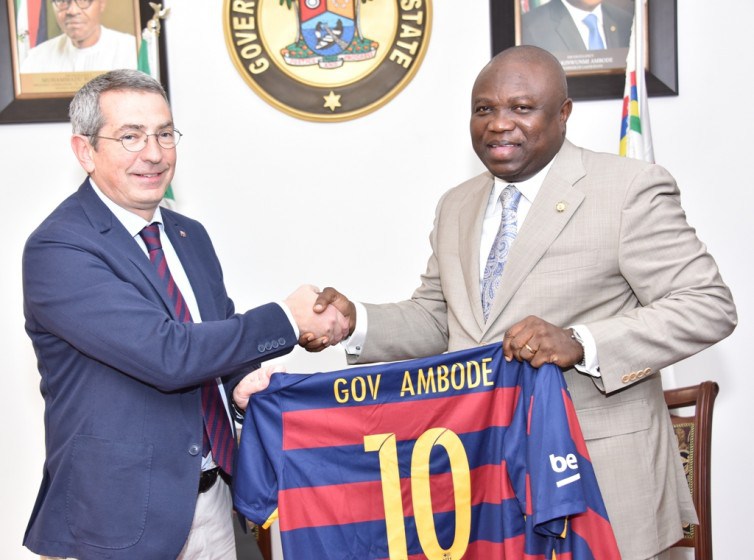
Spanish football club, Barcelona, has announced that it will be setting up its first football academy on the African continent in Lagos State. The Lagos state governor,
Mr. Akinwunmi Ambode, on Monday welcomed the decision of football giant to establish its first football academy in Africa in Lagos and also pledged the maximum support of the government in ensuring the successful take off of the project.
Governor Ambode, who spoke at the Lagos House in Ikeja while receiving senior management staff of the football club, said he was delighted with the development, as it was in sync with his administration’s philosophy for sports development.
Describing the development as an historic moment for the state, Governor Ambode said it was indeed a thing of joy coming at a time when the state was still basking in the euphoria of the successful hosting of the International Marathon.
He said the Lagos Marathon was a major pointer to how Lagos could actualize its dream of improving the Gross Domestic Product (GDP) of the state using sports as a major instrument.
The Governor, who reiterated the importance of sports to integration and development, said that sport was the future of service to create a platform for youth employment and youth engagement in Lagos.
Besides, the Governor pledged the full support of the state government to the Nigeria Football Federation (NFF) in hosting the first ever Beach Soccer African Nations Cup in Lagos, which will hold between December 10 and 23, 2016.
Earlier, Pau Vilanova i Vila-Abadal, Director of Business and Member of FC Barcelona Management Board, who led the team to the State House, thanked Governor Ambode for the support given to them so far in actualizing the project.
He said FC Barcelona decided to establish its Academy in Lagos due to the impressive population of the state, and the opportunity to share the philosophy of the team with the state.
Keypoints
Iranian state media reports no delegation has traveled to Islamabad for scheduled talks.
Tehran demands the lifting of the U.S. naval blockade as a condition...