







Key points
- NIMASA confirmed a collision between two vessels in Bonny Channel that resulted in an oil spill.
- Five crew members aboard MT Lady Martina sustained injuries and were evacuated for treatment.
- The agency has commenced investigations and environmental impact assessment of the affected area.
Main story
The Nigerian Maritime Administration and Safety Agency (NIMASA) has launched an investigation into a vessel collision in the Bonny Channel, Rivers State, which resulted in an oil spill and injuries to crew members.
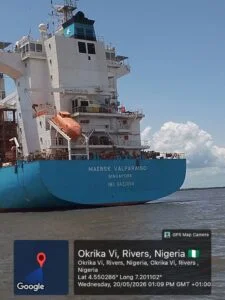
The agency disclosed that the incident occurred around Latitude 4.512375 and Longitude 7.189429, causing oil pollution within the affected marine corridor.
In a statement issued in Lagos, NIMASA’s Deputy Director and Head of Public Relations, Mr Osagie Edward, said the agency’s Deep Blue Forward Operating Base in Bonny received a distress call at about 11:30 a.m. regarding the incident.
According to him, the collision involved MV Valparaiso, a Singapore-flagged container vessel with IMO Number 9433054, and MT Lady Martina, a Nigerian-flagged oil products tanker.
Edward explained that the Deep Blue Base immediately deployed 10 armed personnel aboard interceptor boat DB 214 to the scene to support emergency response operations.
He disclosed that five crew members onboard MT Lady Martina sustained varying degrees of injuries during the collision and were evacuated to the Forward Operating Base sickbay in Bonny for medical attention.
“Following the collision, MT Lady Martina drifted ashore and is currently aground along the Bonny Channel.
“MV Valparaiso also remains grounded at the Bonny Inner Anchorage pending damage assessment and further investigation,” Edward stated.
He added that MAERSK management had formally reported the incident to NIMASA.
The agency’s Director-General, Dayo Mobereola, has since ordered a full-scale investigation into both the immediate and underlying causes of the collision.
NIMASA also established a Situation Monitoring Room to coordinate emergency response operations and monitor developments surrounding the incident.
Mobereola reportedly visited Rivers State personally to inaugurate the monitoring room and supervise ongoing response activities.
The Director-General further directed the agency’s Marine Environment Management Department to immediately commence an Environmental Impact Assessment of the affected area.
He urged officials to implement measures aimed at mitigating the effects of the Tier One oil sheen and protecting the marine ecosystem.
The issues
The incident raises fresh concerns over navigational safety and environmental protection within Nigeria’s waterways, particularly in strategic commercial channels such as Bonny.
Oil spills resulting from maritime accidents pose significant risks to marine biodiversity, fishing communities and coastal economic activities.
The collision also highlights the need for stricter vessel traffic management, enhanced monitoring systems and rapid emergency response mechanisms within Nigeria’s maritime sector.
What’s being said
NIMASA says it is fully committed to uncovering the cause of the collision and ensuring adequate response to the environmental impact.
The agency also assured stakeholders that emergency measures are already in place to contain pollution and safeguard lives and maritime assets.
Industry observers have stressed the importance of stronger maritime safety protocols to reduce the recurrence of such incidents.
What’s next
Investigations into the cause of the collision are expected to continue alongside detailed damage assessments of both vessels.
NIMASA’s environmental team is also expected to carry out pollution impact studies and recommend remediation measures for affected areas.
Further updates are likely as authorities evaluate the extent of the oil spill and determine accountability.
Bottom line
The Bonny Channel collision underscores the persistent safety and environmental challenges facing Nigeria’s maritime sector, reinforcing the urgency for stronger navigation control systems, rapid emergency response and stricter environmental protection measures.





 has launched an investigation into a vessel collision...)