








Key points
- Nigeria’s gas demand is projected to rise to about 15 billion standard cubic feet (bscf) per day by 2030.
- The Decade of Gas Initiative says growing domestic consumption and export opportunities will drive the increase.
- More than 20 gas projects are expected to add 4.6 bscf per day to national production capacity.
- The Federal Government also plans to distribute five million LPG cylinders to rural women by 2030.
Main story
Nigeria’s gas demand is expected to increase to about 15 billion standard cubic feet (bscf) per day by 2030, driven by rising domestic consumption and expanding export opportunities, according to the Decade of Gas Initiative.
The Coordinating Director of the initiative, Ed Ubong, disclosed this during a strategic panel session on “Maximising Gas Export Potential – Regional Integration for Meeting Global Demand” at the ongoing Nigeria Oil and Gas (NOG) Energy Week in Abuja.
Ubong said Nigeria’s gas sector had recorded notable progress, with gas exports climbing to their highest level in five years while domestic gas supply had exceeded two bscf per day.
He added that the country’s proven gas reserves had increased to about 215 trillion cubic feet (tcf), daily production was approaching 7.87 bscf and gas flaring continued to decline, reflecting progress towards the Federal Government’s 2030 production objectives.
According to him, several major infrastructure projects are expected to strengthen gas transportation, improve regional integration and open new domestic and international markets.
These include the completed OB3 gas pipeline crossing, compressor stations, the Ajaokuta-Kaduna-Kano (AKK) gas pipeline and the African Atlantic Gas Pipeline.
“More than 20 gas projects are expected to add about 4.6 bscf per day to current production, enabling Nigeria to meet its 12 bscf daily production target,” Ubong said.
He noted that achieving the country’s gas ambitions would also require a pricing framework that encouraged investment while ensuring domestic affordability and maintaining Nigeria’s competitiveness in export markets.
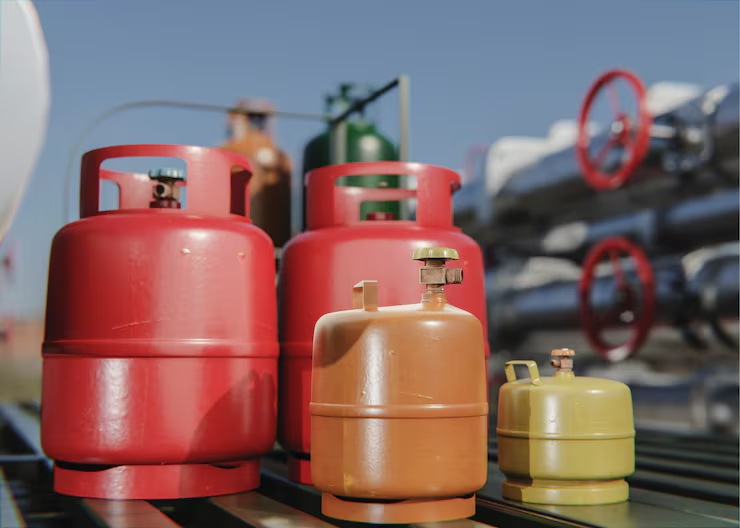
Ubong further disclosed that the Federal Government plans to distribute five million Liquefied Petroleum Gas (LPG) cylinders to rural women by 2030 as part of efforts to expand access to clean cooking solutions and reduce dependence on traditional fuels.
The issues
Nigeria is pursuing a gas-led economic strategy aimed at increasing domestic utilisation, expanding exports and supporting industrial development. Achieving these objectives will depend on sustained investment in production, transmission infrastructure, market reforms and policies that balance investor returns with affordable domestic gas supply.
What’s being said
“More than 20 gas projects are expected to add about 4.6 bscf per day to current production, enabling Nigeria to meet its 12 bscf daily production target.” — Ed Ubong, Coordinating Director, Decade of Gas Initiative
What’s next
The Federal Government is expected to continue implementing major gas infrastructure projects, expand domestic gas utilisation programmes and advance clean cooking initiatives as it works towards its 2030 production and demand targets.
Bottom line
Nigeria is positioning natural gas as a cornerstone of its energy and industrial strategy, with rising domestic demand, expanding infrastructure and growing export opportunities expected to drive the sector over the remainder of the decade.


 per day by 2030, driven by rising ...)