







Key Points
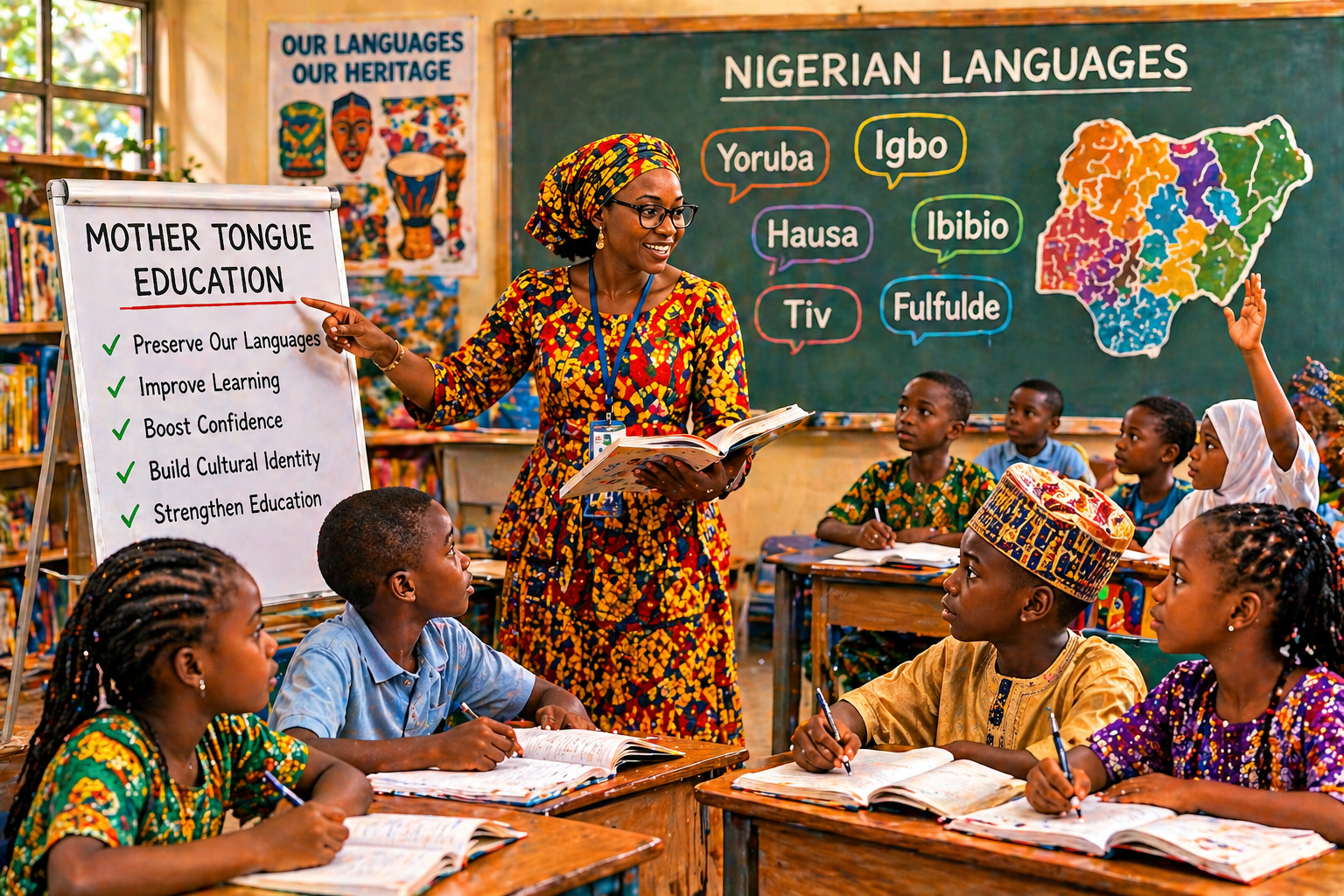
- Education experts are urging Nigeria to reinstate its National Language Policy.
- They say children learn faster when taught in their first language.
- Experts warn that over-reliance on English is weakening local languages.
- Challenges include lack of teachers and learning materials in indigenous languages.
- Stakeholders are calling for stronger policies and investment in mother tongue education.
Main Story
Language and education experts have called on the Nigerian government to bring back and fully implement policies that promote teaching in local languages, especially at the early stages of education.
The call was made during a seminar held in Ibadan, organised by the University of Ibadan Senior Staff Club. The event focused on whether education in the mother tongue should remain part of Nigeria’s education system.
Speaking at the event, Francis Egbokhare, a professor of linguistics at the University of Ibadan, said Nigerian languages are valuable and should not be ignored.
According to him, local languages play an important role in shaping identity, culture, and even technological growth.
He explained that research has shown that children understand lessons better, participate more in class, and gain confidence when they are taught in their first language.
Egbokhare also criticised the decision to reduce the use of indigenous languages in schools, describing it as harmful to both education and national development.
The Issues
One of the biggest concerns raised by experts is the growing preference for English as the main language of instruction in schools.
While English is important for global communication, experts say relying on it too early in education can slow down learning for many children who are more familiar with their native languages.
Clement Kolawole, Vice-Chancellor of Trinity University, explained that children naturally think and solve problems in their first language.
He added that the current system, influenced by colonial history, has weakened indigenous languages over time.
Another challenge is the lack of resources. Many schools do not have enough trained teachers or learning materials in local languages. In addition, Nigeria’s diverse languages can make it difficult to decide which language to use in classrooms with students from different backgrounds.
What’s Being Said
Experts at the seminar agreed that mother tongue education should be strengthened, not abandoned.
Clement Kolawole pointed out that countries like Germany and Japan have achieved high literacy levels by teaching in their native languages.
He suggested that Nigeria can do the same by building its education system around indigenous languages while still teaching English as a second language.
Also speaking, Bamidele Oyinloye from the Oyo State Ministry of Education said children are more creative and learn better when taught in a language they understand.
She, however, noted that making this system work will require strong collaboration, proper planning, and investment in teaching materials.
Meanwhile, Durotoye Adeleke, who chaired the event, emphasised that local languages are key to preserving culture and improving learning outcomes.
What’s Next
Participants at the seminar called on policymakers to revisit the National Language Policy and ensure it is properly implemented.
They also stressed the need for more teacher training, development of learning materials in indigenous languages, and better planning to handle multilingual classrooms.
Experts believe that with the right support, mother tongue education can improve learning outcomes and strengthen Nigeria’s education system.
Bottom Line
Education experts agree that teaching children in their first language is one of the most effective ways to improve learning.
While challenges exist, they say Nigeria should not abandon its local languages but instead invest in them.
Reintroducing and strengthening mother tongue education could help build a more inclusive, effective, and culturally grounded education system.