



KEY POINTS
- UN Secretary General António Guterres says the world has entered an era of deep uncertainty.
- He identified runaway AI, climate change and widening inequalities as three existential threats.
- Guterres called for de escalation and diplomacy over conflicts in Gaza and Ukraine.
- He urged governments to strengthen international cooperation on AI safety and other global challenges.
- The UN General Assembly will debate the Middle East and Ukraine conflicts during the high level session.
MAIN STORY
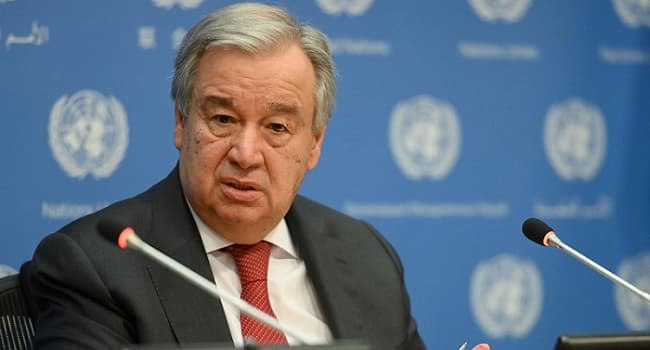
UN Secretary General António Guterres has called on governments to strengthen international cooperation as the world faces what he described as an era of deep uncertainty.
Guterres made the call while speaking to reporters ahead of the 81st Session of the UN General Assembly General Debate in New York.
He identified runaway artificial intelligence, the climate crisis and deepening inequalities as three existential threats requiring coordinated international action.
The UN chief also renewed his calls for a two State solution to the Israeli Palestinian conflict and a ceasefire between Russia and Ukraine, urging leaders to pursue diplomacy and dialogue rather than further escalation.
Guterres acknowledged the need to reform international institutions, including the United Nations, but said institutional changes should not weaken the principles underpinning the organisation.
“Updating our structures can never mean abandoning our principles – it must mean applying those principles with even greater determination,” he said.
He urged UN member states to uphold the UN Charter, defend international law, protect human rights, invest in sustainable development and support peace efforts.
On the Middle East, Guterres expressed concern over the situation in Gaza and called for immediate de escalation.
“At this crucial moment in the Middle East, de-escalation must be priority one, priority two and priority three,” he said.
He also called on parties involved in the regional conflict to respect navigational rights in the Strait of Hormuz and Bab al Mandab and protect civilians.
Guterres said Israel’s annexation of the West Bank “must stop” and highlighted the suffering of Palestinians in Gaza.
On Ukraine, he said more than four years after Russia’s full scale invasion, there was still no clear end to the conflict.
He called for an immediate ceasefire as the first step towards what he described as a just, lasting and comprehensive peace.
The General Assembly is expected to consider both conflicts during its debates next week.
Guterres devoted a significant portion of his remarks to the rapid development of artificial intelligence, acknowledging its potential to contribute to advances in health, education and climate action.
However, he warned that AI development was moving faster than human understanding of its risks.
He said governments had a responsibility to protect citizens from those risks and stressed that cooperation between countries would be necessary, particularly amid concerns over an emerging AI arms race between the United States and China.
Guterres said isolated voluntary pauses in AI development would not be sufficient to address global safety concerns.
“The world cannot afford a race to the bottom on AI safety,” he said.
He pointed to the UN founded Independent International Scientific Panel on AI, which he said would support global discussions by providing evidence on the opportunities and risks associated with the technology.
Guterres called for safeguards that would build trust and ensure AI systems are safe, transparent and accountable while keeping human dignity at the centre of their development.
“International cooperation is more necessary than ever,” he said.
THE ISSUES
- Guterres’ warning reflects a broad set of global challenges that cut across national borders, with AI, climate change and inequality identified as threats requiring coordinated responses rather than isolated national action.
- The conflicts in Gaza and Ukraine remain major concerns for the UN, with Guterres placing emphasis on ceasefires, de escalation and diplomatic engagement as routes towards longer term settlements.
- The rapid development of AI presents a separate governance challenge because technological advances are occurring faster than understanding of their potential risks. The UN is seeking international safeguards covering safety, transparency and accountability.
- Reform of global institutions is also on the agenda, but Guterres maintains that changes to their structures should preserve existing commitments to peace, human rights and international law.
WHAT’S BEING SAID
“Updating our structures can never mean abandoning our principles – it must mean applying those principles with even greater determination.” – António Guterres, UN Secretary General
“At this crucial moment in the Middle East, de-escalation must be priority one, priority two and priority three.” – António Guterres, UN Secretary General
“The world cannot afford a race to the bottom on AI safety.” – António Guterres, UN Secretary General
WHAT’S NEXT
The UN General Assembly’s high level General Debate is scheduled to begin on Sept. 22, with member states expected to discuss the conflicts