









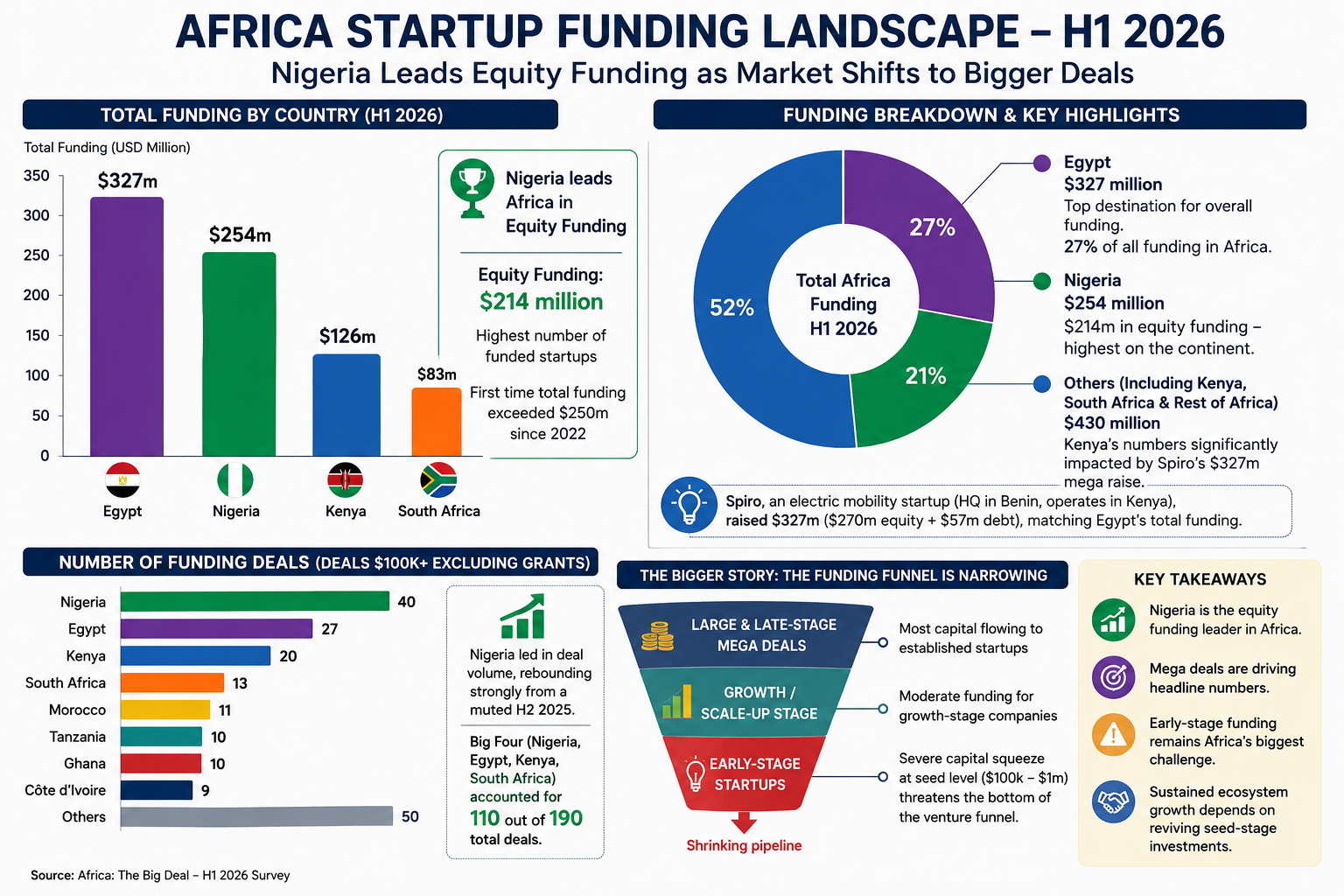
Nigeria has reclaimed its position as Africa’s leading destination for equity funding in the first half (H1) of 2026, a development that signals renewed investor confidence in the country’s technology ecosystem. Yet, a closer look at the data suggests the continent’s startup market is undergoing a structural shift rather than a broad-based recovery.
While headline funding numbers appear encouraging, venture capital is becoming increasingly concentrated in a handful of mature companies, leaving early-stage startups struggling to secure funding. Industry analysts say this emerging trend could shape the future of Africa’s innovation economy.
Why Nigeria’s return to the top matters
According to Africa: The Big Deal, Nigeria attracted $214 million in equity funding in H1 2026—the highest on the continent—while total funding, including debt, reached $254 million, its strongest first-half performance since 2022. This distinction is important.
Equity funding means investors purchase ownership stakes in startups, reflecting long-term confidence in a company’s growth potential. Debt financing, by contrast, involves loans that startups must repay.
Although Egypt topped Africa in overall funding with $327 million, a significant portion of Nigeria’s funding came through equity, suggesting investors were willing to take ownership positions in Nigerian startups rather than merely provide credit.
For venture capital investors, equity often serves as a stronger signal of confidence because returns depend on the company’s future success.
Why Egypt still led overall funding
Egypt’s position at the top of the continental rankings does not necessarily mean it outperformed Nigeria across every measure. Africa: The Big Deal notes that Egypt accounted for a record 27% of all African startup funding during the first half of the year, benefiting from several sizeable transactions. However, one extraordinary transaction distorted the regional picture.
Electric mobility company Spiro, originally founded in Benin and now operating extensively in Kenya, raised $327 million ($270 million in equity and $57 million in debt) an amount equal to Egypt’s entire funding haul for the period. Because of Spiro’s pan-African operations, analysts caution against interpreting Kenya’s apparent decline solely from headline figures.
The real story isn’t who came first, Perhaps the most significant finding is not Nigeria’s return to the top, but the changing nature of venture capital across Africa.
For years, investment flowed relatively broadly across startup stages. Today, investors are increasingly concentrating capital in established businesses with proven revenues and clearer paths to profitability.
Africa: The Big Deal observed that although overall funding remained resilient, deal volumes continued to contract, particularly among startups seeking between $100,000 and $1 million in funding.
This means Africa’s funding ecosystem is becoming increasingly “top-heavy.”
Large companies continue attracting multi-million-dollar investments while younger startups struggle to secure the capital needed to validate products, hire talent and expand.
What experts are saying
Africa: Max Cuvellier Giacomelli, founder of Africa: The Big Deal, has repeatedly warned that the biggest concern is not the headline funding total but the shrinking number of early-stage investments.
According to the report, declines in both half-on-half and year-on-year deal volumes “echo the concerns we have been raising repeatedly… about the concentration of the money on larger deals and the lack of early-stage tickets.”
In other words, the ecosystem may be producing headline-grabbing mega-rounds while weakening the pipeline that creates tomorrow’s high-growth companies.
The latest State of Tech in Africa H1 2026 report reached a similar conclusion, Its lead author, Joseph Oloyede, said discussions with founders and investors increasingly centred on one issue: early-stage capital has dried up, forcing startups to consolidate rather than aggressively expand.
This reflects a broader shift in investor behaviour following several years of higher interest rates and weaker global venture capital markets.
Why are investors becoming more cautious? Several factors are driving this change.
1. Global venture capital has become more selective: Since 2022, investors worldwide have prioritised profitability over rapid growth.Instead of funding dozens of risky startups, many funds now concentrate resources on companies with proven business models and stronger financial performance. African startups are experiencing the same trend.
2. Investors are protecting existing portfolios: Rather than backing new founders, venture capital firms are increasingly investing follow-on capital into companies already within their portfolios. This reduces risk while helping mature startups survive longer.
3. Debt financing is becoming more common : Many mature African startups are raising debt alongside equity because lenders are more willing to finance businesses with stable revenues. This partly explains why overall funding appears stronger than pure equity figures might suggest.
What does this mean for Nigerian startups?
Nigeria’s leadership in equity funding reflects continued investor confidence in sectors where the country has built strong expertise. These include:
Financial technology (fintech)
Digital payments
Logistics
Enterprise software
Climate technology
Artificial intelligence
Nigeria also recorded the highest number of startups raising at least $100,000, indicating that investor activity remains broader than in many competing ecosystems. However, founders seeking seed capital may still face significant fundraising challenges.
Could fewer startup deals become a long-term problem? Yes. A healthy startup ecosystem depends on a continuous pipeline:
- Seed funding produces new startups.
- Series A funding helps them grow.
- Later-stage funding creates regional champions.
If seed-stage funding continues to shrink, fewer companies will be available for larger investments in future years.
This is why analysts increasingly describe today’s challenge as a pipeline problem, rather than simply a funding problem.
Industry experts argue that sustaining Africa’s innovation ecosystem will require more than attracting foreign venture capital.
Key priorities include:
- Expanding local institutional investment in venture capital.
- Strengthening angel investor and accelerator networks.
- Creating government-backed co-investment funds.
- Improving startup-friendly regulation.
- Supporting domestic pension funds and development finance institutions to invest in innovation.
These measures could help address the shortage of early-stage financing that many founders currently face.
Bottom line
Nigeria’s return as Africa’s largest destination for equity investment is an encouraging sign that investor confidence in its technology ecosystem remains intact. However, the broader African venture capital market tells a more nuanced story.
Headline funding has been sustained largely by a handful of very large transactions, while early-stage investment continues to contract. Analysts warn that unless the financing gap at the bottom of the market is addressed, today’s impressive funding totals may not translate into tomorrow’s pipeline of successful African startups.





 of 2026, a development that ...)