








Key points
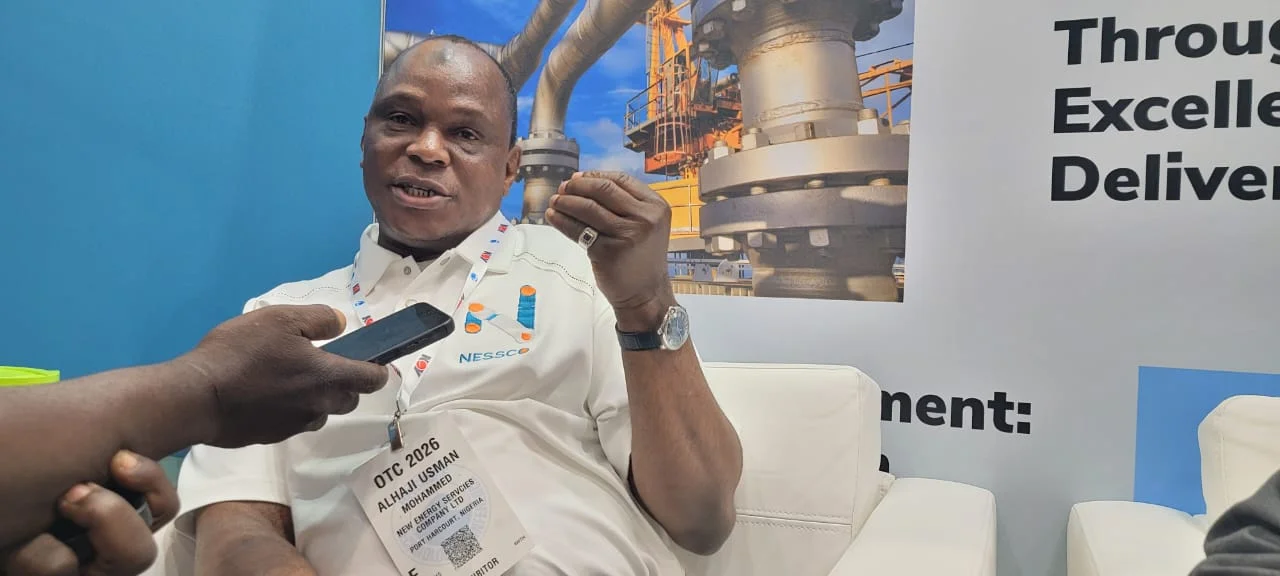
- NESSCO CEO, Usman Mohammed, says Nigeria must accelerate adaptation to the global energy transition to remain competitive.
- He calls for the establishment of a dedicated energy bank to improve financing access for indigenous operators.
- Mohammed says collaboration, local content policies, and gas development are critical to the future of Nigeria’s energy sector.
Main story
The Managing Director and Chief Executive Officer of New Energy Services Company Ltd. (NESSCO), Alhaji Usman Mohammed, has urged Nigeria to accelerate its transition into a cleaner energy economy, warning that the global shift toward gas and renewable energy is rapidly redefining the future of the industry.
Speaking with journalists on the sidelines of the 2026 Offshore Technology Conference (OTC) in Houston, United States, Mohammed said technological advancements and increased global investment in green energy were steadily reducing reliance on crude oil.
According to him, the global energy industry is now tilting more towards gas development and cleaner alternatives, making it imperative for Nigeria to reposition itself strategically.
“Technology is evolving, and the world has effectively launched a revolution in green energy. The focus is now shifting more towards gas development than oil, and that transition is already affecting business turnover across the industry,” he said.
Mohammed described Nigeria’s local content policy as a major driver of indigenous participation in the oil and gas sector, noting that many Nigerian companies had grown through deliberate government intervention.
“We are a direct product of local content development. Many Nigerian companies today owe their growth to deliberate government policies, and the impact is visible across the industry,” he stated.
The NESSCO boss, however, identified limited access to affordable financing as one of the biggest challenges confronting indigenous energy firms.
He called for the establishment of a dedicated energy bank to support local operators, particularly in gas development projects.
“We need a dedicated energy bank, similar to the Bank of Agriculture, that will give indigenous companies access to affordable capital, especially in gas development,” he said.
Mohammed also urged the Nigerian Content Development and Monitoring Board (NCDMB) to simplify financing processes for credible local firms.
“If a company is qualified to execute a contract, it should also be considered qualified to access financing,” he added.
The issues
Nigeria’s energy sector is facing increasing pressure to align with global decarbonisation goals as investors and governments shift attention from fossil fuels to cleaner energy alternatives.
While the country remains heavily dependent on crude oil revenues, experts warn that failure to adapt could weaken competitiveness, reduce foreign investment inflows, and limit long-term economic sustainability.
Industry stakeholders have repeatedly identified inadequate financing, infrastructure gaps, and weak collaboration among local firms as major barriers to indigenous growth and energy transition efforts.
What’s being said
Mohammed said NESSCO has continued to expand its operations through strategic diversification and recently secured a renewed contract alongside a new drilling rig supply agreement with a major operator.
According to him, the company has evolved over the past decade from offshore facility management and crane operations into broader drilling and energy services.
“We are growing deliberately, and by this time next year, we expect major developments in the gas sector,” he said.
He also stressed the importance of partnerships among indigenous companies, noting that sustainable growth in the industry depends on collaboration built on trust and shared objectives.
“No single company can do it all. Collaboration is the way forward, but it must happen naturally,” Mohammed stated.
Drawing from his experience working with international firms including Saipem, TotalEnergies, Baker Hughes, and BW Offshore, he said successful global businesses thrive on strategic cooperation rather than forced alliances.
“Business relationships are built on trust and alignment. You cannot force companies together and expect success,” he said.
Mohammed further urged Nigerians to take ownership of the country’s development agenda.
“Nobody will come from Europe or America to build Nigeria for us. The responsibility is ours. What the government must do is create the right environment and allow indigenous companies to rise to the challenge,” he added.
What’s next
Stakeholders in Nigeria’s energy sector are expected to intensify discussions around gas development, cleaner energy investments, and financing mechanisms for indigenous operators as the global energy transition gathers momentum.
Industry players are also likely to push for stronger policy support, improved access to capital, and enhanced collaboration frameworks to enable local companies compete effectively in the evolving global market.
Bottom line
As the world accelerates toward cleaner energy systems, experts say Nigeria must urgently strengthen its gas infrastructure, empower indigenous operators, and improve financing access to remain relevant in the changing global energy economy.








, Alhaji Usman Mohammed, has urged Nigeria ...)