






By Boluwatife Oshadiya
Key Points
- NGX market capitalisation dropped by N1.92 trillion
- Banking and cement stocks led market decline
- Investors reacted to new CBN foreign subsidiary guidelines
- Analysts say directive may affect banks’ payout capacity
- Experts insist affected banks remain fundamentally strong
Main Story
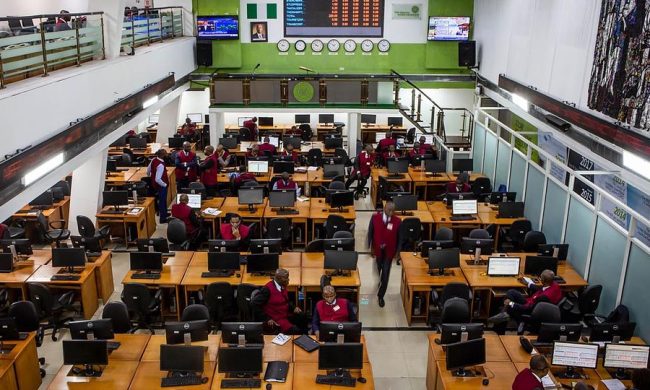
The Nigerian stock market closed sharply lower on Thursday as investors lost an estimated N1.92 trillion amid widespread sell-offs triggered by fresh regulatory guidelines issued by the Central Bank of Nigeria (CBN) concerning banks’ foreign subsidiaries.
Market capitalisation on the Nigerian Exchange Limited (NGX) declined from N155.780 trillion to N153.858 trillion, representing a loss of N1.922 trillion or 1.23 per cent.
Similarly, the All-Share Index (ASI) shed 2,994.90 points, or 1.23 per cent, to close at 239,734.61 points compared to the previous close of 242,729.51.
The market downturn also moderated the Year-to-Date return to 54.82 per cent.
The decline followed investor reactions to the CBN’s latest directive requiring Nigerian banks operating foreign subsidiaries to limit investments in those subsidiaries to 10 per cent of their shareholders’ funds or equity capital.
The apex bank also reportedly instructed lenders already above the threshold to begin divestment processes.
Analysts Explain Market Reaction
Speaking on the development, investment banker and stockbroker Tajudeen Olayinka attributed the sharp market decline to concerns over the potential impact of the new policy on banks’ earnings and future dividend payouts.
According to him, investors interpreted the new regulation as a move that could tighten banks’ capital structures and reduce flexibility in deploying foreign earnings.
“The drop in the ASI and market capitalisation came from market reactions to the new CBN guideline that compels banks operating in foreign countries to limit their investment in foreign subsidiaries to 10 per cent of their equity capital or shareholders’ funds,” Olayinka said.
He explained that the market viewed the directive as an attempt by regulators to integrate revenues and reserves from offshore banking operations into existing regulatory capital calculations.
“The market’s immediate interpretation is that the CBN is effectively integrating revenues and other reserves of banks operating in foreign countries into their existing regulatory capital,” he stated.
“This will limit their corporate payout capabilities or make future payouts dependent on growth trajectories.”
According to Olayinka, the development triggered aggressive repricing in the banking sector, particularly among Nigerian lenders with extensive international operations.
The sell-off later spread to other highly capitalised equities, including major cement companies listed on the exchange.
“So, prices of many of the international banks came down heavily by way of repricing,” he said.
“This was followed by declines in prices of highly capitalised listed companies like cement.”
Investors Dump Banking Stocks
The banking sector has remained highly sensitive to regulatory changes in recent months, particularly following ongoing recapitalisation efforts and tighter supervisory measures introduced by the CBN.
Several tier-one Nigerian banks currently maintain operations across Africa and other international markets, making them more exposed to regulatory restrictions involving foreign subsidiaries.
Despite the sharp market decline, Olayinka argued that the sell-off may be temporary, insisting that many of the affected banking stocks remain fundamentally strong and undervalued.
“I think the development is temporary, as the affected banks are already well capitalised and largely undervalued,” he said.
“Therefore, the upside potentials for the banks are very high, suggesting that anyone selling off banking stocks at this time might actually be throwing away good money.”
He added that the banking industry remains liquid and stable despite investor concerns.
“This is because the industry is now very strong and highly regulated. The liquidity hasn’t gone away,” Olayinka added.
Market Performance
Although the broader market ended in negative territory, market breadth closed positive with 42 gainers against 30 losers. CAP and FTN Cocoa Processors topped the gainers’ chart after both stocks appreciated by 9.99 per cent to close at N212.50 and N8.04 per share respectively. Berger Paints, Zichis Agro Allied Industries and Meyer also recorded notable gains of 9.97 per cent each.
On the losers’ chart, University Press led with a 10 per cent decline to close at N4.50 per share, while Red Star Express fell by 9.59 per cent to N25.45. Skyway Aviation Handling Company declined by 8.63 per cent to close at N130.75 per share.
Market activity, however, improved significantly during the trading session. Total traded volume rose by 29.34 per cent to 1.83 billion shares valued at N72.17 billion exchanged in 81,131 deals.
NEM Insurance emerged as the most traded stock by volume with 360.56 million shares, accounting for 19.70 per cent of total market turnover. Seplat Energy led by transaction value with trades worth N12.98 billion, representing 17.99 per cent of total traded value.
What’s Next
Market analysts expect investors to continue assessing the long-term implications of the CBN directive on banking profitability, capital adequacy and dividend performance.
Attention is also expected to shift toward possible clarifications from the apex bank as well as the response strategies of affected lenders operating across foreign markets.