



KEY POINTS
- US President Donald Trump, Chinese President Xi Jinping and Russian President Vladimir Putin held an unprecedented trilateral meeting in Shenzhen on Thursday.
- Their discussions came amid major differences over Ukraine, Iran, Taiwan, nuclear weapons and international trade.
- Xi urged Washington to handle the Taiwan issue carefully, warning that it could cause major setbacks in US-China relations.
- Trump also criticised the International Criminal Court, suggesting that the three countries could cooperate against what he described as overreach by global institutions.
MAIN STORY
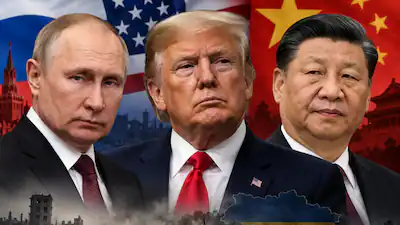
US President Donald Trump, Chinese President Xi Jinping and Russian President Vladimir Putin held an unprecedented three-way meeting on Thursday in Shenzhen, China, bringing together the leaders of the world’s three major powers amid deep disagreements over security, trade and international relations.
The meeting took place on the sidelines of the Asia-Pacific Economic Cooperation (APEC) summit, following separate discussions between Trump and the Chinese and Russian presidents.
Trump had earlier described Xi and Putin as friends and praised the Chinese leader for personally welcoming him at the airport in Shenzhen on Wednesday.
Despite the diplomatic gestures, the three countries face significant differences over the war in Ukraine, tensions involving Iran, nuclear weapons and trade. These disagreements have raised questions about whether the meeting can produce lasting agreements.
One major issue raised during Trump’s bilateral meeting with Xi was Taiwan. According to China’s state news agency Xinhua, Xi urged the United States to do the right thing on the issue to avoid major setbacks in relations between Washington and Beijing.
Xi said relations between the two countries had generally remained stable and called for both sides to expand areas of cooperation while managing unresolved disagreements.
“I look forward to working with President Trump to continue steering the course of China-US relations and ensure that this big ship always sails along the right course,” Xi said.
China considers Taiwan part of its territory and has not ruled out using force to bring the self-governing island under its control. The United States remains Taiwan’s most important international backer.
Trump said in May, after meeting Xi in Beijing, that he was holding back on a proposed arms sale to Taiwan, describing the decision as a possible negotiating advantage.
The Taiwan issue also featured in comments by Japanese Prime Minister Sanae Takaichi, who said on Thursday that Japan’s position remained unchanged from the 1972 Japan-China Joint Communique.
Her statement came amid strained relations between Tokyo and Beijing following her remarks in November 2025 that a hypothetical Chinese attack on Taiwan could trigger a Japanese military response. China has demanded that she withdraw those comments.
Trump also raised the International Criminal Court (ICC) during his opening remarks at the trilateral meeting, suggesting that the United States, China and Russia should work together to protect their sovereignty from what he called rogue international organisations.
He said the court had exceeded its jurisdiction. The ICC prosecutes individuals accused of genocide, war crimes and crimes against humanity.
The court issued an arrest warrant for Putin in 2023 over the alleged unlawful deportation of children from Ukraine, an allegation Russia denies. It has also issued arrest warrants for Israeli Prime Minister Benjamin Netanyahu and former Defence Minister Yoav Gallant.
The United States, China and Russia are not members of the ICC and do not recognise its authority.
THE ISSUES
The significance of the meeting lies in the fact that the three leaders brought together countries with considerable influence over global security, trade and diplomacy. However, their participation does not mean they share the same priorities.
On Ukraine, Russia is directly involved in the war, while the United States has been seeking a way to end the conflict. China has maintained close economic and diplomatic ties with Moscow but has also called for a political settlement.
Nuclear weapons present another challenge. Trump has repeatedly called for a new arms control agreement and wants China included in future negotiations. However, Beijing has been reluctant to accept restrictions while its nuclear arsenal remains considerably smaller than those of the United States and Russia.
Taiwan is another major source of tension. China regards the island as part of its territory, while the United States supports Taiwan’s ability to defend itself. Any change in Washington’s approach could affect its relationship with Beijing and the security calculations of countries across the Asia-Pacific region.
The meeting also comes as smaller countries in the region watch how the three major powers manage their disagreements. Decisions involving Ukraine, Taiwan and regional security could have consequences beyond the countries represented at the table.
WHAT’S NEXT
Trump has concluded the three-day Asia trip, with the trilateral meeting marking the final engagement on his schedule before his departure from Shenzhen.
The immediate question is whether the discussions will lead to further negotiations on nuclear arms control, Ukraine, trade and other areas of disagreement. The meeting itself does not resolve the differences among the three governments.
BOTTOM LINE
The meeting brought Trump, Xi and Putin together for an unprecedented diplomatic encounter, but their countries remain divided on several major international issues. Its significance will depend less on the symbolism of the gathering than on whether the discussions lead to practical agreements.
Reuters