








By Emmanuella Opara | November 19th, 2026
KEY POINTS
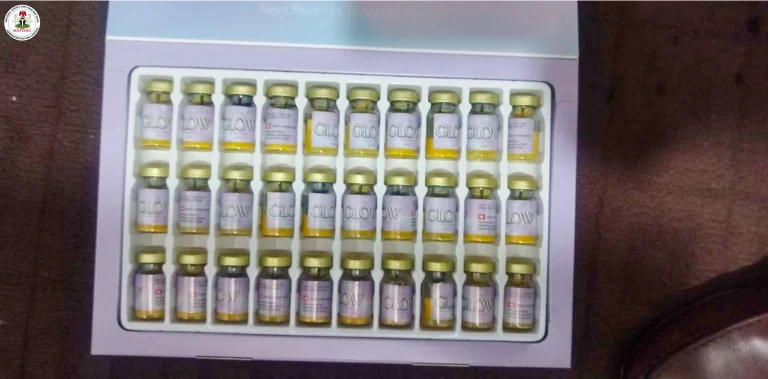
- NAFDAC intercepted 17 cartons of suspected unregistered beverages and skin-lightening and anti-ageing injections at Mallam Aminu Kano International Airport.
- The products were concealed in a 33-carton shipment declared as personal effects.
- The consignment arrived aboard an Ethiopian Airlines flight and had no NAFDAC registration numbers or required import documents.
- The Nigeria Customs Service has taken custody of the shipment pending further regulatory directives.
- NAFDAC said the quality and authenticity of the products had not been established.
MAIN STORY
The National Agency for Food and Drug Administration and Control (NAFDAC) has intercepted 17 cartons of suspected unregistered beverages and cosmetic injections at Mallam Aminu Kano International Airport, Kano.
The seized products, which included skin-lightening and anti-ageing injections, were discovered concealed in a 33-carton consignment declared as personal effects.
In a statement issued on Thursday, the agency said the interception followed a joint examination conducted at the Skyway Aviation Handling Company Plc Shed.
The shipment arrived at the airport the previous day aboard an Ethiopian Airlines flight.
NAFDAC said a physical inspection revealed that the products had no registration numbers issued by the agency, while the consignment lacked the required import documentation.
Following the discovery, the entire shipment was placed on hold under the custody of the Nigeria Customs Service.
The importer was subsequently invited for questioning, and a statement was obtained as part of the investigation.
The agency said the products remained in custody pending further regulatory directives, stressing that their quality and authenticity had not yet been established.
NAFDAC added that it was strengthening surveillance and enforcement activities at Nigeria’s entry points to prevent the illegal importation and circulation of unregistered, substandard and falsified regulated products.
The interception comes amid wider concerns over the circulation of fake and unregistered medicines and other regulated products in the country.
The House of Representatives recently summoned NAFDAC and security agencies over concerns about fake drugs and called for tougher penalties against offenders.
THE ISSUES
The concealment of regulated products in a shipment declared as personal effects highlights the challenges facing authorities in monitoring imported goods at the country’s entry points.
The absence of NAFDAC registration numbers and required import documents also raises concerns about the movement of products that have not undergone the necessary regulatory checks.
Of particular concern are the intercepted skin-lightening and anti-ageing injections, whose quality and authenticity remain unverified. Until regulatory assessments are completed, their safety and suitability for use cannot be established.
The incident also highlights the importance of coordination among NAFDAC, the Nigeria Customs Service and airport handling companies in identifying suspicious consignments and preventing potentially unsafe products from entering the Nigerian market.
WHAT’S BEING SAID
NAFDAC said the intercepted products had no registration numbers and were imported without the required documentation.
The agency added that the quality and authenticity of the products were yet to be established, noting that the consignment remained in the custody of the Nigeria Customs Service pending further regulatory directives.
WHAT’S NEXT
The seized consignment remains in the custody of the Nigeria Customs Service pending further regulatory directives. NAFDAC’s investigation, including the questioning of the importer, is expected to help establish the circumstances surrounding the attempted importation.
BOTTOM LINE
NAFDAC’s interception highlights persistent challenges in controlling the importation of unregistered regulated products. The outcome of its investigation and subsequent regulatory action will determine how the case proceeds and reinforce efforts to protect consumers from potentially unsafe products.

 has intercepted 17 cartons of suspected unregistered...............)