





KEY POINTS
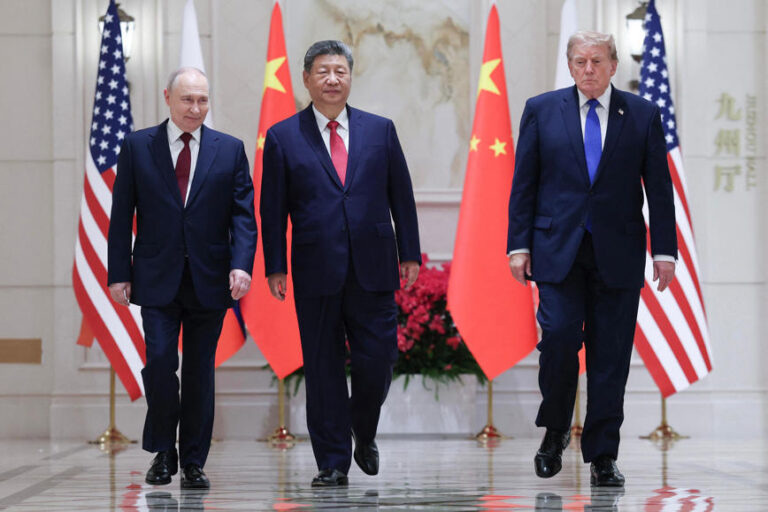
- US President Donald Trump, Chinese President Xi Jinping and Russian President Vladimir Putin issued a four-point joint statement after their first trilateral summit in Shenzhen.
- The leaders pledged dialogue on reducing nuclear risks and preventing nuclear proliferation.
- The statement also addressed refined petroleum supply, the International Criminal Court and reform of the United Nations.
- The leaders discussed regional conflicts, including Ukraine and the Korean Peninsula, but made no specific public announcement of an agreement on these issues.
MAIN STORY
The United States, China and Russia have pledged to hold talks on reducing nuclear risks and preventing the spread of nuclear weapons following their first-ever trilateral summit in Shenzhen, China.
US President Donald Trump, Chinese President Xi Jinping and Russian President Vladimir Putin issued a four-point joint statement on Thursday after a 90-minute meeting at Qilin Mountain Villa, a state guest house in Shenzhen, on the sidelines of the Asia-Pacific Economic Cooperation (APEC) summit.
The statement reaffirmed the principle that “a nuclear war cannot be won and must never be fought” and committed the three countries to dialogue on nuclear risk reduction and non-proliferation.
Trump said the three powers were in a position to discuss ways to reduce the number of nuclear weapons globally and limit the risk of their use.
“We are in a unique position to discuss ways to reduce the number of nuclear weapons on Earth and mitigate the risk of their actual use,” he said.
Xi called for the comprehensive prohibition and eventual elimination of nuclear weapons, while proposing regular high-level exchanges and a crisis management system to help the three countries manage disagreements.
“History shows that when major powers fight, the world descends into chaos,” Xi said, urging the leaders to communicate before taking action on sensitive international issues.
Putin also called for cooperation among the three countries, citing their roles as major powers that emerged from the Second World War and founding members of the United Nations. He identified regional conflicts, including the war in Ukraine, as areas of shared interest.
THE ISSUES
The nuclear commitment is a declaration of intent rather than a detailed arms control agreement. The statement does not specify numerical limits on nuclear weapons, a timetable for negotiations or a mechanism for monitoring compliance.
The distinction matters because the three countries have different nuclear capabilities and positions on arms control. Trump’s remarks suggest Washington wants China involved in negotiations traditionally centred on the United States and Russia, while Beijing has called for broader nuclear disarmament.
The summit also raised questions about how major powers intend to manage disputes involving countries that were not represented at the meeting.
On Taiwan, Xi urged the leaders to respect one another’s core interests and avoid crossing established red lines. His remarks reflected China’s position on issues it considers central to its sovereignty and security.
The leaders also addressed the Korean Peninsula. Although there was no public discussion specifically focused on North Korea’s nuclear programme, China’s Xinhua News Agency reported that the three presidents exchanged views on the peninsula.
WHAT’S BEING SAID
Trump also reiterated Washington’s position on Iran’s nuclear programme, saying: “We will not allow Iran to possess nuclear weapons.”
Xi called for the eventual elimination of nuclear weapons, saying: “We must comprehensively ban and completely eliminate nuclear weapons to ultimately create a world free of nuclear weapons.”
WHAT’S NEXT
Beyond nuclear security, the joint statement covered cooperation on refined petroleum production and supply, opposition to what the leaders described as the abuse of the International Criminal Court’s jurisdiction, and reform of the United Nations.
The commitments will require further diplomatic engagement if they are to produce specific agreements or changes in policy. The statement did not provide detailed implementation plans for the four areas.
BOTTOM LINE
The Shenzhen summit established a platform for direct dialogue among the leaders of three major powers on nuclear risks, energy supply and international institutions. However, the joint statement contains broad commitments rather than measurable arms control targets or detailed implementation arrangements. Its significance will depend on whether the countries translate the declarations into sustained negotiations and concrete action.