







KEY POINTS
• 79 per cent of Nigerian adults, about 94.2 million people, use financial products or services.
• Formal financial inclusion rose to 73 per cent, above the 70 per cent target under the National Financial Inclusion Strategy.

• Digital financial services reached 64.4 per cent of adults, up from 45 per cent in 2023.
• EFInA says the next phase of financial inclusion should focus on meaningful usage, financial health and access to credit, protection and investment.
MAIN STORY
About 94.2 million Nigerian adults now use financial products or services, representing 79 per cent of the adult population, according to the Enhancing Financial Inclusion and Advancement (EFInA).
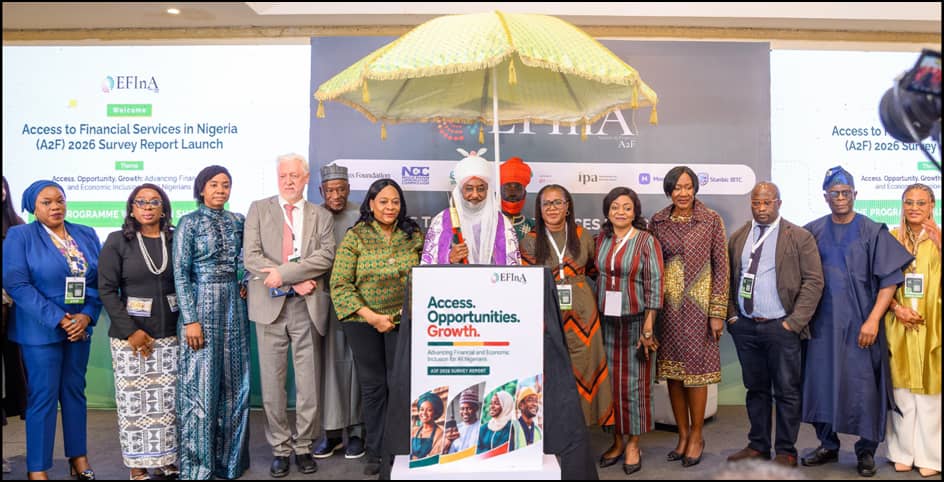
The figure was contained in EFInA’s 9th Access to Financial Services in Nigeria (A2F) Survey, made available to the News Agency of Nigeria (NAN) on Tuesday in Abuja.
The survey showed that formal financial inclusion had risen to 73 per cent, surpassing the 70 per cent target set under the National Financial Inclusion Strategy.
Dr Agnes Martins, Board Chairman of EFInA, said the survey provided insights that administrative data could not fully capture.
She explained that while administrative records showed accounts, transactions, infrastructure and financial service providers, the A2F survey provided information about the people using or excluded from those services.
Martins warned against designing financial services solely around national averages, saying financial needs varied according to income, gender, location, age and economic activity.
Dr Aisha Isa Olatinwo, Director of Consumer Protection and Financial Inclusion at the Central Bank of Nigeria, said the survey evidence was important for policy design, market development, consumer protection and the targeting of financial sector reforms.
She said the findings showed that financial inclusion policy needed to move beyond simply expanding access to financial services.
“The policy challenge before us is therefore no longer simply to open accounts or expand access points.
“It is to ensure meaningful usage, affordability, reliability, safety, trust and measurable improvement in financial health,” Isa Olatinwo said.
The survey also recorded growth in pension participation, with coverage rising from eight per cent of adults in 2023 to 9.1 per cent.
Ms Omolola Oloworaran, Director General of the National Pension Commission, said the increase remained insufficient, noting that most Nigerians were still without pension coverage.
She urged EFInA to collaborate with the commission on a dedicated pension inclusion model, stressing that having an account alone did not amount to pension inclusion if the account was not funded.
Digital financial services recorded a stronger increase, reaching 64.4 per cent of adults, compared with 45 per cent in 2023 and 34 per cent in 2020.
Ms Foyinsolami Akinjayeju, Chief Executive Officer of EFInA, said the growth in digital financial services was the largest movement recorded in the survey and was associated with improved financial outcomes.
According to her, 33 per cent of digital financial service users were financially healthy, compared with 9.1 per cent among non users.
Akinjayeju called for national financial inclusion targets to measure impact alongside access to and use of financial services.
THE ISSUES
- The rise in formal financial inclusion above the national target indicates that the challenge is increasingly shifting from bringing people into the formal financial system to ensuring that they can use financial services effectively and safely.
- The survey highlights differences in financial needs across income groups, genders, locations, ages and economic activities. This means broad national averages may not adequately reflect the barriers faced by particular groups.
- Pension participation remains low despite its increase from 2023. The survey and comments from PenCom indicate that account ownership must be accompanied by actual funding and sustained participation if it is to provide financial security in retirement.
- The expansion of digital financial services creates opportunities for wider access, but the reported difference in financial health between digital users and non users also points to the need to focus on the quality and outcomes of usage.
- EFInA says existing financial relationships should increasingly become pathways to credit, protection, investment and financial security, linking financial inclusion to people’s resilience and economic opportunities.
WHAT’S BEING SAID
“The policy challenge before us is therefore no longer simply to open accounts or expand access points.
“It is to ensure meaningful usage, affordability, reliability, safety, trust and measurable improvement in financial health,” – Dr Aisha Isa Olatinwo, CBN.
“Roughly nine out of every 10 Nigerians are not covered for the day they can no longer work,” – Ms Omolola Oloworaran, PenCom.
“We now have the evidence; the priority is to use it to focus on action where it can make the greatest difference,” – Dr Oluwatomi Eromosele, EFInA.
WHAT’S NEXT
EFInA is calling for national targets that measure the impact of financial services alongside access and usage. It also wants existing financial relationships developed into pathways to credit, protection, investment and financial security, with greater attention to people and locations where financial inclusion gaps remain.
BOTTOM LINE
Nigeria has moved beyond its formal financial inclusion target, but EFInA says the next challenge is ensuring that access translates into meaningful usage, financial health and greater economic resilience.