






By Annette Ikponmwonba | September 15, 2026
Key Points
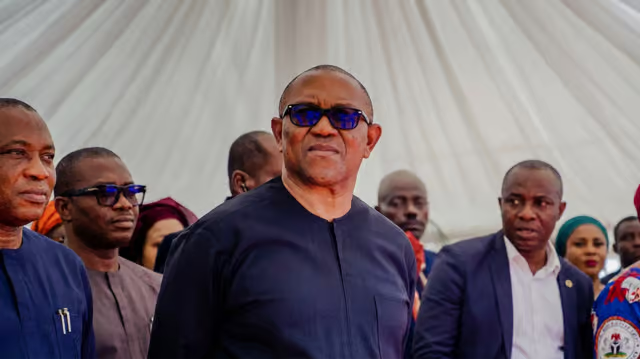
· NDC presidential candidate Peter Obi has rejected claims that his Anambra administration left behind unpaid debts
· The Anambra State Government had alleged inherited liabilities including a ₦2bn ecological loan, contractor debts and unpaid salaries, gratuities and pensions
· Obi says his administration cleared over ₦35bn in historical gratuities and arrears and left the state with no outstanding salary, pension or gratuity obligations
· He specifically disputed the ₦2bn ecological fund claim, saying the money was left untouched in a First Bank account for his successor
· Obi says the ecological funds were separate from the over ₦75bn in savings he claims his administration left behind
· He has challenged anyone to disprove his account, vowing to stop his 2027 campaign if proven wrong
Main Story
Peter Obi, presidential candidate of the Nigeria Democratic Congress, has rejected claims by the Anambra State Government that his administration left behind inherited debts. In a statement on X on Tuesday, he described the allegations as completely false, The claims centered on a ₦2bn ecological loan, contractor liabilities, and unpaid salaries, gratuities and pensions that the state government says it inherited. Obi pushed back directly, saying his administration had systematically cleared more than ₦35bn in historical gratuities and arrears dating back several years before he left office, He maintained that at the point of handover, the state owed nothing in salaries, gratuities or pensions, and that no outstanding obligations existed to any contractor for projects that had been duly executed and certified.
The Issues
The dispute stems from remarks by Anambra State Commissioner for Finance, Izuchukwu Okafor, who said the current administration under Governor Chukwuma Soludo has continued servicing debts inherited from previous governments, including those of Obi and former Governor Willie Obiano. Okafor noted that the Soludo government has not borrowed from any commercial bank since taking office, but has made deductions from the state’s Federation Account Allocation Committee funds to repay legacy loans, while also claiming an 83 per cent reduction in the state’s overall debt burden.
This creates a direct factual clash between two administrations with competing accounts of the state’s financial position at handover. The dispute is not merely academic. It touches on Obi’s broader political brand, which has been built substantially around a reputation for fiscal discipline and prudent public spending during his time as governor. Any credible evidence of unpaid debts or fiscal mismanagement would complicate that narrative heading into the 2027 election cycle.
The specific disagreement over the ₦2bn ecological fund adds a layer of technical detail to the dispute. Obi’s explanation hinges on the fund being tied to a specific erosion control project in Oko and Umuchiana, and his insistence that untouched, earmarked project funds should not be characterized as debt or mismanagement, but rather as a deliberate decision to preserve funds for continuity.
What’s Being Said
Obi was emphatic in disputing the ecological fund claim, explaining that the money was released only about three months before his tenure ended and was meant specifically for the Oko and Umuchiana erosion crisis. He said he resisted pressure to spend it, arguing that government is a continuum and that project-tied funds should be handled accordingly.
He went further to provide specific documentation of his claim, stating that the money was left fully intact in a First Bank account, number 2018779464, with a balance of over ₦2.13bn at handover. He also clarified that these project-specific funds were kept separate from, and not counted within, the more than ₦75bn in general savings his administration says it left behind for the state.
On the Anambra government’s side, Commissioner Okafor’s comments framed the current administration’s position as one of responsible debt management, emphasizing that Soludo’s government has avoided new commercial borrowing while working to pay down what it describes as inherited obligations.
What’s Next
The dispute now largely hinges on whether either side produces concrete documentation to support its version of events. Obi has explicitly invited scrutiny, saying that if anyone can establish evidence contradicting his account, he will stop campaigning altogether, a high-stakes wager that raises the political cost of the claim being proven false either way.
It remains to be seen whether the Anambra State Government or Commissioner Okafor will respond further with specific figures, bank records or documentation to substantiate the original claims, or whether the matter will simply remain a war of competing public statements without independent verification.
Bottom Line
Obi is treating the Anambra debt allegations as a direct threat to his political credibility and has responded with an unusually high-stakes public wager, tying the fate of his 2027 presidential campaign to the accuracy of his financial record as governor, a move that puts pressure on the Anambra government to either substantiate its claims or let the matter drop.