








Key points
- NIMASA and the Nigerian Navy have renewed their strategic partnership through a new Memorandum of Understanding (MoU).
- The agreement is designed to strengthen maritime security, safety and coordinated enforcement across Nigeria’s territorial waters.
- It provides a framework for implementing the SPOMO Act, ISPS Code and other relevant maritime laws.
- The renewed pact is the first formal update of the institutions’ partnership since the original MoU was signed in 2007.
- The Deep Blue Project has been formally integrated into the collaborative framework.
- A joint reporting protocol will strengthen operational communication and information sharing.
- Both institutions will hold an annual conference to review collaboration and address emerging maritime security threats.
Main Story
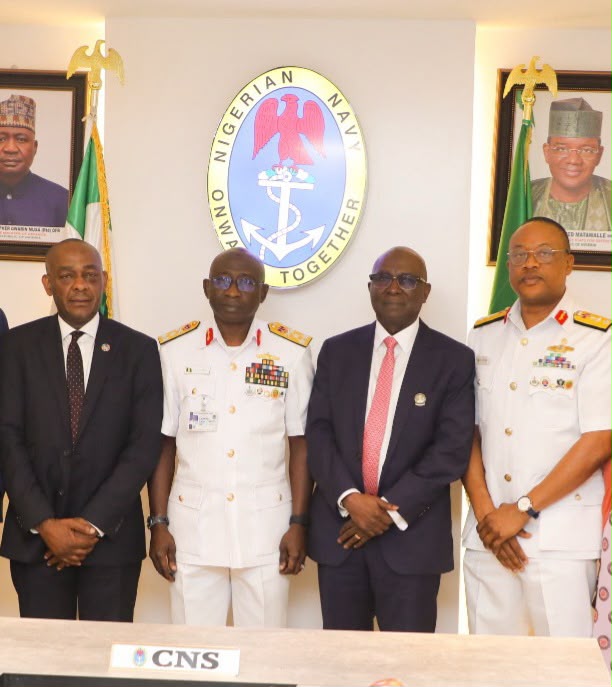
The Nigerian Maritime Administration and Safety Agency (NIMASA) and the Nigerian Navy have renewed their strategic partnership with the signing of a Memorandum of Understanding (MoU) aimed at strengthening maritime security, improving safety and deepening coordinated enforcement across Nigeria’s maritime domain.
The agreement was signed at the Nigerian Navy Headquarters in Abuja by the Director-General of NIMASA, Dr Dayo Mobereola, and the Chief of the Naval Staff, Vice Admiral Idi Abbas.
The renewed agreement represents the first formal renewal of the partnership since the two institutions signed their original MoU in 2007.
Under the new framework, NIMASA and the Navy will strengthen cooperation in maritime security operations and the implementation of the Suppression of Piracy and Other Maritime Offences (SPOMO) Act, the International Ship and Port Facility Security (ISPS) Code and other relevant maritime laws.
The agreement is also expected to improve information sharing, operational coordination and joint responses to emerging threats within Nigeria’s maritime space.
According to NIMASA, the partnership will consolidate gains already recorded in maritime security while providing both agencies with a stronger institutional framework for delivering their statutory mandates.
The Issues
Nigeria’s maritime domain remains strategically important to the country’s economy, with a significant proportion of international trade and economic activity dependent on the waterways.
Consequently, threats to maritime security can have implications for trade, shipping, revenue generation, investment and the development of the Blue Economy.
The evolving nature of maritime threats also requires stronger coordination among agencies responsible for maritime safety, security and law enforcement.
The renewed MoU seeks to address some of these challenges by establishing clearer channels for information sharing, joint reporting and coordinated operational responses.
What’s Being Said
Dr Dayo Mobereola, Director-General, NIMASA
Mobereola commended the Minister of Marine and Blue Economy, Adegboyega Oyetola, for his commitment to strengthening inter-agency cooperation as a driver of maritime security and Blue Economy development.
He said the renewed agreement would support the Federal Government’s efforts to unlock the potential of Nigeria’s maritime sector.
“As we renew this partnership today, I urge our respective teams to ensure that the spirit of this agreement translates into practical and measurable outcomes.”
The NIMASA DG also thanked the Nigerian Navy for its continued support towards strengthening the partnership.
Vice Admiral Idi Abbas, Chief of the Naval Staff
Abbas described the agreement as a significant milestone in the longstanding relationship between the Navy and NIMASA.
He said the renewed MoU contains provisions designed to strengthen Nigeria’s response to evolving maritime security challenges.
“Whether we like it or not, the water is where we get whatever we are getting—our revenue, everything and even the trade we engage in, in large percentages, is done through the water.”
He stressed the importance of maintaining strong institutions capable of securing Nigeria’s maritime environment.
What’s New in the MoU?
One of the major additions is the formal integration of the Deep Blue Project into the collaborative framework.
The arrangement is expected to strengthen cooperation between the Nigerian Navy’s Maritime Guard Command and the Deep Blue Project in responding to maritime security threats.
The MoU also introduces a joint reporting protocol to improve communication and information sharing during operations.
This is expected to facilitate faster decision-making and ensure that maritime incidents receive a more coordinated response.
Another provision is the establishment of an annual conference, where both institutions will review their collaboration, assess progress and develop responses to emerging security challenges.
What’s Next
NIMASA and the Nigerian Navy are expected to translate the renewed agreement into practical joint operations, stronger intelligence and information sharing, coordinated enforcement and improved responses to maritime incidents.
The annual conference will provide an additional platform for reviewing implementation and identifying areas requiring stronger cooperation.
The partnership is also expected to contribute to the Federal Government’s broader Blue Economy agenda by creating a safer and more secure environment for shipping, investment, trade and other maritime activities.
Bottom Line
The renewal of the NIMASA-Navy MoU marks an important step towards building a more coordinated maritime security architecture for Nigeria.
With the Deep Blue Project now incorporated into the framework, alongside joint reporting and regular institutional reviews, the agreement could strengthen Nigeria’s ability to respond to maritime threats.
Ultimately, the success of the pact will depend not on the signing ceremony alone, but on how effectively both institutions convert the agreement into sustained joint action, faster information sharing and measurable improvements in maritime safety and security.




 and the Nigerian Navy have renewed their strategic partnership ...)