











By Boluwatife Oshadiya | July 21, 2026
Key Points
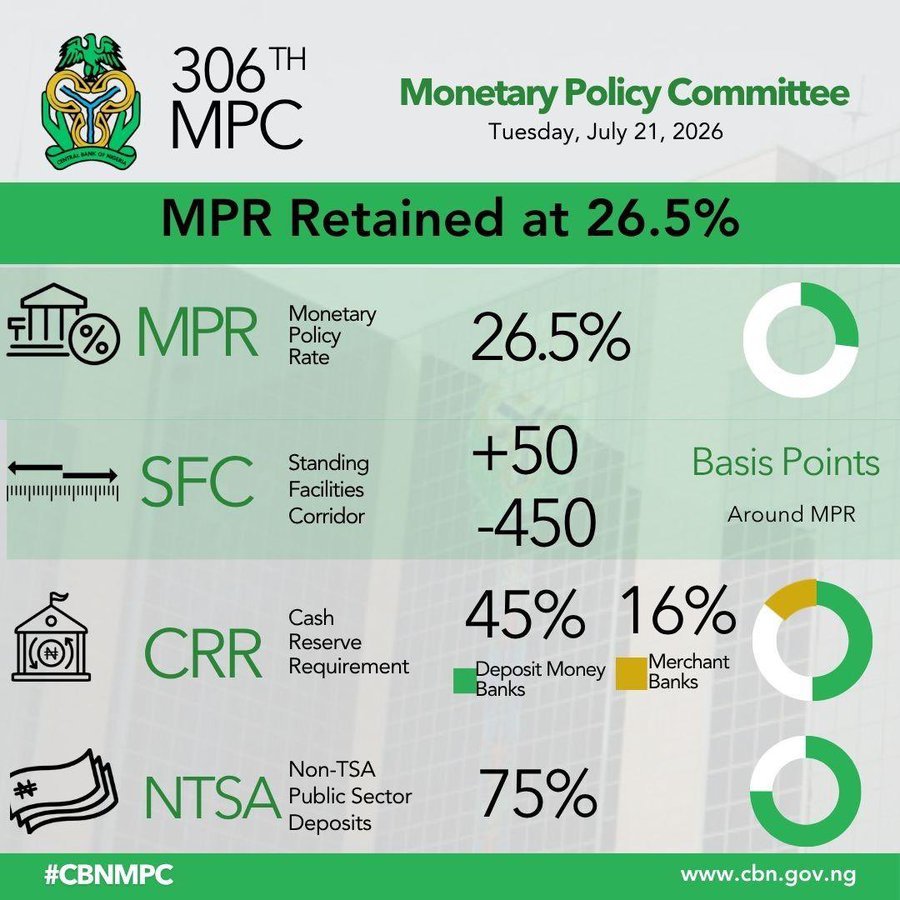
- The Central Bank of Nigeria retained the Monetary Policy Rate at 26.5% at the conclusion of its 306th Monetary Policy Committee meeting
- The MPC maintained all key monetary policy parameters, citing easing inflation but heightened geopolitical risks from the Middle East
- Nigeria’s external reserves climbed to $52.52 billion while inflation slowed marginally to 15.91% in June 2026
Main Story
The Central Bank of Nigeria (CBN) has retained the Monetary Policy Rate (MPR) at 26.5%, maintaining its tight monetary policy stance as policymakers balance moderating domestic inflation against growing global economic uncertainties.

The decision was announced on Tuesday after the conclusion of the 306th Monetary Policy Committee (MPC) meeting held on July 20 and 21, 2026, where all eleven committee members unanimously voted to leave the benchmark lending rate unchanged.
Alongside the benchmark rate, the MPC also retained the Standing Facilities Corridor at +50/-450 basis points around the MPR, while leaving the Cash Reserve Ratio (CRR) unchanged at 45% for Deposit Money Banks, 16% for Merchant Banks, and 75% for non-Treasury Single Account (TSA) public sector deposits.
The Committee said its decision followed a careful assessment of domestic economic conditions and emerging global risks, particularly renewed hostilities in the Middle East, which have raised concerns over higher global energy prices and their potential impact on inflation.
Although Nigeria’s headline inflation eased marginally to 15.91% in June 2026 from 15.93% in May, the MPC said maintaining the current policy stance would allow it to closely monitor incoming economic data before considering any adjustment to interest rates.
The Committee noted that recent reforms by both the fiscal and monetary authorities have strengthened the Nigerian economy’s resilience to external shocks. It also welcomed the Federal Government’s renewed commitment to policy coordination, saying stronger alignment between fiscal and monetary policies would improve macroeconomic stability.
The MPC further commended ongoing efforts to increase crude oil production and diversify government revenue through sectors such as solid minerals. It also described the banking sector recapitalisation exercise as a positive development, noting improvements in the industry’s resilience while urging continued regulatory oversight to safeguard financial stability.
Economic indicators reviewed during the meeting showed that Nigeria’s economy remained on a stable growth path despite external pressures. Real Gross Domestic Product (GDP) expanded by 3.89% in the first quarter of 2026, supported largely by growth in telecommunications, financial services, trade, transportation and other non-oil sectors.
Meanwhile, Nigeria’s gross external reserves increased to $52.52 billion as of July 17, 2026, up from $50.47 billion at the end of May, providing enough cover for approximately 11 months of imports, well above the international benchmark of three months.
“Although headline inflation moderated marginally in June 2026, global uncertainties have heightened due mainly to the renewed hostilities in the Middle East. In view of the evolving developments, maintaining a cautious monetary policy stance remains appropriate,” the Monetary Policy Committee said in its communiqué.
What’s Being Said
The CBN said the moderation in headline inflation suggests previous monetary tightening measures are beginning to yield results, even as food inflation remains elevated due to supply constraints.
“Maintaining the current monetary policy stance will provide an opportunity to closely monitor incoming data and assess the trajectory of inflation to guide future policy decisions,” the Committee stated.
Economists are likely to interpret the latest decision as a signal that the CBN remains focused on preserving price stability while waiting for clearer evidence that inflation is on a sustained downward path before considering any policy easing.
What’s Next
- The CBN will continue monitoring inflation, exchange rate movements and the impact of global geopolitical developments before making further monetary policy adjustments.
- Policymakers expect inflation to moderate further in the coming months, supported by exchange rate stability, the lagged effects of previous monetary tightening and improved food supply during the harvest season.
- The Monetary Policy Committee is scheduled to hold its next meeting on September 21 and 22, 2026.
Bottom Line
The Bottom Line: The CBN’s decision to hold interest rates at 26.5% signals that the battle against inflation remains its top priority despite improving macroeconomic indicators. With inflation easing only gradually and geopolitical tensions threatening fresh price shocks, the central bank appears determined to prioritise stability over an early shift toward monetary easing.











 has retained the Monetary Policy Rate (MPR) at 26.5%, maintaining its tight monetary policy stance as...)