Key points
- President Donald Trump has signed two executive orders seeking to further restrict birthright citizenship.
- One order targets automatic citizenship for children of certain non-U.S. citizens, including foreign government employees and people classified as “alien enemies.”
- Another order seeks to curb “birth tourism” by people travelling to the U.S. to give birth.
- The move follows a Supreme Court ruling that rejected an earlier attempt to restrict birthright citizenship.
Main story
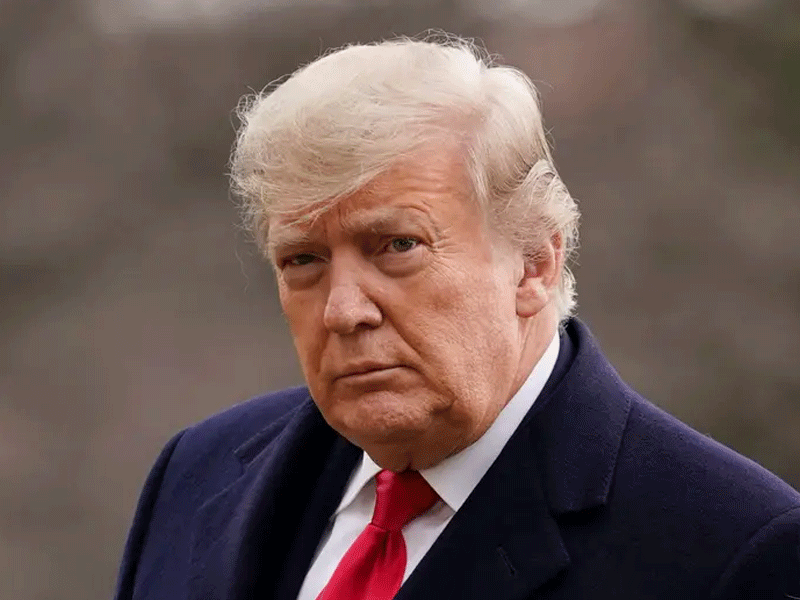
U.S. President Donald Trump has signed two executive orders aimed at further restricting birthright citizenship and curbing what his administration describes as “birth tourism.”
One of the executive orders seeks to deny automatic U.S. citizenship to certain children born to parents who are not U.S. citizens, including children of foreign government employees and individuals classified as “alien enemies.”
The second order targets “birth tourism,” the practice of travelling to the United States primarily to give birth so that a child acquires U.S. citizenship by birth.
The latest measures form part of the administration’s broader effort to tighten immigration policies and limit access to birthright citizenship.
Earlier in his second term, Trump signed an executive order seeking to deny automatic citizenship to children born to parents who were in the United States temporarily or without lawful permanent residence.
However, the U.S. Supreme Court rejected that order in June, reaffirming that the Citizenship Clause of the 14th Amendment has guaranteed automatic citizenship to individuals born on U.S. soil since 1868.
Although executive orders direct federal government policy, they do not override constitutional provisions or existing laws and remain subject to judicial review.
The issues
Birthright citizenship has long been protected under the 14th Amendment to the U.S. Constitution, which grants citizenship to most people born in the United States. Trump’s latest executive orders are likely to face legal challenges over whether a president can restrict constitutional rights through executive action without congressional approval or a constitutional amendment.
What’s being said
“One order seeks to deny automatic citizenship to certain children whose parents are not U.S. citizens, including children of foreign government employees and people classified as ‘alien enemies.'” – Executive Order signed by U.S. President Donald Trump:
“The other seeks to ban so-called ‘birth tourism,’ a term used to describe people visiting the U.S. for the purpose of giving birth so that their child obtains U.S. citizenship.” – Executive Order signed by U.S. President Donald Trump:
What’s next
The executive orders are expected to face immediate legal scrutiny, with courts likely to determine whether the measures are consistent with the 14th Amendment and existing Supreme Court precedent on birthright citizenship.
Bottom line
Trump’s latest immigration measures renew a long-running legal and political battle over birthright citizenship, but any lasting changes will likely depend on the outcome of expected court challenges.