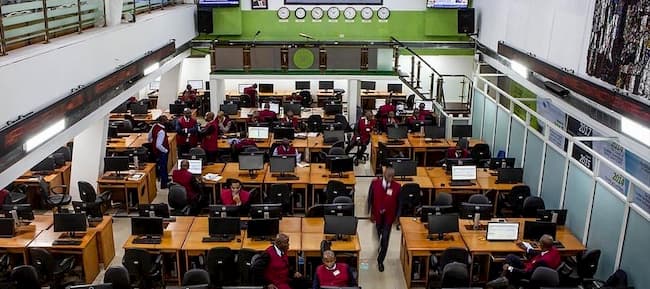
President Bola Ahmed Tinubu has said the unprecedented expansion of Nigeria’s capital market is a clear demonstration of investor confidence in the bold economic reforms of his administration.
Speaking in Brazil on Tuesday when he received the Director-General of the Securities and Exchange Commission (SEC), Dr. Emomotimi Agama, and the Board of the Nigerian Exchange Group (NGX) Plc, the President pointed to the surge in market capitalisation and trading volumes as evidence of a resilient economy on a new trajectory under the Renewed Hope Agenda.
“Nigeria’s markets must be a trusted engine of enterprise and prosperity. My government will continue to pursue reforms that unlock capital, protect investors, and drive innovation, so that our economy works for every Nigerian,” Tinubu stated.
The President commended the NGX Board and SEC leadership for their stewardship of the market, stressing that sustained dialogue among regulators, operators, and government was vital to consolidating recent gains and cementing Nigeria’s status as Africa’s leading investment hub. He further assured that his administration would deepen liquidity, expand opportunities, and strengthen investor protection to keep Nigeria’s markets globally competitive.
SEC Director-General, Dr. Agama, described the recently signed Investment and Securities Act (ISA) 2025 as a “game-changer” and one of Africa’s most comprehensive legal frameworks for capital markets. He projected that the Act would propel Nigeria toward a N300 trillion market size while ensuring regulatory clarity, investor protection, and equitable wealth distribution.
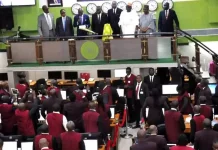
Chairman of the NGX Group, Alhaji Umaru Kwairanga, attributed the near tripling of trading volumes and market capitalisation within two years to the President’s “bold and decisive reforms.” He urged the Federal Government to fast-track the listing of state-owned enterprises, including NNPC Limited, and introduce tax incentives to sustain growth momentum. He also extended an invitation to President Tinubu to ring the opening bell at the NGX trading floor in recognition of the market’s transformation.
Group Chief Executive Officer of NGX, Temi Popoola, highlighted the Exchange’s ambition to transform into a global investment hub by modernising market infrastructure, expanding product offerings, and deepening strategic partnerships. He also emphasised the drive to boost retail participation through digital channels as crucial to fostering inclusive growth.
Similarly, NGX Group Director, Nonso Okpala, lauded the administration’s reforms for stabilising the exchange rate and enhancing macroeconomic predictability—factors he noted were accelerating listings and encouraging more Nigerian businesses to democratise wealth by going public.
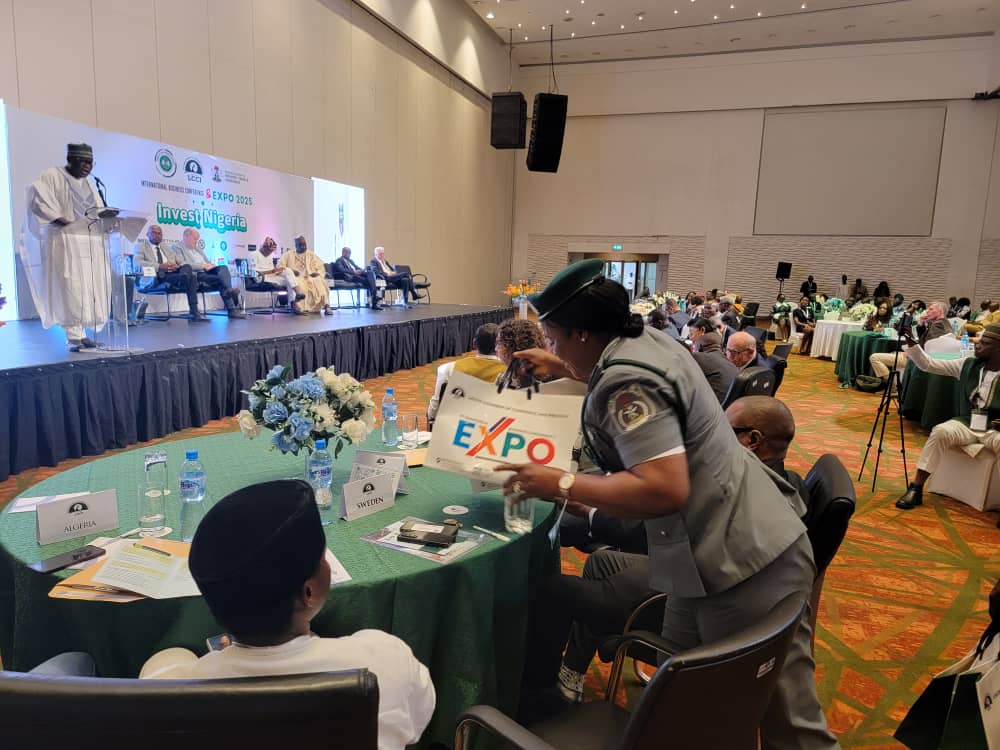
The Nigeria Customs Service (NCS) has taken centre stage at the Lagos Chamber of Commerce and Industry (LCCI) International Business Conference and Expo 2025, held in Lagos on Tuesday, 26 August 2025. This marks its first-ever participation in the high-profile gathering themed “Invest Nigeria.”
Speaking on behalf of the Comptroller-General of Customs (CGC), Adewale Adeniyi, the Zonal Coordinator for Zone A, Assistant Comptroller-General (ACG) Charles Orbih, said Customs’ presence at the event signals a new era of openness and innovation for the Service.
According to him, the Customs stand was designed to demonstrate how the Service is advancing trade facilitation and revenue collection through modern technologies.
He highlighted the Unified Customs Management System, codenamed B’Odogwu, which he described as a resilient, error-free platform that has cut down delays and ensured seamless clearance of goods.
“We are here to showcase what we are doing as Customs and to enlighten visitors from across Africa and beyond on our reforms. The B’Odogwu project ensures seamless clearance of goods and quick release of containers, thereby boosting trade facilitation”, he stated.
Also speaking at the pavilion, Comptroller Salamatu Atuluku of the Project and Monitoring Unit, Abuja, stressed the system’s impact on business efficiency. “With B’Odogwu, importers can clear goods within days without bottlenecks. This is ease of doing business at its best. We are here to show the world that doing business with Nigeria Customs is transparent, fast and effective.”
The NCS displayed reform-focused materials, including handbooks on Authorised Economic Operators, Reputation Management, Clearance Audit and Post-clearance audit processes, underscoring its drive to align operations with World Customs Organisation (WCO) standards.
Earlier in his welcome address, President of the LCCI, Gabriel Idahosa, described Nigeria as a big player in the future of Africa’s prosperity.
“Nigeria is not just an option for investors. It is an integral part of any viable international investment plan”, Idahosa said. He noted opportunities in agriculture, technology, renewable energy, creative industries and real estate.
Delivering President Bola Ahmed Tinubu’s message, Minister of State for Industry, Trade and Investment, Senator John Enoh, reaffirmed government’s commitment to reforms that would unlock Nigeria’s investment potential.
He pointed out over 180 reforms under the Presidential Enabling Business Environment Council (PEBEC), new tax laws, infrastructure renewal and technology-driven governance as measures designed to foster competitiveness.
The conference, brought together top policymakers, Diplomats, investors and development partners.
The two-day event is expected to generate dialogue on overcoming Nigeria’s investment challenges and positioning the country as a gateway to Africa’s trillion-dollar continental free trade market.
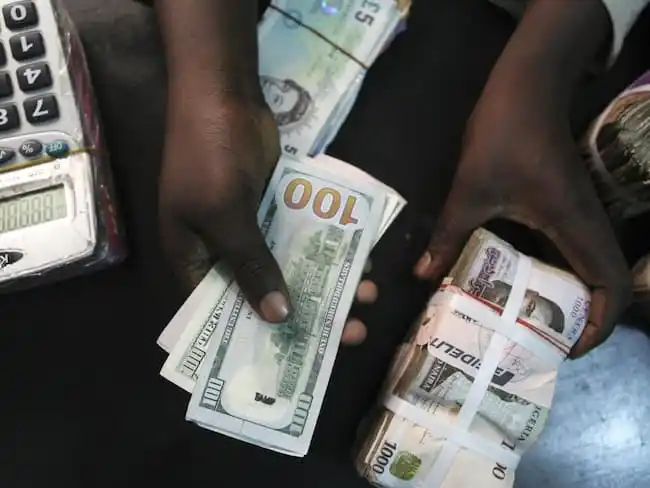
The exchange rate between the Naira and the US dollar, according to the data released on the FMDQ Security Exchange, the official forex trading portal, showed that the naira closed at 1535.00 per $1 on Wednesday, August 27th , 2025. The naira traded as high as 1528.00 to the dollar at the investors and exporters (I&E) window on Tuesday.
How much is a dollar to naira today in the black market?
Dollar to naira exchange rate today black market (Aboki dollar rate):
The exchange rate for a dollar to naira at Lagos Parallel Market (Black Market) players buy a dollar for ₦1538 and sell at ₦1528 on Tuesday 26th August, 2025, according to sources at Bureau De Change (BDC).
Please note that the Central Bank of Nigeria (CBN) does not recognize the parallel market (black market), as it has directed individuals who want to engage in Forex to approach their respective banks.
Dollar to Naira Black Market Rate Today
Dollar to Naira (USD to NGN)
Black Market Exchange Rate Today
Buying Rate
₦1538
Selling Rate
₦1528
Dollar to Naira CBN Rate Today
Dollar to Naira (USD to NGN)
CBN Rate Today
Highest Rate
₦1537
Lowest Rate
₦1535
Please note that the rates you buy or sell forex may be different from what is captured in this article because prices vary.
The National Examinations Council (NECO) has announced that it will migrate from the paper-pencil method to a fully computer-based examination system. The transition will commence with the November/December 2025 Senior School Certificate Examination (SSCE) External.
To this effect, NECO has invited interested Computer-Based Examination (CBE) centre operators across the country to apply for registration, subject to strict technical, infrastructural, and security requirements.
Below are the official CBE Centre Requirements and Guidelines:
A. System Requirements
Minimum of 150 functional computer systems/laptops with 10% (15) backups.
Minimum 15-inch monitor for desktops or 17-inch screen for laptops.
Computers must connect to a robust server capable of handling at least 150 systems concurrently.
All systems must be equipped with up-to-date antivirus software and remain virus-free.
Systems must be connected via a cable LAN in star topology (wireless connections are not allowed).
Switches must run on uninterrupted power supply (UPS) throughout examinations.
Each centre must provide at least two backup Gigabit switches.
B. Hall Requirements
Individual cubicles for candidates, with minimum dimensions of 26 inches (length) x 18 inches (breadth) x 18 inches (height), each with an appropriate seat.
Adequate air-conditioning and lighting must be provided.
Installation of CCTV with IP cameras for live monitoring is mandatory.
CCTV must be cabled, not wireless.
Exposed or flying cables are prohibited; all cabling must be trunked.
Strong MTN or Airtel signal must be available at the centre’s location.
Centres must install wall clocks visible to all candidates, as wristwatches will no longer be allowed.
Make-shift CBT centres are prohibited; centres must be dedicated facilities maintained year-round.
Centres must not be located in shared premises such as cinema halls, shopping malls, or markets.
C. Facilities and Personnel Requirements
Provision of backup power supply: minimum 40kva generator for a 250-system centre and UPS/inverters supporting all systems for at least three hours.
At least two technical personnel and one network engineer must be available per centre.
All CBE personnel must be of high moral standing, dependable, and capable of upholding exam integrity.
Centres must provide a holding room or reception area (e.g., canopy with chairs) for candidates.
Each centre must have internal toilets within the CBT hall.
Adequate security personnel must be deployed.
The centre premises must be adequately fenced.
The Council emphasized that only centres meeting these conditions will be accredited for the new computer-based SSCE.
Nigeria’s World Cup qualifying campaign suffered a setback on Tuesday after first-choice goalkeeper Stanley Nwabali picked up an injury while in action for Chippa United.
The 29-year-old was stretchered off during the first half of a league clash against Richards Bay, appearing in severe discomfort. Chippa United’s medical team is still assessing the extent of the injury, leaving both club and country anxious over his availability.
The timing is troubling for the Super Eagles, who face crucial qualifiers against Rwanda and South Africa next month. Nwabali, capped 21 times, has been central to coach Eric Chelle’s plans and is widely seen as Nigeria’s most reliable option between the posts.
His setback deepens Nigeria’s goalkeeping worries. Maduka Okoye is sidelined by a two-month suspension for betting violations, leaving only untested or inexperienced options: Amas Obasogie of Tanzania’s league, yet to earn a senior cap; Adebayo Adeleye of Greek side Volos NPS, who has one international appearance; and 15-year-old Ebenezer Harcourt, a recent youth standout unlikely to be risked in high-stakes fixtures.
Nigeria currently sits fourth in its qualifying group with seven points, six adrift of leaders South Africa. With two decisive matches looming, Nwabali’s absence could significantly damage the Super Eagles’ chances of narrowing the gap.
The Academic Staff Union of Universities (ASUU) on Tuesday staged coordinated protests across campuses nationwide, pressing long-standing demands from the Federal Government just two days before a decisive meeting scheduled for Thursday in Abuja.
From Obafemi Awolowo University, Ile-Ife, to the University of Ilorin, Federal University of Lafia, University of Calabar, Usmanu Danfodiyo University Sokoto, Federal University of Technology Akure, Plateau State University, University of Maiduguri, Abia State University, and Osun State University, lecturers marched with placards, chanting solidarity songs and warning of an imminent strike if government inaction continued.
Core demands included implementation of the 2009 ASUU-FGN agreement, release of three and a half months’ withheld salaries, payment of outstanding 25–35 per cent salary arrears and promotion arrears, revitalisation of universities, rejection of the proposed tertiary institution staff loan scheme, and adoption of UTAS in place of IPPIS to protect university autonomy.
At OAU, ASUU Chairperson Prof. Tony Odiwe accused government of deliberately stalling the report of the Yayale Ahmed renegotiation committee submitted in February 2025. He noted that lecturers had been on the same salary scale since 2009, warning that collapse of industrial peace would be blamed on government.
Similar sentiments echoed nationwide. At FUOYE, Akure Zonal Coordinator Prof. Adeola Egbedokun declared that patience among academics had reached breaking point, saying members “teach on empty stomachs, live in debt, and can no longer afford basic needs.” At Lafia, branch chair Sunday Orinya accused government of deceit and neglect, lamenting that many lecturers had died due to hardship.
At Plateau State University, the protest drew the Vice Chancellor, Prof. Shedrack Best, alongside ASUU National President Prof. Chris Piwuna, who warned that poor salaries, unpaid allowances, and IPPIS enforcement were undermining university autonomy.
In Sokoto, protests brought together members from three universities, with UDUS chair Prof. Nurudeen Almustapha calling the government’s loan scheme a “poisoned chalice” and demanding immediate implementation of the Yayale Ahmed report.
At UNILORIN, placards read “University workers are not slaves” and “Honour your agreement with ASUU.” Branch chair Dr. Alex Akanmu said failure to implement agreements had pauperised lecturers and pushed the system to collapse.
Similar grievances were aired in Akure, Calabar, Maiduguri, Umuahia, and Osogbo, with chairs condemning unpaid arrears, poor retirement benefits, and alleged victimisation of staff.
Across the campuses, the message was unified: unless Thursday’s Abuja meeting delivers concrete action, Nigeria’s universities may once again be thrown into a nationwide strike.
Short-term benchmark interest rates moved in different directions on Tuesday as liquidity in the financial system fluctuated following an open market operation (OMO) by the Central Bank of Nigeria (CBN).
The open repo rate closed unchanged, setting the floor for money market indicators, as borrowing by banks at the CBN’s standing lending facility slowed sharply. By contrast, the overnight lending rate ticked higher, reflecting mild funding pressure from a mix of inflows from matured OMO bills and settlement obligations for a fresh CBN auction.
Liquidity was further shaped by the Debt Management Office’s (DMO) settlement of FGN bonds from Monday’s auction, even as the system was boosted by a ₦758 billion inflow from maturing OMO bills.
To mop up excess liquidity, the CBN offered a ₦400 billion short-dated OMO auction, which attracted strong investor interest with ₦710.96 billion in subscriptions. The apex bank eventually allotted ₦349.46 billion.
Despite the auction settlement, interbank rates held firm. According to AIICO Capital Limited, the open repo rate remained steady at 26.50%, while the overnight rate inched up by 4 basis points to 26.96%. Analysts expect rates to hover around 26.5% on Wednesday unless significant funding pressures emerge.
Meanwhile, the Nigerian Interbank Treasury Bills True Yield (NITTY) curve advanced across all maturities, with yields on the 1-month, 3-month, 6-month, and 12-month papers rising by 5 bps, 19 bps, 25 bps, and 9 bps, respectively.
The Nigerian stock market is heating up again, and leading the charge are two telecom heavyweights: MTN Nigeria and Airtel Africa. No longer just rivals in call rates and internet speed, both companies are now pivoting toward cloud computing and artificial intelligence (AI)—a shift that could redefine their business models and open new opportunities for investors.
MTN Nigeria recently unveiled the Dabengwe Data Cloud, a platform built to help businesses, institutions, and developers store and leverage data using cloud technology, with AI-driven solutions at its core.
Not to be outdone, Airtel Africa has announced plans to build a 38-megawatt hyperscale data centre, designed to support AI applications, cloud services, and high-capacity data processing across the continent.
This rivalry goes beyond infrastructure—it’s setting the stage for Nigeria’s future digital economy. Because the two stocks move closely together, a significant price shift in one is likely to ripple into the other, underscoring how tightly their fortunes are linked.
Currently, MTN Nigeria trades at ₦435.00 per share, while Airtel Africa stands at ₦2,310.50. On face value, MTN offers a lower entry point, appealing to retail and institutional investors seeking affordability with growth potential. But context matters:
Airtel’s higher price reflects its smaller share float and strong earnings base.
MTN’s deeper liquidity and broader shareholder base mean greater volatility—and often stronger traction during market rallies.
For investors, the key question is who executes first—whether through revenue growth, client adoption, or strategic partnerships. The first mover could ignite a wave of price appreciation, with both stocks riding the momentum.
Market signals suggest a new price floor is forming, especially for MTN. As Nigeria transitions into a more digital economy, these stocks may soon trade less like traditional telecoms and more like technology leaders.
This is more than a fight for subscribers—it’s a race to power Nigeria’s digital future. And for investors, those who take positions early may be best placed to enjoy the upside.
The average yield on Federal Government of Nigeria (FGN) bonds climbed on Tuesday as the Debt Management Office (DMO) auction triggered profit-taking and portfolio adjustments. Local bond yields, which have been oscillating below 17% in recent sessions, reflected shifting investor positioning and tight supply conditions.
Yields spiked following heavy sell-offs in bonds maturing in February 2028, March 2027, March 2028, November 2028, April 2029, and November 2029. Post-auction risk-off sentiment pushed the average yield higher by 19 basis points to 16.89%, according to investment banking sources.
Across the curve, yields expanded at the short (+27 bps) and mid (+5 bps) ends, led by a sharp sell-off in the FEB-2028 (+113 bps) and APR-2032 (+19 bps) papers. The long end of the curve, however, remained unchanged.
Analysts noted initial demand for the newly issued 2027, 2029, and February 2031 papers, but yields edged higher later as trading slowed amid wide bid-offer spreads and thin volumes.
The secondary market was largely subdued after the DMO allotted N136.2 billion—well below the N200 billion on offer and short of market expectations based on recent auction trends.
According to CardinalStone Securities Limited, the DMO’s decision to allot below the target may reflect reluctance to cross the 18.00% yield threshold, which could effectively serve as a ceiling in the near term.
The average yield on Nigeria’s U.S. dollar-denominated bonds declined as strong demand from foreign portfolio investors lifted sentiment in the international market. Hopes of economic recovery and a sharp drop in headline inflation have spurred appetite for the country’s sovereign eurobond papers—contrasting with the bearish tone seen among some African peers.
Analysts expect Nigeria’s borrowing costs in the global debt market to ease further in the absence of major economic or political shocks, supported by recent credit rating upgrades from Moody’s, Fitch, and S&P Ratings.
In its market note, Cowry Asset Management Limited said Nigeria’s Eurobond segment ended on a positive footing, with the average yield slipping by two basis points to 8.01%, reflecting robust buying interest and stronger investor confidence.
By contrast, African Eurobonds broadly weakened as falling oil prices and heightened U.S. political risk unsettled markets. Analysts at AIICO Capital Limited noted that investors reacted to former U.S. President Donald Trump’s escalating pressure on the Federal Reserve and his threats of fresh trade measures. Trump’s call for the removal of Fed Governor Lisa Cook and his hints at further tariffs and tech export curbs against U.S. trade partners rattled sentiment, raising concerns over Fed independence and global trade tensions.
Last week, Nigeria’s Eurobond curve had closed on a bearish note, with average yields widening by 16 basis points to 8.12% from 7.96% in the prior week. Losses were broad-based, but the 2032 (+24 bps to 8.28%) and 2033 (+21 bps to 8.60%) bonds bore the heaviest selling pressure.
The Nigerian naira experienced mixed trading across foreign exchange (FX) markets on Tuesday, as surging dollar demand from corporates seeking overseas payments weighed on the local currency.
Data from investment banking firms showed that the naira appreciated by ₦3 in the parallel market, closing at ₦1,547/$1. However, at the official Nigeria Foreign Exchange Market (NFEM) window, the naira slipped by 6 basis points, exchanging at ₦1,537.75/$1, compared to ₦1,536.42/$1 in the previous session.
Analysts at AIICO Capital Limited noted that the NFEM interbank market was pressured by heightened FX demand against limited supply, with the local currency trading between ₦1,537/$1 and ₦1,539/$1. In response, the Central Bank of Nigeria (CBN) intervened last week, selling $50 million to banks to ease pressure on the system.
Meanwhile, Nigeria’s external reserves rose to $41.19 billion as of August 25, 2025, reflecting an increase of $85.58 million from the previous day. Analysts said the uptick in reserves could help sustain exchange rate stability in the near term.
Global market developments further shaped outlook for the naira. Crude oil prices fell sharply, with Brent crude sliding 2.3% to $67.22 per barrel, while U.S. West Texas Intermediate (WTI) declined 2.4% to $63.25 per barrel. Market watchers linked the dip to renewed U.S. tariff concerns, the Ukraine conflict, and uncertainty over Russian fuel supplies.
On the other hand, gold prices advanced to a two-week high, supported by safe-haven demand after U.S. political tensions rattled investor confidence. Spot gold rose 0.5% to $3,382.19, while U.S. gold futures for December delivery also gained 0.5% to $3,433.00.
Market analysts noted that investors may remain cautious in the oil market due to the lingering uncertainty surrounding geopolitical risks and global trade tensions.
The Central Bank of Nigeria (CBN) on Tuesday conducted a fresh round of Open Market Operation (OMO) auctions, offering bills worth ₦400 billion to both foreign portfolio investors and local deposit money banks.
According to details from the apex bank, the bills carried a maturity period of 84 days and were introduced to mop up liquidity following the expiration of earlier OMO instruments.
Although the offer size was pegged at ₦400 billion, the CBN under-allotted, selling ₦349.46 billion at a stop rate of 26.50%. Market data showed that total subscriptions reached ₦710.96 billion, reflecting strong investor appetite for short-term, high-yield assets.
Analysts said the higher interest rate aligns with the CBN’s strategy to attract foreign portfolio inflows and maintain liquidity balance in the financial system.
Meanwhile, the interbank market remained buoyant, supported by ₦758 billion OMO maturity inflows. The central bank has consistently raised OMO rates in recent weeks, a move seen as critical to curbing inflationary pressures while keeping offshore investors engaged.
Market experts believe that with yields now at record highs, demand from both local and foreign investors is expected to remain strong in subsequent auctions, especially given the CBN’s commitment to stabilizing the naira through aggressive liquidity management.
There’s something about UEFA draw season that makes football fans sit up a little straighter. Maybe it’s the tension in the room, the glittering ceremony lights, or that strange thrill of seeing your club’s name tumble out of the pot. Either way, the 2025/26 UEFA club competition draws promise all of that—and more. And this time, Monaco is where the football world’s eyes will turn on 28 and 29 August.
So what exactly is on the table? A familiar Champions League format, a shiny new stage for the Europa and Conference League, and a jam-packed schedule that’s going to keep fans, players, and pundits talking well into December. Let’s walk through it all.
Monaco, Glamour, and the Champions League Draw
When UEFA sets up in Monaco, it isn’t just about football—it’s about spectacle. Think red carpets, iconic backdrops, and European football royalty brushing shoulders with one another. And at the center of it all? The Champions League draw.
Scheduled for 28 August at 18:00 CET, the ceremony will look and feel almost identical to last season’s. For the traditionalists, that’s good news. The 36 teams will be sorted into four pots, with the Champions League titleholder proudly placed at the top of Pot 1.
Here’s where it gets interesting:
Each club will face two teams from each pot (home and away).
Clubs from the same country won’t meet each other.
No team will get more than two opponents from the same league.
The mechanics are a mix of old-school and futuristic. The draw starts with one physical ball picked on stage—yes, the iconic moment everyone waits for—before UEFA’s digital software steps in to instantly map out opponents. It’s a hybrid system designed to mix theatre with efficiency.
For fans, it means that within minutes, you’ll know exactly who your team will have to beat, whether it’s a blockbuster clash with Bayern or a tricky away trip to a lesser-known Eastern European side. The fixture list, complete with match dates and kick-off times, will land by 30 August.
The Europa and Conference League Go Joint-Show
Now, here’s the real shake-up this year: for the first time, the Europa League and Conference League draws will happen in a single ceremony. It’s bold, it’s efficient, and—if UEFA’s PR team gets it right—it could actually make the “other two” competitions feel more like main events.
The big day is 29 August at 13:00 CET, live from the Grimaldi Forum in Monaco. Fans can expect a streamlined, modern show, complete with slick graphics, suspenseful reveals, and the kind of fanfare usually reserved for the Champions League.
UEFA is going fully digital here. Forget the iconic plastic balls spinning in a glass bowl; one press of a button will randomize all fixtures. Opponents, home-and-away order—everything will be spat out by the software in seconds. The suspense comes not from watching balls being opened but from how the results get revealed pot by pot. It’s UEFA’s way of keeping eyeballs glued to the screen while speeding up what used to be a long-winded ritual.
And honestly? It makes sense. Football today is as much about how you package content as the game itself. Just ask fans scrolling TikTok for highlights before the full-time whistle.
Why the Software Matters
Some fans worry when football decisions get handed to algorithms. But UEFA is keen to show that its digital partner, AE Live, has done its homework. Since 2023, AE Live has stress-tested its system with over a million simulations—ensuring randomness, fairness, and compliance with all competition rules.
And it’s not just UEFA claiming this. Independent auditors at Ernst & Young will be on-site in Monaco, keeping a close eye to ensure nothing shady slips through. For anyone old enough to remember past controversies—like when “hot and cold balls” were rumored to influence draws—this level of transparency feels reassuring.
It might not be as romantic as Gianni Infantino fumbling with a draw ball on live TV, but it’s football in the digital age: clean, fast, and accountable.
What This Means for Fans
For fans, the appeal of these draws is half nerves, half excitement. You dream of the glamorous nights—Real Madrid at the Bernabéu, Liverpool under the Anfield lights—but you also dread that “group of death” headline.
And let’s not forget travel. Away days are the soul of European football for many supporters. Thousands of fans are probably already checking Skyscanner while the draw is still unfolding, hoping the algorithm gifts them a weekend in Barcelona rather than a midweek trek to Kazakhstan.
That’s part of the magic: the draw doesn’t just shape matches—it shapes memories.
Mark the Calendar: Key UEFA Dates
If you’re a football obsessive (and if you’ve read this far, you probably are), here’s a quick snapshot of what’s coming:
28 August – Champions League draw (plus Europa & Conference play-off second legs)
29 August – Europa League and Conference League draw
30 August – Women’s Champions League qualifying finals
31 August – Women’s Champions League third qualifying round draw
16–18 September – Champions League Matchday 1
24–25 September – Europa League Matchday 1
2 October – Conference League Matchday 1
And that’s just the start. From September to December, the European calendar is wall-to-wall action. Tuesdays and Wednesdays belong to the Champions League, Thursdays to the Europa and Conference Leagues. Week after week, football lovers will be juggling time zones, streaming platforms, and maybe even work schedules to catch every kick.
Why This Year Feels Different
Let’s be honest—UEFA draws can feel like déjà vu. Big clubs in Pot 1, minnows in Pot 4, a few juicy clashes sprinkled in. But this year feels different for two reasons:
The joint Europa-Conference ceremony makes the secondary competitions feel less like an afterthought. Clubs like West Ham, Atalanta, or Villarreal suddenly share the stage with the “big boys.” That’s good for visibility, sponsorship, and, yes, bragging rights.
The sheer density of fixtures. With the expanded league-phase formats, there’s simply more football. More matches to watch, more rivalries to spark, more stories to unfold. It’s exhausting in the best way possible.
The Cultural Side of It All
Football isn’t just sport—it’s culture. And nowhere is that clearer than in these draws. Fans wear club jerseys, journalists dissect every possible outcome, and cities prepare for an influx of travelers.
For Monaco, it’s also a statement: luxury meets football passion. The principality has hosted draws for decades, becoming almost as synonymous with them as Nyon is with UEFA headquarters. It’s glitzy, sure—but also strangely fitting. Because football, at its heart, is a mix of grit and glamour.
Looking Ahead
So, what should fans expect? Nerves, drama, maybe even a few shocks. A group of death will almost certainly emerge, while another team will get labeled “lucky.” Social media will explode with memes before the ceremony even ends. And clubs will begin plotting their paths to Istanbul, Dublin, or wherever their finals may be.
UEFA has made a clear bet this year: tradition for the Champions League, innovation for the Europa and Conference Leagues. It’s a balancing act, but one that shows European football isn’t afraid to evolve.
And let’s be real—you’ll be tuning in. Because whether your club ends up at the Camp Nou or somewhere you need Google Maps to find, there’s no moment quite like hearing the draw confirm your fate.
Final Thought
The Monaco draws aren’t just administrative formalities; they’re the overture to a season-long symphony of football. The anticipation, the hope, the occasional dread—it’s all part of the theatre that makes European nights so addictive.
So mark 28 and 29 August on your calendar. Clear your schedule. Because when those pots are spun and those fixtures revealed, another unforgettable chapter of European football begins.
You know what’s at the heart of every great marriage? Trust. It’s like the foundation of a house—if it’s shaky, the whole thing starts to wobble. Safety, faithfulness, commitment, and reliability: these are the four pillars that hold up the roof of a strong relationship.
If even one starts to crumble, cracks appear, and before you know it, the whole structure feels unsteady. Let’s break down why these pillars matter so much and how you can shore them up, whether you’re planning a wedding, counseling couples, or dreaming of your own happily-ever-after.
Safety: The Warm Embrace of Trust
Imagine coming home after a rough day, knowing you can collapse into your partner’s arms without fear of judgment. That’s what safety in a marriage feels like. It’s not just about physical safety—though that’s non-negotiable—it’s about emotional security, too. Can you share your wildest dreams, your deepest fears, without worrying they’ll be brushed off or, worse, used against you?
Here’s the thing: little moments chip away at safety. A harsh word, a dismissive eye-roll, or—let’s be real—that all-too-familiar nag. Nagging isn’t just annoying; it’s a subtle signal that says, “I don’t trust you to do your part.” Next time you catch yourself nagging (or being nagged), pause. Ask yourself, “What’s really going on here?” Maybe it’s not about the dishes—it’s about feeling unheard or unvalued. A gentle reminder? Fine. But constant nagging? That’s a red flag something deeper needs addressing.
Faithfulness: More Than Just Staying True
Faithfulness seems obvious, right? You don’t cheat, you stay loyal, done. But it’s more than avoiding physical infidelity. Emotional faithfulness—sharing your heart, your secrets, your goofy side with your spouse—builds a bond that’s just as critical. John Gottman, a guru in marriage research, talks about “turning toward” your partner in small moments. When they’re stressed and need to vent, are you there, really listening? Those tiny acts of being present stack up, creating a trust that says, “I’ve got your back, no matter what.”
And here’s a thought: faithfulness also means sticking around when things get messy. Anger, arguments, bad days—they’re part of the deal. A ground rule like, “It’s okay to be mad, I’m not going anywhere,” acts like emotional cement, holding you together when life tries to pull you apart.
Commitment: Showing Up, Day After Day
Commitment isn’t just a vow you make in front of a crowd—it’s a daily choice. It’s choosing to carve out time for each other, even when life’s a whirlwind. Date nights, coffee chats, or just binge-watching your favorite show together—these moments scream, “You’re my priority.” And honestly, isn’t it amazing how much a simple gesture, like putting your phone down to really talk, can mean?
Commitment also means following through on the little things: picking up groceries like you said you would, showing up to that family event you promised to attend. These acts aren’t glamorous, but they’re evidence you’re reliable. They tell your partner, “You can count on me.” And when you’re a team, tackling life’s chaos together, that trust grows stronger.
Reliability: The Glue That Holds It All Together
If safety, faithfulness, and commitment are the pillars, reliability is the glue that keeps them standing. It’s doing what you say you’ll do, when you say you’ll do it. Sounds simple, but it’s powerful. When you consistently show up—whether it’s fixing that leaky faucet or being there for a late-night heart-to-heart—you’re building a track record of trust.
But let’s be honest, nobody’s perfect. Life gets hectic, and we all drop the ball sometimes. The key is owning it. A sincere apology and a plan to make it right can go a long way. And here’s a tip for couples: create routines that make reliability easier. Maybe it’s a shared calendar for chores or a weekly check-in to talk about what’s working (or not). These habits turn “I’ll try” into “I’ve got this.”
What Happens When a Pillar Wobbles?
Here’s where it gets real: trust isn’t a one-and-done deal. It’s built, maintained, and sometimes rebuilt. Maybe you’ve noticed a pillar in your relationship feeling shaky—nagging creeping in, or a sense that you’re not fully “there” for each other. That’s okay. Recognizing it is the first step.
Try this: carve out a moment for emotional safety. Sit down, no distractions, and ask your partner, “What makes you feel most loved and supported?” Listen—really listen. You might be surprised what you learn. And if you’re a marriage counselor or wedding planner, nudge your clients toward these conversations early. Trust me, it’s easier to build these habits before the wedding cake is cut than to patch things up later.
A Little Spark of Hope
Here’s the beauty of it all: trust is something you can nurture. Every small act—listening without interrupting, keeping a promise, staying faithful in the big and little moments—adds a brick to your foundation. And when life throws curveballs (because it will), a marriage built on safety, faithfulness, commitment, and reliability can weather anything.
So, whether you’re helping couples plan their big day or dreaming of your own, remember this: trust isn’t just a buzzword. It’s the heartbeat of a marriage that lasts. What’s one small way you can build trust with your partner today?
The Nigerian Exchange (NGX) All-Share Index sustained its upward momentum on Tuesday, with bullish trading activities dominating the local bourse for the second consecutive session this week.
According to official trading data, the benchmark index advanced by 0.23%, closing at 141,761.36 points, while overall market capitalization rose by ₦203.48 billion, settling at ₦89.69 trillion. This movement pushed the year-to-date (YTD) return to 37.73%.
Market analysts attributed the positive performance to strong buying interest in GTCO, INTBREW, and ZENITHBANK, although general trading activity reflected weaker sentiment compared to the previous session.
NGX figures showed that total trading volume climbed by 2.43%, reaching 585 million units, while transaction value closed at ₦12 billion across 27,667 deals. Despite a negative market breadth, investor appetite for medium- and large-cap equities drove the market’s uptrend.
On the activity chart, FCMB led in volume terms, contributing 14.81% of total trades. It was followed by VERITASKAP (11.36%), AIICO (6.00%), NSLTECH (4.53%), and MBENEFIT (3.90%). In value terms, WAPCO dominated transactions, accounting for 12.72% of the total.
The gainers’ chart was topped by NCR, which appreciated by 10.00%, followed by BERGER (+9.06%), BETAGLAS (+8.16%), CADBURY (+8.04%), SOVRENINS (+7.55%), and CHAMS (+6.92%), among others.
However, 33 equities declined, led by LEGENDINT, which lost 10.00%, trailed by CUTIX (-8.97%), FTNCOCOA (-7.29%), ELLAHLAKES (-3.16%), JAPAULGOLD (-1.75%), and WEMABANK (-0.43%).
Sectoral performance was largely positive, with banking stocks advancing +0.73%, consumer goods adding +0.48%, oil & gas up +0.48%, and industrials gaining +0.09%. Conversely, the insurance index shed 0.18%, while the commodities sector closed flat.
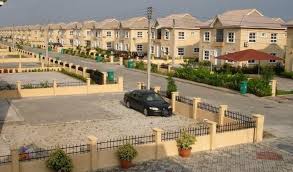
Behind imposing gates and guarded entrances sit some of Lagos’ most coveted addresses—exclusive estates where security, privacy, and prestige define daily life.
These enclaves represent the height of luxury living, with offerings that range from sleek high-rise apartments to palatial mansions. Demand remains strong, driven by Nigeria’s estimated 6,800 high-net-worth individuals (HNWIs) and consistent investment from the diaspora, even as prices continue to climb.
What sets these communities apart is not just prime location, but the self-sufficiency of their infrastructure. In Lagos, residents and developers often fund their own water supply, electricity, drainage, and security—services typically handled by government in other global cities. Here, exclusivity is less about seamless urban planning and more about controlled access and private management.
Yet, despite these unique challenges, these estates continue to rank among the most desirable residential addresses in Nigeria’s commercial capital. Below is a closer look at Lagos’ most prestigious estates in 2025, along with current rental and sale price estimates.
Banana Island, Ikoyi
Widely regarded as the crown jewel of Lagos real estate, Banana Island is home to billionaires, business executives, and celebrities. Its banana-shaped layout overlooks Victoria Island and Lekki Phase 1, combining scenic waterfront views with architectural elegance.
The estate features smart luxury apartments, waterfront villas, and office towers equipped with infinity pools, cinemas, and premium finishes. Security is tight, infrastructure is privately managed, and access is highly restricted.
Land: around ₦2m per sqm; new luxury projects start from $750,000.
Prices have surged sharply in recent years, with six-bedroom homes now almost quadruple their 2022 value.
Parkview Estate, Ikoyi
Bordering Banana Island, Parkview is another sought-after enclave known for its quiet ambience and landscaped surroundings. It is primarily residential but also hosts boutique hotels and private offices.
Known for its waterfront views of the Lagos Lagoon, Osborne Foreshore blends luxury living with modern infrastructure. It offers apartments, duplexes, and penthouses with amenities such as gyms, swimming pools, and clubhouses.
Originally built for Chevron staff, Nicon Town is now one of Lekki’s most exclusive gated estates. It features paved roads, landscaped areas, and round-the-clock security.
Rent: 3–4 bedroom terraces ₦14m–₦22m; 5-bedroom detached homes ₦25m–₦30m.
Sale: 4-bedroom terrace ₦145m; larger homes up to ₦2.5bn.
Pinnock Beach Estate, Lekki
Pinnock offers residents a coastal lifestyle with controlled access, private surveillance, and landscaped gardens. Many homes feature swimming pools and terraces with waterfront views.
Sale: 4-bedrooms ₦600m–₦950m; 5-bedrooms ₦850m–₦1.3bn; prime waterfront homes ₦1.5bn+.
Ogudu GRA, Kosofe
One of Lagos’ fastest-rising neighbourhoods, Ogudu GRA offers both residential and commercial opportunities with good road networks and quick access to the Lagos–Ibadan Expressway.
Rent: 3-bedrooms ₦3m–₦7m; 4-bedrooms from ₦12m; 5-bedrooms ₦7m–₦20m.
Sale: 3-bedrooms ₦120m–₦220m; 4-bedrooms ₦135m–₦500m; 5-bedrooms ₦300m–₦650m; high-end terraces up to ₦1.6bn.
From Banana Island to VGC, Lagos’ luxury estates continue to attract the wealthy despite soaring costs. Demand is fuelled by Nigeria’s elite, the diaspora, and foreign investors seeking prestige and exclusivity. While residents often pay a premium for private services, these communities remain the benchmark of high living in Africa’s largest city.
The Manufacturers Association of Nigeria (MAN) has criticised the Nigeria Customs Service (NCS) for reintroducing a four per cent Free on Board (FOB) charge, which took effect on August 4.
In a statement on Monday, MAN Director-General Segun Ajayi-Kadir said the decision contradicts the government’s earlier suspension of the levy and would significantly increase production costs, particularly for companies importing raw materials, machinery, and spare parts unavailable locally.
He explained that MAN conducted a rapid assessment following the reintroduction and found that the impact on manufacturers could be severe. “The idea that the charge streamlines previous multiple charges and reduces cargo clearance costs does not reflect reality. The cost of the four per cent charge on a manufacturing company is enormously higher than the combined effect of the seven per cent surcharge and one per cent Comprehensive Import Supervision Scheme (CISS) levy,” Ajayi-Kadir said.
He added that other West African countries, including Ghana, Côte d’Ivoire, and Senegal, apply targeted inspection or collection fees of between 0.5 per cent and one per cent FOB, with higher levies only imposed on luxury or non-essential imports.
According to him, a uniform four per cent FOB levy in Nigeria would raise the cost of doing business, encourage cargo diversion, promote under-declaration, and drive manufacturers toward informal cross-border sourcing.
MAN urged the Federal Government and the NCS to suspend the implementation and extend the timeline to December 31, allowing for consultations and a full impact assessment. This, Ajayi-Kadir said, would align with the January 2026 rollout date for recently introduced tax laws.
In the meantime, MAN proposed that the customs service retain the existing one per cent CISS and seven per cent cost of collection fee to balance revenue generation with industrial competitiveness. Ajayi-Kadir warned that failure to do so could trigger avoidable price hikes that would affect more than 230 million Nigerians.
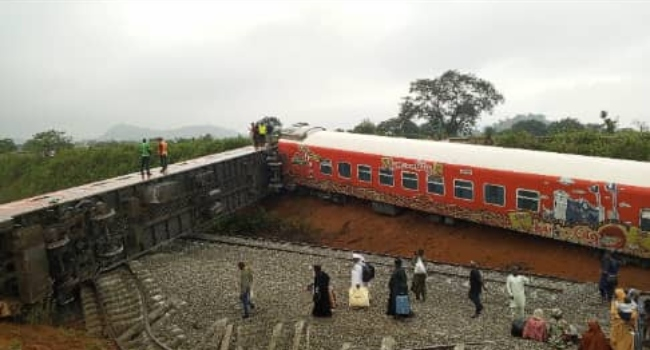
A passenger train travelling from Abuja to Kaduna derailed on Tuesday morning, leaving several carriages overturned and triggering panic among passengers. The incident occurred around 11:09 a.m. at KM 49, between Kubwa Station and Asham Station, shortly after the train departed Abuja. The derailment caused chaos on board, with eyewitnesses describing scenes of confusion as passengers scrambled out of the cabins to safety.
“It was complete pandemonium. People were seen running in different directions in panic,” one passenger recounted.
The Nigerian Safety Investigation Bureau (NSIB) confirmed that six passengers sustained injuries, though no fatalities were recorded. In a statement signed by its Director of Public Affairs and Family Assistance, Bimbo Olawumi Oladeji, the Bureau said a “go-team” has been deployed to collect evidence, engage stakeholders, and begin an investigation into the cause of the accident.
“The Bureau sympathises with those injured and extends its support to all passengers affected. The investigation will focus on identifying the direct and underlying factors that led to the derailment, with the aim of issuing safety recommendations to prevent a recurrence,” the statement read.
NSIB Director General, Captain Alex Badeh, said the investigators’ priority is to uncover the root cause of the derailment. “Our commitment is to ensure safer rail transport for Nigerians through a transparent and independent investigation,” he added.
Meanwhile, the Managing Director of the Nigeria Railway Corporation, Kayode Opeifa, also confirmed the incident, noting that rescue operations were underway at the scene.
The Abuja–Kaduna rail corridor is one of Nigeria’s busiest passenger routes, but it has faced repeated disruptions, including the March 2022 terrorist attack in which several passengers were killed and dozens abducted.
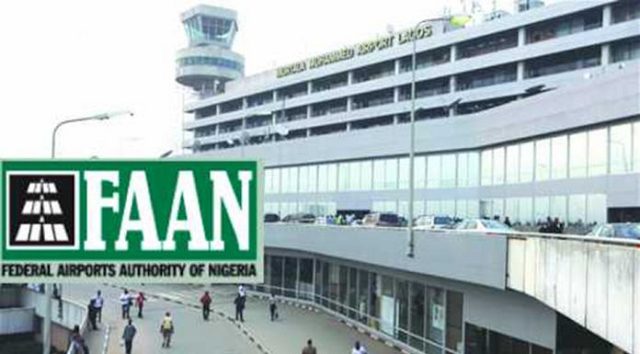
The Federal Airports Authority of Nigeria (FAAN) has introduced expanded wheelchair assistance and special support services for passengers with disabilities, the elderly, and others requiring mobility aid across airports nationwide.
According to the agency, the initiative is aimed at promoting dignity, safety, and comfort for all categories of travellers.
In a statement released Monday on X (formerly Twitter), FAAN’s Director of Public Affairs and Consumer Protection, Obiageli Orah, said wheelchair services will now be available from check-in through boarding and on arrival.
“Dedicated staff are available to offer guidance and support. Priority is given at security checks and boarding gates,” the statement noted.
Orah added that accessible facilities, including restrooms and elevators, have been installed at terminals to make air travel more convenient for passengers with special needs.
She also encouraged travellers requiring assistance to notify their airline or airport staff in advance, or to make a request at the special assistance desk upon arrival.
Most Nigerian banks are on track to exit a prolonged period of regulatory forbearance by the close of 2025, despite challenges from the reclassification of some large Stage 2 loans as impaired, according to a new Fitch Ratings analysis of the nation’s leading financial institutions.
The Nigerian banking sector faces stringent regulations, with high inflation and interest rates expected to persist in the near term. The expiration of system-wide forbearance by mid-2025 is likely to increase impaired loan ratios and strain capital adequacy ratios across the industry. However, banks are preparing through measures like loan restructuring, significant capital raises driven by new paid-in capital requirements, and improved net interest margins that enhance loss-absorption capacity.
Fitch Ratings indicates that these steps will mitigate the impact of higher loan impairment charges and prudential provisions following the forbearance expiry. Some banks may continue operating under forbearance with penalties, such as restrictions on dividend payments.
The recent naira devaluation has bolstered foreign-currency liquidity in the banking sector by increasing forex market turnover. Additionally, Nigerian banks hold sufficient liquidity to meet upcoming Eurobond obligations, with USD2.2 billion in maturities or callable bonds due by the end of 2026, eliminating the need for refinancing.