Guinness Nigeria has confirmed that a Notice of Discontinuance of the court action instituted against the National Agency for Food and Drug Administration and Control (NAFDAC) and the Attorney General of the Federation has been filed.
The action was started following imposition of administrative charges of one billion naira (N1billion) on the company by NAFDAC.
The termination of the court action was predicated on the letter dated 15th February 2016 from NAFDAC to the company which was stated to “supercede the decisions contained in the Agency’s letter dated 9th November 2015”.
As part of the resolution, NAFDAC would be present during the destruction of the expired raw materials in its rented warehouse and both parties agreed that this would be the procedure for the exercise in future.
Guinness Nigeria also agreed to pay administrative and service charges to NAFDAC to cover the cost of the investigative inspection of raw materials carried out by the Agency as well as the supervision by NAFDAC of the destruction of the raw materials which would be carried out by Guinness Nigeria.
The administrative and service charges of approximately N11.4m has since been paid to NAFDAC.
Guinness Nigeria is home to some of the most iconic brands in Nigeria including Guinness Foreign Extra Stout. As part of the Diageo group of companies, Guinness Nigeria operates to the highest standard of quality in its production and processes, being guided not only by Nigerian but global best practices.
Guinness Nigeria acknowledges the support received from the Honourable Minister of Health and from the former Director-General and senior management of NAFDACtowards the amicable resolution of the matter and expresses its commitment to maintaining and fostering a strong and mutually beneficial relationship with NAFDAC.
Market Capitalization of the Nigerian Stock Exchange, NSE, on Wednesday, March 9, appreciated by N45 billion or 0.51 per cent, reverting the negative trend.
The News Agency of Nigeria (NAN) reports that the market capitalisation closed higher at N8.904 trillion against N8.859 trillion posted on Tuesday due to gains by highly capitalised stocks.
Okomu Oil Palm recorded the highest gain to lead the gainers’ chart, growing by N1.50 to close at N31.50 per share.
Nigerian Breweries came second having garnered 96k to close at N97, while Dangote Cement appreciated by 88k to close at N164 per share.
Unilever gained 50k to close at N28, while Lafarge Africa also increased by 50k to close at N85.50 per share.
On the other hand, Beta Glass topped the losers’ table with a loss of N2.50 to close at N47.50 per share.
PZ Industries dipped 50k to close at N24.70, while Nigeria-German lost 24k to close at N4.67 per share.
Custodian and Allied Insurance shed 10k to close at N3.80 and ETI also lost 10k to close at N18 per share.
NAN reports that a total of 214.95 million shares valued N1.35 billion were exchanged by investors in 3,327 deals.
This was in contrast with 233.43 million shares worth N1.42 billion traded in 3,224 deals on Tuesday.
FCMB Group was the toast of investors as they staked N28.21 million on 34.42 million shares traded in 166 deals.
It was trailed by Fidelity Bank with 27.77 million shares worth N31.97 million achieved in 101 deals, while FBN Holdings sold 18.82 million shares valued N69.54 million traded in 345 deals.
Zenith Bank accounted for 14.14 million shares worth N175.27 million exchanged in 299 deals and UBA transacted 13.62 million shares valued N46.94 million in 238 deals. (NAN)
The Managing Director of Total Nigeria, Nicholas Terraz, has said the oil giant has invested sum of $10bn in Nigeria.
Terraz who made this known on Wednesday, March 9, when he paid a courtesy call to the Rivers Governor, Nyesom Wike, in Port Harcourt, said the company has enhanced development in its host communities.
He said the company would continue to ensure a healthy environment.
Nigeria’s external reserves continued a steady rise, soaring by 0.2 per cent within seven days in March as global oil price leaped to $40 per barrel on Wednesday, March 9.
Reserves which had begun a slow recovery since February having dropped to $27.789 billion stood at $27.823 billion as at February 29 but had risen to $27.879 billion as at Monday March 7, 2016, according to latest data given by the Central Bank of Nigeria.
Oil prices broke above $40 a barrel on Wednesday, driven by anticipation that the world’s largest exporters may agree as soon as this month to freeze output, which could accelerate a decline in the largest global build in unwanted crude in years.
Meanwhile, the Debt Management Office says it plans to raise N100 billion in local currency denominated bonds with maturities ranging between five and 20 years next week Wednesday, March 16, 2016.
The debt office said it will raise N40 billion at par in the local bond maturing in 2036, N40 billion of the paper maturing in 2026 and N20 billion of the debt maturing in 2020.
The 2026 and 2020 maturing notes are reopening of previously issued paper, while the 2036 maturing note is a fresh issue.
At the interbank market, lending rates among banks faced south with the exception of overnight rates which rose to 5.0487 per cent from 4.7917 per cent which it was in Tuesday.
One month rate dropped to 7.6966 per cent from 8.0506 per cent. Three and six month’s rate also dropped from 9.4052 and 11.0947 per cents to 8.9165 and 10.757 per cents respectively.
Power generation in the Nigerian Electricity Supply Industry (NESI) on Tuesday, March 8, slid to about 2,000 Mega Watts (Mw) from a peak generation of 4,300MW early in the week.
The drop followed a partial system collapse at the Shiroro Power Station .
It was also learnt that due to the collapse, the Transmission Company of Nigeria (TCN) reduced the allocation to the Abuja Electricity Distribution Company (AEDC) from 450MW to 245MW yesterday .
However, the situation worsened on Wednesday, to the extent that allocation to the Abuja Disco stood at about 181.77Mw.
A source said there was a partial system’s collapse on Tuesday at Shiroro, which brought down generation to about 2000MW from the 4300 peak that was attained earlier in the week.
This brought down AEDC’s allocation on Wednesday to about 245MW from its normal baseline of about 450MW.
“At about 7.34am today, (yesterday the allocation rose to about 327MW, but caved
in again at 9.48am to 181.77MW. The situation deteriorated to 131.77MW as at 1.25pm,” a source said
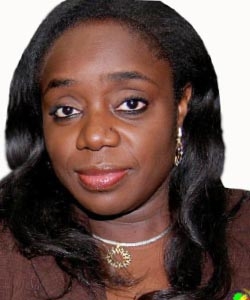
The Minister of Finance Kemi Adeosun, on Wednesday, March 9, said Federal Government is probing an additional 11,000 workers to determine if they are ghost workers.
About 23,000 such workers were uncovered recently, saving the government N2.29 billion monthly.
The Minister, while briefing State House correspondents, said the Federal Executive Council (FEC) approved continuous audit process, particularly on the payroll.
According to her, the audit would be extended to other areas of government’s expenditure to block fraud.
She said: “The approval of a presidential initiative on continuous audit. In the budget speech, the President said we would introduce a continuous audit process, particularly of the payroll and that work has resulted in the elimination of about 23,000 fraudulent recipients of federal salary and more work is still on.
“We felt that the continuous audit should not be limited to payroll, there is actually need to strengthen internal audit across government and to that extent, the World Bank in 2010 started an initiative to try and introduce real-space internal audit in Nigeria, but it wasn’t successful.”
Stressing that the World Bank indicated its readiness to support Nigeria in the initiative, she added that it would take six months to get the required legislation through.
She said: “So, in the interim, we have agreed to do the presidential initiative on continuous audit, which will give backing to the work we are doing and will allow us to extend this work beyond payroll to other areas of expenditure.”
The National Examinations Council , NECO, on Wednesday, March 9, released results of the 2015 November/December Senior School Certificate Examination, with about 43.52 per cent of candidates passing at credit level.
NECO’s Registrar/Chief Executive Prof. Abdulrashid Garba, who announced the results at its headquarters in Minna, said of 50,060 candidates that registered, 47,507 sat for English language and 47,554 sat for mathematics.
He said 29,718 (62.55 per cent) got credit passes in English language. Also, 32,484 candidates obtained credit passes in maths.
Garba added that 43.73 per cent got credit passes in biology, and in chemistry, 11,951(53.63 per cent), obtained credit passes.
Similarly, of the 22,201 candidates, who sat for physics, 818 (3.68 per cent) passed at credit levels.
In geography, 19,781 sat for the examination and 3,851 or 19.46 per cent passed at credit levels.
In economics, 39,406 sat for the examination and 23,991 or 60.88 per cent passed at credit levels.
The registrar said malpractice was high as against previous years, adding that the council was devising ways to curb the malaise.
He said candidates should access results on NECO’s website using their registration number and scratch cards.
American oil giant, Chevron Corporation, has unveiled plans to achieve capital spending budget of between $17 billion and $22 billion yearly for 2017 and 2018.
The company’s executives at its annual security analyst meeting in New York reiterated priorities, expressed confidence in the company’s near term outlook and emphasized an advantaged position when markets rebound.
They also highlighted upcoming project completions and shale drilling efficiency.
Chevron’s chairman and chief executive officer, John Watson said:“We’re completing major projects that have been under construction for several years. This enables us to grow production and reduce spending at the same time, which should improve our net cash flow significantly.”
Watson reiterated the importance of dividend growth and maintaining a strong balance sheet in the company’s financial priorities, noting the company’s record of 28 consecutive years of dividend increases, and plans to limit debt increases beyond 2016.
International Finance Corporation (IFC), a member of the World Bank Group, on Wednesday signed an advisory agreement with Fidelity Bank Ghana to expand agent and mobile banking in Ghana. It aims to make financial services more easily available to low-income customers, small-scale entrepreneurs and rural communities.
Fidelity Bank was the first bank in Ghana to deploy agent banking to expand formal financial services to previously unbanked customers. It launched its inclusive banking service Smart Account in 2014 with the goal to reach 5.0 million customers. The initiative is intended to help increase the rate of financial inclusion in Ghana, currently at an estimated 35 percent of the adult population.
Dr. William Derban, Director for Inclusive Banking at Fidelity Bank said, “As the leading bank promoting financial inclusion in Ghana, we understand the needs of the unbanked and we are dedicated to finding innovative solutions to help them. This project will help us promote our agency banking service to help more Ghanaians access basic financial services”.
As part of the three-year advisory project, IFC will provide Fidelity Bank with strategic and technical advice for the expansion of the agent banking service. This will include advice on risk management related to deploying digital financial services and on customer acquisition with a focus on the unbanked.
Ronke Ogunsulire, IFC Country Manager for Ghana, said, “Fidelity Bank is a mobile banking pioneer in its market, and its Smart Account service has already made real impact. There is considerable potential to further advance digital financial services in Ghana, with benefits for individuals as well as the overall economy.”
The project is funded by the Partnership for Financial Inclusion, a $37.4 million joint initiative of IFC and The MasterCard Foundation to expand microfinance and advance digital financial services in Sub-Saharan Africa. The program works with microfinance institutions, banks and mobile network operators across the continent to further financial inclusion.
Vice President, Prof. Yemi Osinbajo SAN, disclosed yesterday that the Federal Government has accepted an offer of the Swiss government to return $321m stolen funds from Nigeria under the Abacha government, and is now developing a framework that will aid the repatriation of the funds stashed abroad.
He said the framework once finalized will be made available publicly and it would cover the whole spectrum from the source of the stolen asset to how it would be managed once recovered.
Prof. Osinbajo commended the Swiss government on its assistance in repatriating the country’s stolen assets, saying that the federal government appreciated the Swiss government for their very laudable efforts.
Meanwhile, the attorney-general of the federation and justice minister, Mr. Abubakar Malami, SAN, signed an agreement which was described as a “Letter of Intent” between the Swiss government and the Nigerian government on the restitution of illegally-acquired assets forfeited in Switzerland. Mr. Burkhalter signed the letter for the Swiss government.
Under the agreement, the Swiss government will award to Nigeria $321m of funds illicitly acquired by the Abacha family, initially deposited in Luxembourg and confiscated by the Judiciary of the Republic and Canton of Geneva pursuant to a Forfeiture order dated 11th December 2014.
Kemi Adeosun Hon. Minister of Finance, Federal Republic of Nigeria
Discipline… it is all in the detail.
Economists have long found Nigeria to be something of a conundrum. The macro picture has always appeared compelling – large population, oil reserves, mineral reserves, endless tracts of arable land and sea borders for regional domination. Indeed the absurdity of our underperformance is only surpassed by our ability to accurately quantify our losses and missed opportunities.
In the short period that I have been privileged to serve as Minister of Finance, I have observed that even the most basic systems and controls over the management of our resources are in dire need of strengthening. While we are regaled with and shocked by details of amounts stolen, diverted or wasted, we must face the cold reality that such acts are facilitated by weaknesses in our systems. Even if we successfully prosecute and jail every looter, ghost worker and other economic saboteur, there is every risk that those caught will only be replaced by persons who are just as bad, or worse – unless we radically strengthen our systems and institutions.
Our President’s brave and committed fight against corruption and waste is as much an economic crusade as it is a moral one. The objective is not just to stem the corruption and loss but to execute an economic plan to channel those monies into much needed areas that will support and reposition the economy. In short, the fight against corruption is not about “retribution” and meting out punishment, it is about releasing funds for our economy. I am humbled to be part of the ongoing work on recovery and can report that the urgency in the work, especially our interface with nations where our money has been stashed, is propelled by our need for funds to invest into our economy.
Our economic plans are not about austerity and frugality; if that were the case then we would not be attempting an expansionary budget. We could have pursued fiscal consolidation and maintained 2015 budget size, and then introduced severe public spending cuts to balance the books by laying off workers and cutting projects. Had we done so, we would by now be the darling of the IMF and other multi-laterals.
Conversely, we are undertaking an ambitious counter cyclical strategy to stimulate our sluggish economy and expanding government spending with a focus on infrastructure, the true catalyst for economic growth. This will have contractors returning to site and re-engaging workers, it will see new projects commencing, arrears released and economic activity reinvigorated across the nation. We plan to take advantage of low global prices for commodities and contract prices. Existing contracts are being renegotiated downwards, with significant savings recorded and new projects priced to reflect current commercial realities. Our spending stimulus is private sector driven, supported by a robust procurement system that will see permanent local capacity built in a number of sectors including oil and gas, housing construction and agriculture. However, and this is the key differentiator, we plan to spend in a disciplined manner that will extract the maximum value for every naira spent.
The process of building the internal control framework to support this need for disciplined spending has begun in earnest. Our Efficiency Unit has reviewed four years of detailed expenditure data to identify trends and is already negotiating volume discounts that appropriately reflect the buying power of government. Personnel remains our largest cost. In addition to the BVN driven cleaning of our payrolls that has so far removed 23,000 fraudulent entries, we have initiated significantly stronger controls over our payroll. These efforts will exert a constant downward pressure on personnel costs until such a time as we have assurance that every payment is accurate and valid. A similar process is now commencing in Pensions. The N160 Billion spent monthly on personnel and pensions related costs demands this as an absolute minimum.
The revenue focus is non-oil. We are revisiting historical decisions that are no longer in the best interests of the national economy. The establishment of various boards and parastatals to undertake the operational and revenue generating business of government was a well-intentioned attempt to provide separation from policy makers. However, as the economy has grown, so too has the revenue earned in these agencies and their financial autonomy has grown in a manner that no longer fully serves the public interest. Port charges, maritime charges, airport landing fees, visa charges, passport charges, telecoms licence fees, among many others, must be tracked and accounted for. While the Fiscal Responsibility Act was designed to provide control, actual compliance has been poor. The result has been leakage on a staggering scale, as findings from our ongoing audits suggest. This is a serious issue. The upside is a significant revenue opportunity which the TSA implementation has given us sight of, and which we are supporting with a proactive drive for improved accountability.
At the same time, our traditional revenue sources are being supported to be more effective. In Customs, we are making the necessary investments in container scanners and other equipment required to improve collection efficiency. This is combined with the results of a compensation survey which will see the introduction of performance related pay, to reduce corruption and create an alignment of interest that will enhance revenue generation. With FIRS there is a well-defined plan to enhance compliance by widening the tax net. Using data to drive tax compliance, we will ensure that the tax regime is efficiently administered and that everyone pays their fair share.
There is a need for disciplined and effective system of managing our financial resources to ensure maximum value. We will no longer measure performance by the size of our budget or the amount disbursed; we must measure by the impact of that expenditure on the lives of Nigerians. To measure and manage this we have already made some key changes in the way funds are released. We have abandoned the old system of capital releases that funnelled a proportional share of available funds released to each Ministry, Department and Agency. We have a robust system in place where funds are tied to specific outcomes as documented by each agency. This is being supported by follow up reviews to ensure implementation.
As Benjamin Disraeli once said, “We are not creatures of circumstance; we are creators of circumstance.” I am firmly convinced that Nigeria is on the right path. The path of discipline will confront some age old destructive habits. It will challenge some unwritten rules, and I personally will step on some highly placed toes on this journey. All this I am fully prepared for, and so I do not expect nor do I particularly want to be popular.
However, I will act in the best interest of all Nigerians to ensure that we build the economy that we desire and richly deserve.
This is the second of three articles by Mrs. Kemi Adeosun, Minister of Finance, Federal Republic of Nigeria.
Research conducted by local travel booking website Travelstart has revealed the grim state of affairs at Nigerian airports. The research, which was conducted by way of a survey designed to gauge public sentiment around Nigeria’s airports, posed questions to more than 500 frequent business and leisure travelers.
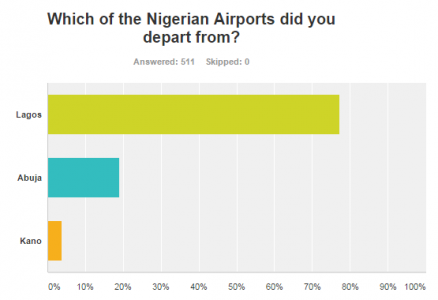
Murtala Muhammed International Airport was a forerunner in negative sentiment with 77% of the survey respondents citing Lagos as the airport they travel through most regularly. Survey respondents ranked a lack of facilities (59%), general conduct of officers of the force such as Immigration, Port Health, Customs (57%) and careless handling of luggage (44%) as the top pain points of travelling through our airports.
Luggage
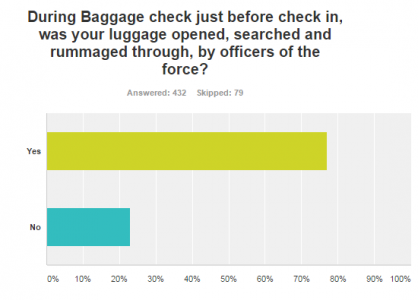
70% of survey respondents say they have experienced problems with their luggage either being “searched or rummaged through” at a Nigerian airport; most of these incidents occurring at Lagos (LOS), Abuja (ABV), Port Harcourt (PHC) and Kano (KAN) respectively.
Airport luggage searches are mandatory to protect against security threats and 55% of Nigerian travellers agree that the checks should not be abolished. However, most believe the way in which checks are conducted should be reviewed as the vast majority of innocent passengers don’t want to feel criminalised by the innocent contents of their baggage. In addition, modernising current methods of scanning luggage would serve to combat this annoyance and improve the quality of service delivery sans the “rough handling” which has become commonplace.
Airport experience
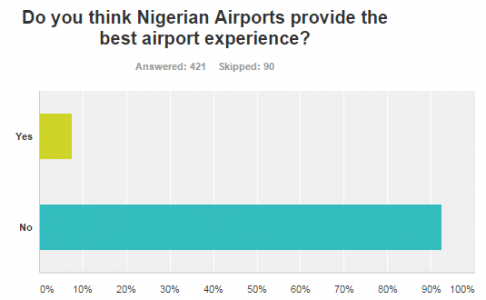
The survey determined that 92% of Nigerians feel the airport experience as a whole does not measure up to an acceptable standard. The airport experience should be aligned with the country’s tourism outlook if the Ministry of Culture, Tourism and National Orientation is to meet its goal of improving foreign arrivals in the country. For many passengers, transiting through hubs such as Lagos offers their first impression of the country and their perception is guided by what they experience at the airport. Compounding the grim outlook was a recent article by Business Day South Africa which reflected unfavourably on Nigerian airports, naming Lagos Airport the worst on the continent. Similarly, CNN ranked Port Harcourt Airport as the worst airport in the world in an article published in February 2016.
Improvements
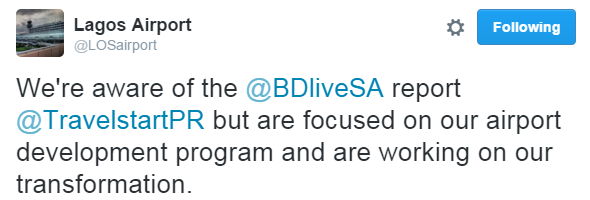
Those who responded to Travelstart’s survey were given the opportunity to comment on what features should be added or improved on to make for a better airport experience. Analysis of the responses showed that Wi-Fi, air conditioning, customer service and staff training are areas FAAN (Federal Airports Authority of Nigeria) could focus on to improve facilities and the overall experience. Many agree that airport authorities should upgrade technology to address inefficiencies – “The system needs to be more fluid, bearing in mind the volume of people travelling. The luggage check, annoying as it is, can’t be abolished because there are no luggage scanners but it is the biggest interrupter of the process,” one answer said. Lagos Airport authorities responded on Twitter saying, “We are focused on our airport development program and are working on our transformation.”
The 127.6-kilometre-long expressway connecting Ibadan, the capital of Oyo State andLagos State, popularly referred to as “Lagos-Ibadan expressway”, is the oldest and remains one of the busiest inter-state routes in West Africa. As major traffic artery, it has certainly hosted its share of accidents over the years.
While many have attributed the frequency of these accidents to the bad state of the road, there are other factors that play major roles in facilitating these accidental calamities. From drunk-driving to the negligence of road laws as well as speeding, these factors but can be adequately tackled and accidents prevented by taking key steps.
Jovago.com, Africa’s No.1 online hotel booking site throws light on steps motorists can take to avoid accidents on Lagos-Ibadan expressway.
Stay away from the ‘fast lane’.
It the expressway, so it feels natural to kick up your gear and soar…but remember that speed thrills and also kills. While on the expressway, keep a rein on your speed and stay in control of your vehicle.
Also, stay away from the fast lane and instead, use the center or right lane. Doing so ensures you have more escape routes should a problem suddenly arise that requires you to quickly change lanes. Actually, most of the accidents on the Lagos-Ibadan expressway occur in the left lane, so stay away already reduces your chances of being involved. An added perk is to stay away from the fast lane ensure that less conspicuous to the highway patrols and will not be flagged down so often.
Do not drive on drugs and alcohol
This may sound cliché but, alcohol and drugs, not just cocaine or intoxicants like marijuana but any kind of drug basically, alter the normal body system and so can impair judgments as well as slow down reflexes.
Driving under the influence of alcohol, marijuana or other drugs can cost you your license – or your life. So many accidents that have occurred on the expressway have been as a result of drivers who insisted on heading out while on drugs or alcohol. Even if you think it is just only one drink or one smoked joint, do not take the risk, stay off the wheel and save not just your life, but the life of others.
Check your vehicle before you set out. Know its limits.
A lot of drivers just set out with their vehicles, without first checking to see if the engine and brake are in perfect condition or the tires well inflated and screwed in. This negligence puts the driver as well as other motorists at risk. Drivers must ensure their vehicles are in good working condition- there should be no compromise on the quality of brakes and tires.
Aside from checking the engine, rate the performance limits of the vehicle. Pay attention to how your particular vehicle reacts in certain situations, how long it can last on the road and how many people plus cargo it can take per time. The risk of a fatal crash also increases with every additional passenger or luggage.
Ignore aggressive drivers, do not tailgate.
If you have driven past the Lagos-Ibadan expressway, you will be well aware of the kind of crazy drivers that parade the road. They are far from courteous and flaunt road rules with no remorse. They also like to challenge other drivers by doing such things as speeding recklessly or cutting other drivers off. Do not engage this kind of drivers or try to beat them at their own game, the best thing to do is to get as far out of their way as possible. Rather than play their games and get them even much more infuriated, slow down and let them pass. The quicker you can get them away from you, the safer you will be.
Do not tailgate any other vehicle or allow others to tailgate you. Leave a three-second cushion between you and the car in front of you and begin your journey early enough so you do not have to speed to make up time. Again, large tractor-trailers need extra space when making wide right turns, so, stay away from the right side of anyone you see on the expressway.
Lock your Mobile phones away. Avoid other in-car distractions.
Mobile phones are not the best companion on the road and should only be used for emergency purposes only. And even before being use, the driver should cut off motion and make a parking by the road side to take or make the call. Talking on the phone, while driving, is a straight ticket to an accident as it is extremely distracting.
If you must use your cell phone while driving, try a hands-free model or enable a Bluetooth connection with the car’s radio. It is important basically to avoid all forms of distractions, from loud music to doing things like eating or brushing your hair (yes, some people who actually do these things). If you are not concentrating solely on your driving, you will not be prepared for anything that is up ahead and you put yourself at risk of an accident.
The Niger Delta Development Commission, NDDC, has called for the support of the United States and other willing partners to achieve its goal of creating entrepreneurs and wealth across rural communities of the Niger Delta.
Speaking during a courtesy visit by a delegation from the United States Congress, the Acting Managing Director and Chief Executive Officer of the NDDC, Mrs Ibim Semenitari, said the Commission’s top priorities for the year 2016 were project completion, human capital development and settlement of indebtedness to contractors.
Semenitari, who stressed the need to change the orientation of people, so as facilitate the creation of entrepreneurs and wealth in the Niger Delta region, said: “We have noticed that there is poverty in the region because people do not have access to credit, if they want to engage in small scale farming, fishing or business. When they have access to credit, they do not have someone who can take them through the process of becoming entrepreneurs.”
“So for 2016, our focus will be on human capital development and also on creating wealth in the local communities. We will be looking at creating clusters of business people that will grow along the entire spectrum, from micro through small to medium scale,” said the NDDC Managing Director.
Noting that it would be virtually impossible for NDDC to undertake sustainable development of the Niger Delta region by itself, Semenitari said: “Whenever we are able to talk to people who are partners in development, it is always a great opportunity. We are shopping for partners who are willing to support us in the region to achieve our goals. Any kind of support is welcome.”
Giving further insight into goings-on and future plans of the Commission, the NDDC boss acknowledged the Commission’s indebtedness to so many contractors, adding that some of the debts date back to 2009. “We are trying to clear debts of N10 million and below up till 2013. That is our plan to exit our indebtedness to our contractors,” she said.
She said that since NDDC could not just focus on how to get out of debt, “we are looking to have a budget that focuses largely on project completion. So we hope that by the end of 2016, we would have completed a good number of our infrastructural development projects, as funds will allow us.”
The NDDC Acting Managing Director said: “We will start very few projects that must have very high impact on the people and we will be doing this with the consent of and after consultation with the people. To kick-start this we have asked the nine state governments to furnish us with what they thought were their needs for 2016.”
Earlier, the Staff Director, US House Sub-committee on Africa, Global Health, Global Human Rights and International Organisations, Mr Gregory Simpkins, who led the visiting delegation, said: “We came to speak with the NDDC, which is the major development catalyst in the Niger Delta region, to see what is happening and what is being planned for the future.”
Jaiz Bank Plc, the pioneer non-Interest (Islamic) bank in Nigeria, has concluded plans to go national.
The Bank’s Manager in Kaduna Halilu Murtala said additional branches would soon open in Lagos, Ibadan, Ilorin and Port Harcourt.
He said: “This is in line with the Approval-in-Principle issued to the bank by the Central Bank of Nigeria (CBN) to go national. With this approval, we intend to have presence is the six geopolitical zones to start with.
“We have already finalised arrangements in fulfilment of CBN’s requirements towards going national. As soon as the CBN gives its node, we will open in these locations for full banking. Our plan is to add at least ten more branches spread across the country before the end of this year.”
Jaiz Bank began operations in 2012, with only three branches in Abuja, Kano and Kaduna. As at the end of last year, the Bank increased its branch network to 19. He commented that the bank is ready to bring its specialized banking close to the door steps of Nigerians, Christians, Muslims, etc.
“We have SMEs and Retail products designed for critical segment of the society. Our philosophy is to better the life of all, irrespective of their tribal or religious background,” he said
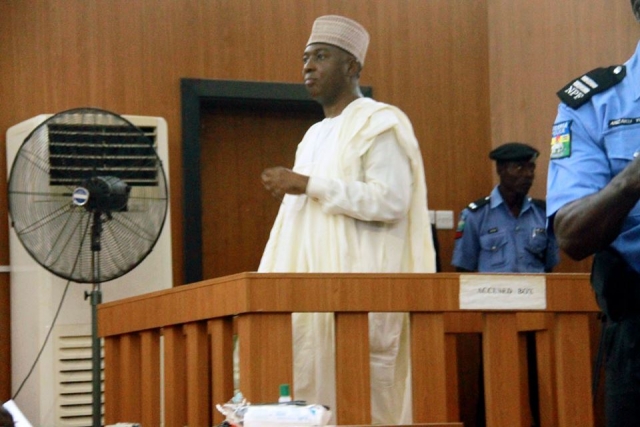
Senate President, Bukola Saraki at the Code of Conduct Tribunal
The Media Office of Senate President, Dr. Abubakar Bukola Saraki has disclosed alleged attempts by forces determined to nail him at all costs employing the tools of media and political blackmail.
The Senate President stated that he was ready for trial at the Code of Conduct Tribunal(CCT) and would prove his innocence.
“In this smear campaign, the anti-Saraki forces using their allies in the media have tended to rubbish reputations built by some individuals over several decades.
One of such individual was the respected former Chief Justice of Nigeria, Alfa Modibo Belgore who they falsely accused of trying to bribe judges on behalf of Dr. Saraki when nothing like that ever happened.
“We therefore call on members of the public to disregard the antics of these desperate and devilish elements. We assure all Nigerians and other observers of the Nigerian situation to be rest assured that the Senate President is ready to have his day in court.
His lawyers are ready to defend his right and prove his innocence.”
The Corporate Affairs Commission (CAC) has disclosed that it has commenced the process of delisting 38,717 dormant or portfolio companies from its register.
The commission’s Director of Public Affairs, Mr Churchill Williams, who made this known this in an interview with the News Agency of Nigeria (NAN) on Tuesday in Abuja, said the affected companies were those that failed to file their annual returns to CAC as required by sections 370 to 378 of the Companies and Allied Matters Act (CAMA), and that the move became necessary after the companies also failed to respond to several notices of de-registration from the commission through various channels.
According to him, a comprehensive list of the affected companies has been sent to all the state offices of the commission, newspaper publications, and has also been published on the commission’s website, to enable people check and then file their annual returns.
Churchill said that dormant companies impeded the efficiency of the commission to manage and provide better supervisory services in line with its mandate
According to him, an economy made up of largely dormant companies makes economic planning difficult.
Africa’s richest man and President, Dangote Group, Alhaji Aliko Dangote, controls 43 per cent of the Nigerian stock market.
According to reports, four of Dangote’s companies listed on the Nigerian Stock Exchange (NSE) had a market capitalisation of N3.832 trillion. This value is about 43 per cent of N8.91 trillion, which was the total capitalisation of the equities listed on the Nigerian bourse as at Monday.
An analysis of the companies indicate that Dangote Cement has the highest value of N2.862 trillion, which is 32 per cent of the total capitalisation of the equities market.
Dangote Sugar Refinery Plc trailed with N68 billion, while NASCON Allied a Industry Plc has N18 billion. Tiger Branded Consumer Goods has a value of N9.45 billion.
Dangote revealed that the company has recorded a 47 percent growth in sales volumes between January and February 2016.
He said the company can export up to $500 million worth of cement annually from Nigeria to neighboring West African countries. He disclosed that 2018 – 2020 there will be no need by Dangote Group of businesses to get foreign exchange from the Central Bank of Nigeria (CBN).
He further added that Dangote Sugar will stop imports of $1 billion worth of sugar into Nigeria in five year’s time.
The Speaker, Kwara State House of Assembly, Dr Ali Ahmad has disclosed that the state government has earmarked about N1bn for the completion of Ilorin phase II water reticulation project in the 2016 budget.
He expressed hope that once the on-going reticulation is completed, the water scarcity in Ilorin metropolis would be a thing of the past.
Ahmad added that the assembly would ensure judicious spending of every money allocated for projects in the 2016 budget through constant oversight function.
However, he challenged the leadership of the Ilorin Emirate Descendants Progressive Union(IEDPU) and other developmental associations to fashion out means of addressing the problem of open defecation in the state capital.
South African President, Jacob Zuma has pledged his commitment to help Nigeria in the generation of electricity even as he declared that it can also assist in the exploration of solid minerals. He said there is potential for greater business to business engagements between the two countries.
Zuma further stated that both countries must collaborate by diversifying their economies to create employment as this will further improve the impact that Africa can have in the global economy and to reconfigure the terms of trade.
“the diversification of the economy, namely electricity generation and supply, agriculture and agro-processing, tourism development including the hospitality sector, mining, banking, infrastructure development, aviation, manufacturing and the automotive sector.
He said by doing this, both countries would break away from the colonial legacy that has turned Africa into providers of primary commodities and recipients of processed goods.
“We must strive to bring the manufacturing plants closer to the sources of raw materials. South Africa and Nigeria can to a large extent, complement each other towards the achievement of this”, he pointed out.