KEY POINTS
- Oil prices surged after U.S. President Donald Trump rejected Iran’s response to a U.S.-backed peace proposal.
- The standoff has heightened fears that the conflict could continue disrupting shipping through the Strait of Hormuz, a critical global energy route.
- Iran has demanded an end to hostilities, sanctions relief, and guarantees over regional security, while the U.S. and its allies remain divided over the next steps.
MAIN STORY
Global oil prices climbed sharply on Monday after U.S. President Donald Trump swiftly rejected Iran’s response to a U.S.-brokered peace proposal, deepening concerns over the ongoing conflict and disruptions to global energy supplies.
The development intensified fears that the 10-week-old conflict could drag on, prolonging instability around the Strait of Hormuz, a strategic maritime corridor through which roughly one-fifth of the world’s oil and liquefied natural gas supplies previously passed before the outbreak of hostilities.
Days after Washington proposed a framework aimed at restarting negotiations, Iran released a response on Sunday calling for an end to the conflict across all fronts, including in Lebanon, where U.S. ally Israel continues military operations against the Iran-backed Hezbollah.
Tehran’s proposal also demanded compensation for war-related damages, recognition of its sovereignty over the Strait of Hormuz, an end to the U.S. naval blockade, guarantees against future attacks, the lifting of sanctions, and the removal of restrictions on Iranian oil exports.
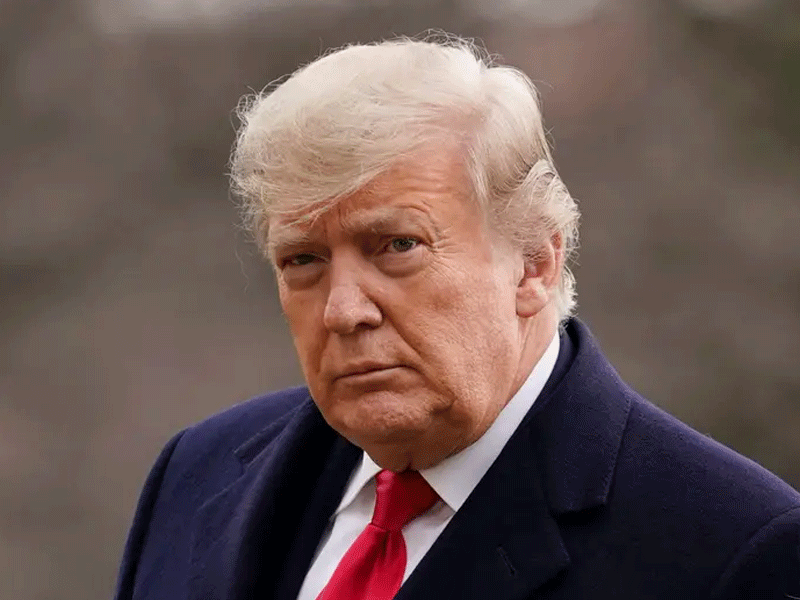
However, Trump dismissed the proposal within hours through a post on Truth Social.
“I don’t like it. Totally unacceptable,” Trump wrote, without providing further details.
The United States had reportedly sought an immediate cessation of hostilities before entering broader negotiations covering contentious issues such as Iran’s nuclear programme.
Responding on Monday, Iranian Foreign Ministry spokesperson Esmaeil Baghaei defended Tehran’s conditions, describing them as legitimate demands.
“Our demand is legitimate: demanding an end to the war, lifting the U.S. blockade and piracy, and releasing Iranian assets that have been unjustly frozen in banks due to U.S. pressure,” Baghaei said.
He added that ensuring safe passage through the Strait of Hormuz and restoring regional security constituted “a generous and responsible offer.”
Oil prices reportedly surged by about four dollars per barrel before easing slightly later in the day as uncertainty surrounding the conflict continued to unsettle global energy markets.
Shipping through the strait has significantly declined since the conflict began on Feb. 28, with maritime data providers Kpler and LSEG reporting that only a handful of crude tankers exited the waterway last week, many reportedly switching off tracking systems to avoid potential attacks.
Although a ceasefire implemented in early April has reduced full-scale military confrontations, sporadic flare-ups near the strategic waterway have continued to threaten regional stability and global trade routes.
The conflict is also emerging as a domestic political challenge for Trump ahead of key U.S. elections, as rising fuel prices fuel public dissatisfaction and economic pressure.
Washington has reportedly struggled to secure broader international military backing, with NATO allies unwilling to deploy naval forces to reopen the waterway without a comprehensive peace agreement and an internationally mandated mission.
Meanwhile, Turkey’s Foreign Minister, Hakan Fidan, is expected to visit Qatar on Tuesday for talks involving the United States, Iran, and mediator Pakistan on de-escalation efforts and navigational safety in the Gulf.
Trump is also expected to arrive in Beijing on Wednesday for discussions with Chinese President Xi Jinping, where the Iran conflict and its impact on global energy supplies are expected to feature prominently.
Washington has been urging China to use its influence to pressure Tehran toward a diplomatic agreement.
However, Baghaei suggested Beijing could instead challenge U.S. actions in the Gulf region.
“Our Chinese friends know very well how to use these opportunities to warn about the consequences of the U.S.’s illegal and bullying actions on regional peace and security,” he said.
Addressing the conflict, Trump stated in remarks aired on Sunday that although Iran had suffered major setbacks, the confrontation was not necessarily over.
“They are defeated, but that doesn’t mean they’re done,” he said.
Israeli Prime Minister Benjamin Netanyahu also maintained that the conflict could not end until Iran’s enriched uranium stockpiles, nuclear facilities, proxy networks, and ballistic missile capabilities were addressed.
Speaking to CBS News’ “60 Minutes,” Netanyahu said diplomacy remained preferable but did not rule out further military action.
Iranian President Masoud Pezeshkian, meanwhile, insisted that Tehran would “never bow down to the enemy” and would continue defending its national interests.
Regional tensions remained high on Sunday, with the United Arab Emirates reporting the interception of two drones launched from Iran, while Qatar condemned a drone strike targeting a cargo vessel in its waters.
Kuwait also announced that its air defence systems had intercepted hostile drones entering its airspace.
THE ISSUES
The continued conflict threatens global energy stability, with disruptions in the Strait of Hormuz posing major risks to oil supplies, shipping operations, and international trade.
Analysts warn that prolonged instability in the Gulf could trigger sustained increases in oil prices, worsen inflation globally, and deepen geopolitical tensions involving major world powers.
The crisis also reflects broader concerns over nuclear diplomacy, regional proxy conflicts, and the growing militarisation of strategic waterways critical to global commerce.
WHAT’S BEING SAID
The United States insists that Iran must agree to broader negotiations and security guarantees before sanctions relief and diplomatic normalisation can proceed.
Iran, however, maintains that any peace agreement must include guarantees against future attacks, the lifting of sanctions, and recognition of its regional security concerns.
Global leaders and energy analysts are warning that failure to secure a diplomatic breakthrough could further destabilise the Middle East and international energy markets.
WHAT’S NEXT
Diplomatic engagements involving the United States, Iran, Turkey, China, and regional actors are expected to continue in the coming days as efforts to prevent further escalation intensify.
Global markets will also closely monitor developments surrounding the Strait of Hormuz and oil supply disruptions.
The outcome of Trump’s upcoming talks with Xi Jinping may also shape future diplomatic efforts and international pressure on Tehran.
BOTTOM LINE
Trump’s rejection of Iran’s peace proposal has heightened fears of a prolonged conflict in the Gulf, driving up oil prices and increasing uncertainty over global energy supplies. With tensions around the Strait of Hormuz remaining high, world powers are under growing pressure to secure a diplomatic resolution before the crisis further disrupts regional stability and the global economy.