





Key points
- The Federal Government will tap into the €59 million West Africa Sustainable Ocean Programme (WASOP) to tackle illicit and unmonitored fishing operations.
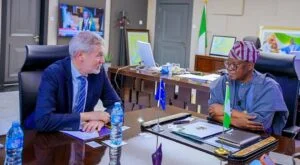
- Marine and Blue Economy Minister Adegboyega Oyetola held a diplomatic strategy session in Abuja with European Union Ambassador Gautier Mignot to cement the agreement.
- Official statistics identify illegal, unreported, and unregulated (IUU) fishing as a direct hazard that degrades coastal economies and damages national food sovereignty.
- The regional EU-backed fund is structured to improve tactical collaboration among West African coastal states and protect fragile marine ecosystems.
- Beyond counter-piracy operations, the administration is seeking specialized technical assistance from European partners to upgrade deep-sea surveillance networks.
Main Story
Nigeria is set to intensify its crackdown on unauthorized maritime activities by leveraging the €59 million European Union-funded West Africa Sustainable Ocean Programme.
The strategic integration plan was finalized during a high-level diplomatic meeting in Abuja between the Minister of Marine and Blue Economy, Dr. Adegboyega Oyetola, and the EU Ambassador to Nigeria, Gautier Mignot. According to a state communiqué distributed from Lagos by the ministry’s executive secretariat on Sunday, both jurisdictions pledged to significantly step up operational actions regarding sustainable ocean governance and defensive patrolling throughout the Gulf of Guinea.
The intervention comes at a critical time when the domestic blue economy is seeking to aggressively upgrade its enforcement capabilities. Government officials explained that the newly accessed international fund offers an ideal framework to secure advanced technical assistance and financial backing. The primary goal is to establish robust monitoring infrastructure capable of tracking down international trawlers operating illegally within territorial waters, which continually disrupts local food supplies and harms delicate aquatic habitats.
Simultaneously, the ministry is using the opportunity to drive institutional updates outlined under its National Policy on Marine and Blue Economy. While recent state interventions have successfully enhanced cargo port logistics and decreased regional sea piracy, regulators are urging global development partners to expand their scope of cooperation. Moving forward, the joint security architecture aims to address a wider range of maritime challenges, including cross-border human trafficking, environmental degradation, and deep-sea commercial tracking.
The Issues
- Dismantling sophisticated, unregulated foreign fishing fleets that continuously bypass local maritime boundaries.
- Shifting international maritime support from basic anti-piracy patrolling to tracking complex environmental and tracking crimes.
- Installing advanced, real-time satellite surveillance hardware across vast territorial waters with limited coastal security personnel.
What’s Being Said
- Outlining the national security and socioeconomic dangers tied to unchecked maritime resource theft, the Minister of Marine and Blue Economy, Dr. Adegboyega Oyetola, warned: “Illegal, unreported and unregulated fishing is a direct threat to national security, food sovereignty and the survival of our coastal communities.”
- Emphasizing the state’s resolve to protect local fishermen and marine resources, Oyetola added: “We cannot afford to stand by and watch our marine ecosystems depleted and economic livelihoods eroded.”
- Demanding an aggressive, tech-driven international approach to permanently halt illicit syndicates, Oyetola stated: “We are calling for an era of stronger international collaboration, backed by aggressive monitoring and uncompromising enforcement systems. This is necessary to permanently dismantle these illicit operations and safeguard our waters,”
What’s Next
- Technical working groups from Nigeria and the European Commission will convene to map out funding allocations for surveillance assets.
- The Ministry of Marine and Blue Economy will begin updating fisheries tracking systems using the incoming technical support.
- Neighboring West African coastal nations will hold synchronization meetings under the WASOP framework to harmonize deep-sea enforcement laws.
Bottom Line
Nigeria is partnering with the European Union to utilize the €59 million WASOP fund, with Minister Oyetola demanding aggressive monitoring systems to dismantle illegal fishing operations that threaten food security in the Gulf of Guinea.