





Keypoints
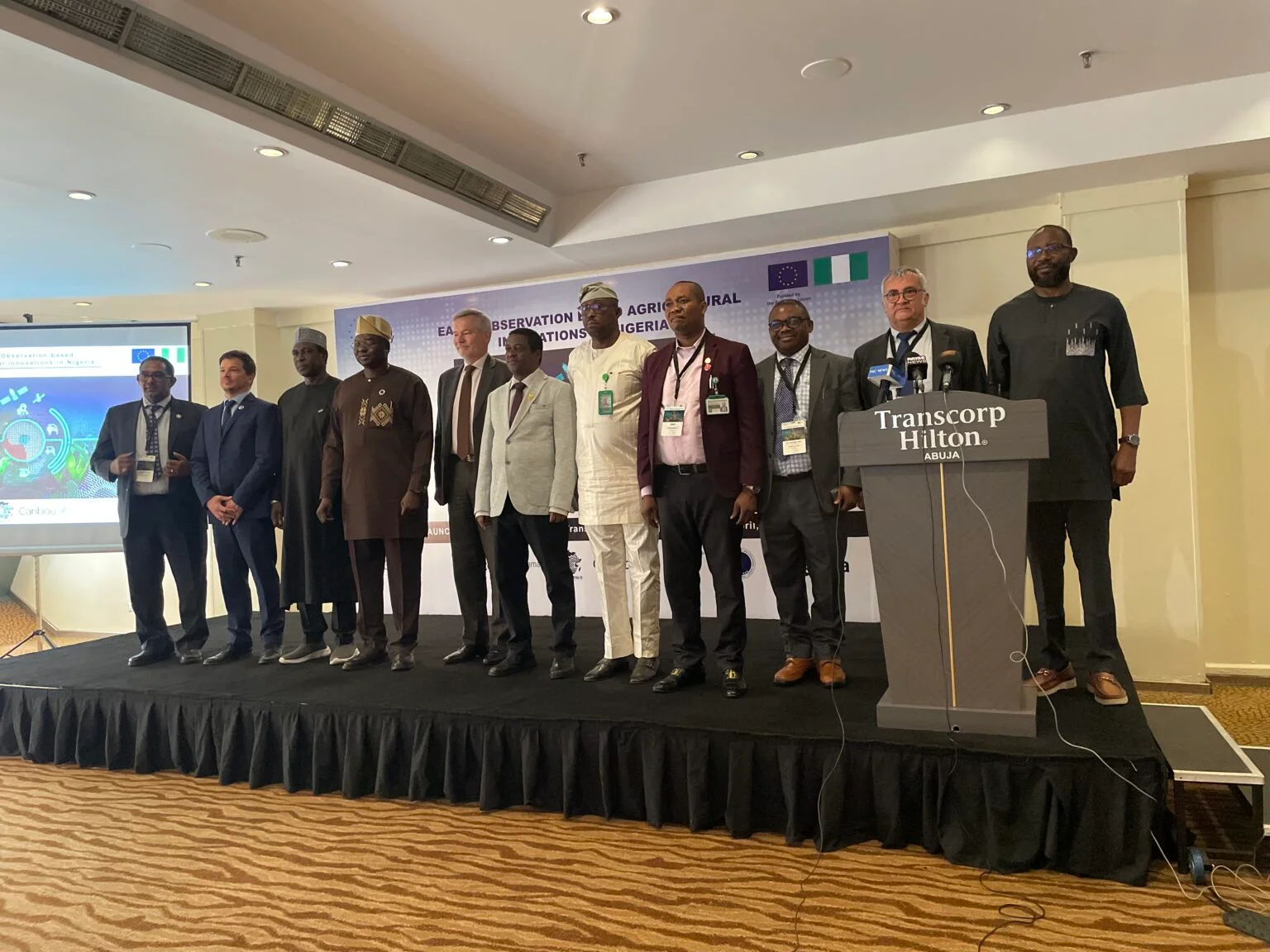
- The Federal Government and the European Union (EU) have inaugurated a £2.7 million Earth Observation (EO) Agricultural Innovation Project in Abuja.
- Jointly implemented by NASRDA and the European Space Agency (ESA), the initiative uses satellite data to drive climate-smart agriculture.
- The project will run for three years and deploy AI-based tools, IoT devices, and satellite imagery to help farmers and herders improve productivity.
- Seven states (Kano, Bauchi, Plateau, Oyo, Enugu, Cross River) and the FCT have been selected as demonstration hubs across Nigeria’s agro-ecological zones.
- Key features include a web dashboard, mobile app, and voice-based AI advisory services to provide real-time data to rural farmers.
Main Story
Nigeria is turning to the stars to solve its down-to-earth food security challenges. On Thursday, the Ministry of Science, Technology, and Innovation, alongside the European Union, launched a £2.7 million project designed to modernize the nation’s farming systems through space technology.
Dr. Kingsley Udeh, the Minister of Science and Tech, described the inauguration as a “defining moment,” noting that traditional farming must now shift toward a data-driven paradigm to combat climate change and land degradation.
The initiative, funded under the EU Global Gateway strategy, leverages the technical expertise of the National Space Research and Development Agency (NASRDA) and the European Space Agency.
By using Earth Observation (EO) satellites, the project will provide scalable data for crop monitoring and environmental risk assessment. NASRDA Director-General Dr. Matthew Adepoju emphasized that the goal is to translate complex satellite data into “practical solutions” that can be easily understood by smallholder farmers on the ground.
The Issues
The primary challenge is the digital-literacy gap; while satellite data is sophisticated, translating it into actionable advice for rural farmers who may not use smartphones is a significant hurdle. Authorities must solve the problem of connectivity in remote areas, as the IoT devices and AI tools planned for the seven demonstration states require stable internet infrastructure to transmit data. Furthermore, there is a data-sustainability risk; once the three-year EU funding cycle ends, NASRDA must ensure the open-source agricultural information system remains funded and updated by the Nigerian government. To succeed, the project’s “voice-based AI advisory” must be available in local languages to ensure inclusivity for non-literate populations.
What’s Being Said
- “EO technologies provide accurate, timely and scalable data that can improve crop monitoring and evidence-based decision-making,” stated Dr. Kingsley Udeh.
- EU Ambassador Gautier Mignot explained the choice of partner: “The EU chose to work with Nigeria because the country was advancing in technology.”
- Sen. Abubakar Kyari, Minister of Agriculture, highlighted that satellite imagery will finally allow for “accurate soil mapping and crop yield forecasting” at a national scale.
What’s Next
- Demonstration farms in the seven selected states and the FCT are expected to begin receiving IoT sensor installations in the third quarter of 2026.
- The AI advisory platform is anticipated to undergo beta testing with a select group of farmers to refine the voice-based SMS alerts.
- Training sessions for NASRDA staff and extension workers will likely ramp up to ensure the human capacity exists to manage the new satellite data systems.
- A mid-term review of the project’s impact on food security in the pilot states is expected by early 2027 to determine if the model can be scaled nationwide.
Bottom Line By merging European space expertise with Nigerian agricultural needs, this £2.7 million investment aims to turn “farming by intuition” into “farming by information.” If successful, the project will not only boost yields but also cement Nigeria’s position as the continent’s primary hub for agricultural innovation.