






By Paul Onehi
Despite a marginal 0.02 percent decline on Thursday, negative market breadth and sustained selling pressure point to lingering caution among investors, while a 20-stock watchlist records no qualifying extreme price declined.
Nigeria’s equities market may have recorded only a marginal decline on Thursday, but the figures behind the closing index tell a more complicated story about investor confidence, market direction and the risks facing shareholders.
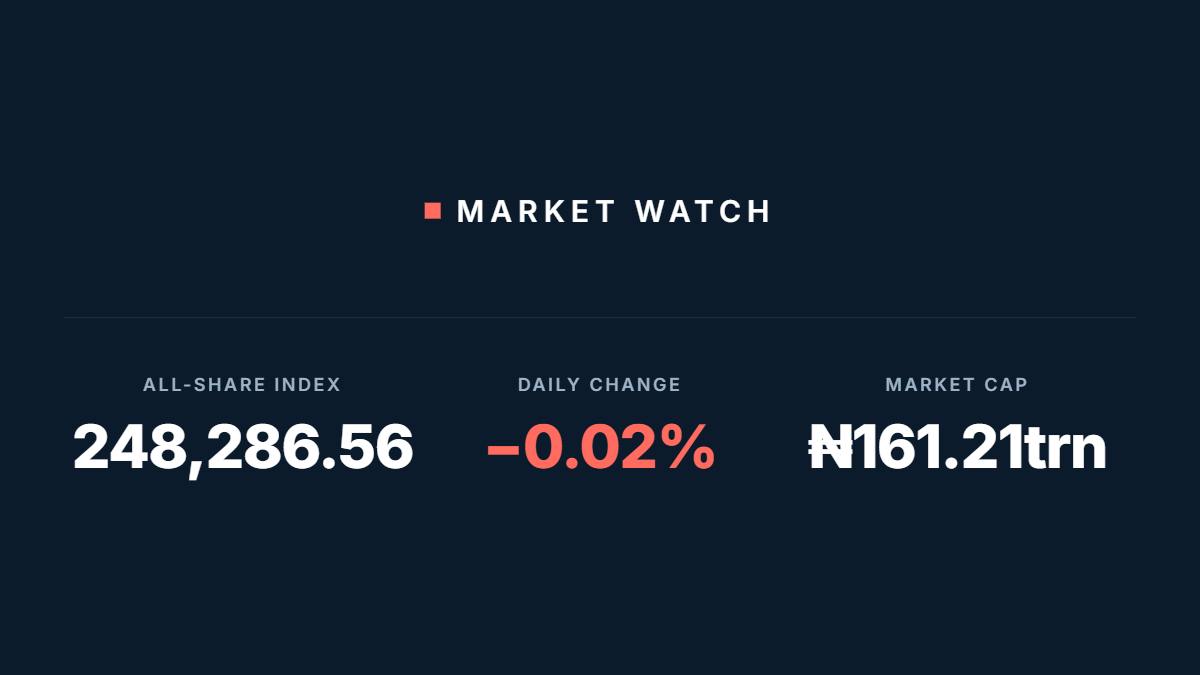
The Nigerian Exchange (NGX) All-Share Index, the benchmark used to measure the overall performance of listed equities, declined by 43.09 points, representing 0.02 per cent, to close at 248,286.56 points on November 19, 2026.
Market capitalization, which represents the combined market value of listed companies’ shares, also fell by approximately ₦27.98 billion to ₦161.21 trillion.
On the surface, the decline appears modest. However, Thursday’s performance came after a difficult stretch for the market, during which investors lost approximately ₦2.93 trillion in market value over three trading sessions.
The development raises a more important question than whether the market closed in the red: Are investors simply taking profits after a strong rally, or is the market beginning to experience a deeper reassessment of share valuations?
One important indicator deserves closer attention: market breadth.
Market breadth measures the number of stocks that appreciated compared with those that declined during a trading session. It helps investors understand whether market gains or losses are concentrated in a few large companies or spread across the wider market.
On Thursday, 26 stocks declined, while 19 advanced.
In practical terms, more stocks lost value than gained it. This suggests that the negative sentiment was not confined to a single company or sector.
Nevertheless, a negative market breadth does not automatically mean that every investor is selling or that the entire market is entering a prolonged downturn. It is an indication of the balance between advancing and declining stocks during that particular session.
Trading activity also moderated. Approximately 372 million shares valued at ₦14.37 billion changed hands in 28,429 deals.
The decline in trading volume and transaction value suggests that market participation was lower than in the preceding session. While reduced activity can accompany investor caution, it does not, on its own, establish the reason behind the slowdown.
A closer examination of 20 selected NGX stocks across banking, telecommunications, manufacturing, energy, consumer goods, pharmaceuticals and other sectors provides another perspective.
The watchlist comprises NAHCO, NASCON, Unilever Nigeria, UACN, Seplat Energy, MTN Nigeria, Aradel Holdings, TIP, Jaiz Bank, Zenith Bank, GTCO, First HoldCo, UPDC REIT, CWG, HBMNG, Dangote Cement, Airtel Africa, Fidson Healthcare, May & Baker and PZ Cussons.
Data compiled by GTI Research for Thursday’s trading session show that none of the 20 stocks recorded a daily decline within the 8 to 10 per cent threshold established for this monitoring exercise.
This is significant because the exercise is designed to identify unusually sharp price corrections that may warrant further investigation.
However, the absence of such declines should not be interpreted as evidence that all the stocks performed positively. Some declined modestly, others appreciated, while several closed at their previous session’s prices.
For instance, TIP fell by 1.18 per cent, closing at ₦25.20 from ₦25.50 in the previous session. Zenith Bank appreciated by 0.62 per cent, moving from ₦113 to ₦113.70, while HBMNG gained 0.82 per cent to close at ₦345.80 from ₦343.
The remaining stocks recorded no change in their closing prices, according to the published daily price list.
These movements illustrate why investors must distinguish between a stock that is declining, one that is appreciating and one that is simply maintaining its previous closing price.
An unchanged closing price does not necessarily mean that a stock attracted no investor interest. Several securities recorded transactions and trading volume despite closing at the same price as in the preceding session.
In stock market discussions, the expression ‘buy the dip’ describes an investment approach in which investors consider purchasing shares after a significant price decline, usually in anticipation of a recovery.
But a declining share price is not, by itself, proof that a stock has become undervalued.
A company may experience a sharp decline because of temporary market pressure, profit-taking or broader investor sentiment. Alternatively, the fall may reflect deteriorating earnings, rising debt, regulatory difficulties, weak business performance or other company-specific problems.
The distinction matters. A price correction caused by temporary market conditions may present a different investment situation from one driven by weakening fundamentals.
This is why the watchlist uses a narrow daily decline threshold of between 8 and 10 per cent as an alert mechanism rather than an automatic instruction to buy.
When a stock enters that range, the next step should be to examine its financial statements, corporate announcements, regulatory disclosures and relevant market developments.
Where no credible explanation is available, the appropriate conclusion is to acknowledge that no verified catalyst has been established rather than attribute the decline to rumours or speculation.
The immediate concern for market participants is whether the recent selling pressure will continue or begin to ease.
Investors should pay attention to three important indicators. First rst is market breadth. A sustained improvement in the number of advancing stocks could suggest that buying interest is returning beyond a handful of large-cap companies.
Second is trading activity. A recovery in turnover, supported by improving prices, could provide stronger evidence of renewed participation.
Third is company-specific performance. Investors should monitor corporate earnings, dividend announcements, capital-raising activities, regulatory disclosures and other developments capable of influencing individual share prices.
For companies such as Dangote Cement, Seplat Energy, Aradel Holdings, MTN Nigeria and the major banking stocks, movements in their individual share prices should also be examined against their respective financial and operational developments.
The broader economic environment remains relevant as well. Inflation, interest rates, exchange-rate movements, government policy and the cost of doing business can influence corporate profitability and investors’ appetite for equities.
However, these factors should not be presented as the direct cause of an individual stock’s decline without supporting evidence.
Thursday’s trading session demonstrates an important reality about the Nigerian capital market: the headline index does not always tell the complete story.
A 0.02 percent decline may appear insignificant when viewed independently, but the preceding erosion of approximately ₦2.93 trillion in market capitalization over three sessions, alongside negative market breadth, deserves attention..
Equally, the absence of an extreme decline among the 20 monitored stocks does not mean that investors should become complacent.
For investors, the priority should be understanding why a share price moves, whether the underlying business remains financially sound and whether the prevailing market price reflects the company’s actual prospects.
A cheaper share is not automatically a better investment. Sometimes, the market is presenting an opportunity; at other times, it is signaling a risk that deserves closer examination.
Ultimately, successful investing requires more than reacting to red and green figures on a trading screen. It requires patience, reliable information, an understanding of company fundamentals and the discipline to separate market noise from meaningful developments.