







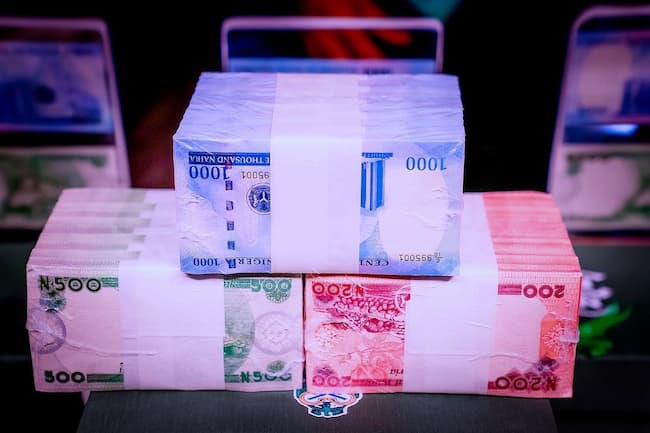
The official exchange rate of the naira weakened by N13 to settle at N1,609.63 per US dollar, following a $270 million intervention by the Central Bank of Nigeria (CBN) in the foreign exchange market.
Data from the CBN’s foreign exchange platform showed that the local currency declined from N1,596.68 to N1,609.63 per dollar over the course of the week at the Nigerian Foreign Exchange Market (NFEM).
However, the FMDQ FX spot rate recorded a slight appreciation, climbing 9 basis points to close at N1,607.20. Meanwhile, in the parallel market, the naira hovered around N1,620 as market participants speculated that the central bank may halt dollar sales to Bureau De Change (BDC) operators by May.
Trading in the USD/NGN currency pair was marked by volatility throughout the week, opening on a bullish note as falling crude oil prices reignited foreign exchange demand among both domestic and international market players.
The pair reached intraday peaks of N1,614 but eventually closed within the N1,604–N1,610 range. To mitigate the pressures on the local unit and maintain market liquidity, the CBN injected an estimated $270 million in several trading sessions, according to AIICO Capital Limited.
Market analysts noted that sporadic foreign exchange inflows from exporters also contributed to easing the pressure. Nevertheless, the naira depreciated by N13 on a week-on-week basis to close at N1,609.63, CBN figures revealed.
Experts at AIICO Capital maintained that the CBN’s consistent interventions would likely stabilize the naira around its current level, assuming no major external disruptions. In the forward contracts market, the naira strengthened across the board amid reports that Nigeria is no longer listed as a debtor by the International Monetary Fund (IMF).
The 1-month forward rate appreciated by 0.2% to N1,641.59, while the 3-month rate also rose by 0.2% to N1,707.37. The 6-month forward rate gained 0.8% to close at N1,799.21, and the 1-year contract increased by 1.7% to N1,988.66.
Cordros Capital remarked in a report that continued global economic uncertainty could pose downside risks to the naira in the short term due to its impact on capital inflows. However, a relatively healthy level of external reserves may empower the CBN to sustain market interventions and curb excessive exchange rate fluctuations.
Despite persistent volatility in global oil markets and ongoing CBN interventions, Nigeria’s foreign reserves inched higher by $86.66 million on a weekly basis to reach $38.09 billion.
Global oil prices ended the week on a positive note, as easing tensions between China and the United States—two of the world’s largest oil consumers—boosted investor sentiment. The United Kingdom’s announcement of a “breakthrough” trade agreement with the US also contributed to bullish sentiment.
Brent crude rose by $1.07 or 1.7% to settle at $63.91 per barrel, while US West Texas Intermediate gained $1.11 or 1.85% to $61.02 per barrel. On a weekly basis, both benchmarks recorded gains of over 4%.
Gold prices also climbed more than 1% on Friday, buoyed by a softer US dollar and market reactions to President Donald Trump’s latest tariff comments ahead of a scheduled meeting with Chinese officials. Spot gold rose 1.4% to $3,341.71 per ounce, posting a nearly 3% increase over the week.
Market watchers anticipate that a confirmed date for US-China trade talks, along with any mutual tariff reductions, could lift investor confidence and push crude oil prices higher by $2–$3 per barrel.