










KEY POINTS
- Lotus Bank has disbursed ₦3.2 billion to Zanoplus for the deployment of solar mini-grids across four locations in Bauchi State.
- The projects will provide a combined 1.2MWp of distributed renewable energy capacity, targeting communities in Gabarin East, Futuk, Gangalawai, and Daburai.
- This follows a previous ₦7.4 billion disbursement to Ventura Logistics Services under the Distributed Access through Renewable Energy Scale-up (DARES) Program.
- The Rural Electrification Agency (REA) MD, Abba Aliyu, highlighted the speed and transparency of the performance-based financing framework as a “clear message” to investors.
MAIN STORY
The Managing Director of the Rural Electrification Agency (REA), Abba Aliyu, announced a significant milestone on Thursday, March 19, 2026, confirming that Lotus Bank has disbursed ₦3.2 billion to Zanoplus.
The funding is specifically earmarked for the rapid deployment of solar mini-grids in Bauchi State, marking the second major capital release under the ₦100 billion DARES financing facility. The project is set to deliver a total of 1.2MWp of clean energy, providing electricity to rural clusters that have long been underserved by the national grid.
According to Aliyu’s statement, the projects include Gabarin East (450kWp), Futuk (400kWp), Gangalawai (200kWp), and Daburai (150kWp). He emphasized that the primary success factor is the speed and transparency of the execution, which demonstrates the “vibrancy of local financing capacity” being catalyzed by the REA.
This performance-based model ensures that capital flows only to projects that are technically ready and aligned with strict delivery milestones, thereby de-risking the sector for commercial lenders.
The Lotus Bank Zanoplus disbursement is seen as a pivotal step in scaling the DARES framework, which aims to provide electricity to 17.5 million Nigerians. By having local financial institutions like Lotus Bank step forward as drivers rather than just participants, the agency believes it is creating a sustainable market for renewable infrastructure. For developers and investors, this active pipeline signals that the Nigerian market is responding to structured energy transition models.
WHAT’S NEXT
- Zanoplus is expected to begin immediate site mobilization in the four Bauchi communities, with a goal to achieve first-power within the next six months.
- The REA is reportedly processing the next set of Performance-Based Grants (PBG) for other qualified Renewable Energy Service Companies (RESCOs).
- Following Lotus Bank’s lead, other Tier-1 and Tier-2 Nigerian banks are expected to announce dedicated renewable energy desks to tap into the $750 million DARES facility.
WHAT’S BEING SAID
- “What is important here is not just the projects, but the speed and transparency of execution,” stated Abba Aliyu, MD of the REA.
- “This is exactly how a performance-based financing framework is meant to work—capital flowing to projects that are ready,” Aliyu added via his social media today.
- “Nigerian financial institutions are stepping forward not just as participants, but as drivers of infrastructure,” noted a renewable energy investment analyst.
BOTTOM LINE
The Bottom Line is that performance-based financing is finally unlocking the “deadlock” between banks and energy developers. With ₦10.6 billion now moved by Lotus Bank alone in just weeks, the DARES program is proving that local capital can solve local energy poverty when the regulatory and financial guardrails are transparent.



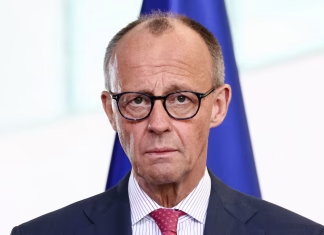







, Abba Aliyu, announced a significant milestone on Thursday, March 19, 2026, confirming that Lotus Bank has disbursed ₦3.2 billion to Zanoplus.)