By Boluwatife Oshadiya | July 21, 2026
KEY POINTS
- Harry Kane finished the 2025–26 season with 73 goals across all competitions for club and country, the second-best scoring output by any player since the turn of the millennium
- Spain won the 2026 FIFA World Cup, defeating Argentina 1–0 in extra time, with Rodri named Player of the Tournament and Lamine Yamal at the centre of a fresh Ballon d’Or debate
- The 70th Ballon d’Or ceremony will be held on October 26, 2026, in London — the first time the prestigious award leaves its traditional home of Paris — with Kane now the clear betting favourite
- At least 20 players have staked legitimate claims over the course of the 2025–26 campaign, making this the most open Golden Ball race in almost two decades
- Spain’s World Cup triumph adds enormous weight to the cases of Rodri, Yamal, Pau Cubarsi, Mikel Oyarzabal, and Fabian Ruiz, complicating an already extraordinary field
MAIN STORY
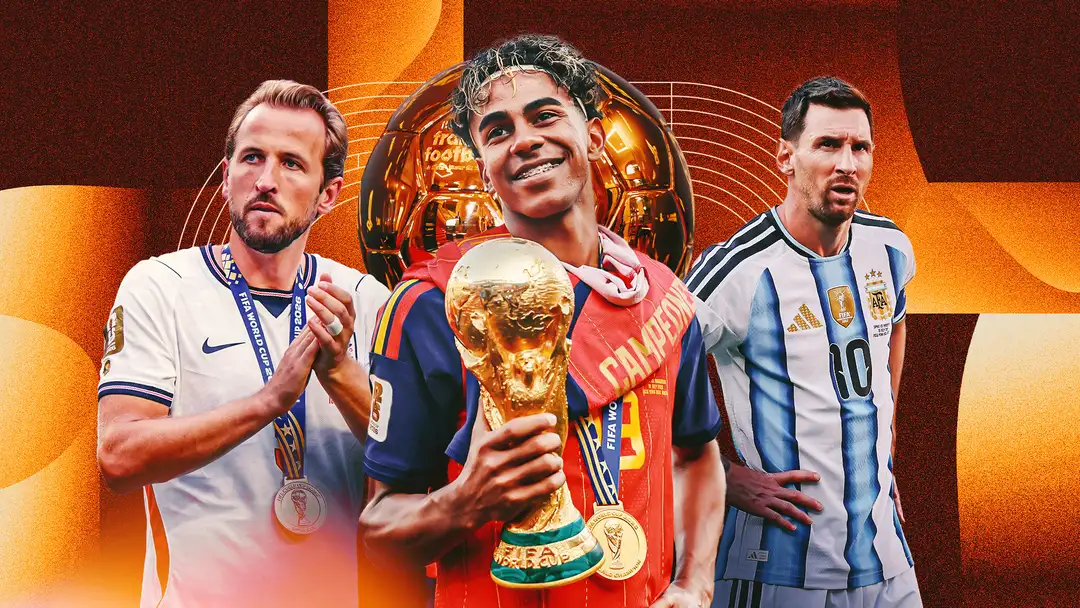
The Ballon d’Or has rarely felt so fiercely contested as it does in 2026. With the suffocating Lionel Messi–Cristiano Ronaldo duopoly that defined the award for nearly 20 years now firmly in the rearview mirror, football’s most prestigious individual honour has entered a new era of extraordinary competition. Ousmane Dembele, of Paris Saint-Germain, claimed the Golden Ball in 2025 following PSG’s historic Champions League triumph, becoming the first man since Messi in 2021 to win the award back-to-back. Now, as the 2025–26 season concludes with the curtain falling on the 2026 FIFA World Cup in North America, the stage is set for what many observers believe will be the most fiercely debated Ballon d’Or ceremony in the modern era — one to be held on October 26 in London, the first time in the award’s 70-year history that the ceremony takes place outside Paris.
At the summit of football’s individual mountain stands Harry Kane. The Bayern Munich and England striker has produced a season of such relentless, almost inhuman, goal-scoring brilliance that even his fiercest critics have struggled to mount a serious argument against his candidacy. Kane registered 73 goals and eight assists across all competitions for club and country during the 2025–26 campaign — a tally that, according to the Bundesliga’s own records, is the second-best scoring output by any player since the year 2000, surpassed only by Lionel Messi’s staggering 82-goal haul in the 2011–12 season. He scored 36 goals in the Bundesliga alone, winning the Torjägerkanone — the German top-flight’s golden boot — for the third consecutive season, a feat achieved previously only by the legendary Robert Lewandowski. He hit 14 Champions League goals and notched 61 goals in all competitions for Bayern Munich across 51 club appearances, then added six more for England during the Three Lions’ run to the 2026 World Cup semi-finals in North America. In February, he passed the remarkable milestone of 500 career senior goals.
Yet for all that, football’s Golden Ball race has never been just about goals. And Spain’s World Cup victory — achieved with a 1–0 extra-time triumph over Argentina in the final at New York New Jersey Stadium, courtesy of a Ferran Torres strike in the 106th minute — has dramatically complicated the picture
THE ISSUES
The Messi–Ronaldo vacuum and a 20-player field
The end of the Messi–Ronaldo era has not simplified the Ballon d’Or — it has exploded it. For roughly 16 years, the award was, with only the occasional exception, a two-horse race. That era ended with the emergence of Vinicius Junior, Jude Bellingham, Erling Haaland, and a new generation who no longer feel constrained by those two shadows. The 2026 edition is the product of that opening up: a season in which at least 20 players across five leagues and multiple international tournaments made credible cases for the Golden Ball.
The World Cup effect — and its structural ambiguity
World Cup years have always tilted the Ballon d’Or balance. In 2022 and 2023, Messi’s Argentina triumph ultimately delivered him an eighth Golden Ball at Inter Miami. The fundamental tension in 2026 is this: does individual goal-scoring brilliance across an entire season outweigh a player’s role in a winning team at the sport’s biggest tournament? Kane’s 73-goal campaign for Bayern and England dwarfs any individual output in the field. But Rodri won the World Cup Golden Ball, and Spain’s tournament triumph has injected at least five of La Roja’s players into serious Ballon d’Or contention. Historically, the award has tended to reward individual output more than collective success — but that principle has proven malleable when the player in question was the orchestrating force behind a World Cup triumph.
The Champions League factor and the PSG cluster
Paris Saint-Germain won their second consecutive Champions League title in 2025–26, with Dembele once again scoring in the final — a victory achieved at Arsenal’s expense. That success means a cluster of PSG players, including Vitinha, Khvicha Kvaratskhelia, Fabian Ruiz, and Achraf Hakimi, carry impressive trophy hauls into the voting. Kvaratskhelia, in particular, produced one of the great individual Champions League knockout campaigns, becoming the first player in the competition’s history to score or assist in seven consecutive knockout matches. The absence of a World Cup for Georgia, however, places a ceiling on his ambitions. For Kane, PSG’s elimination of his Bayern side in the Champions League semi-finals remains the most significant hole in an otherwise remarkable CV.
WHAT’S BEING SAID
The Ballon d’Or conversation around Kane has been building since before the World Cup began, with the bookmakers consistently placing him at the head of the market.
“Kane is unstoppable right now,” noted Coral, the British bookmaker, after Kane’s brace against DR Congo — his fourth and fifth World Cup goals — further burnished his credentials. “He has jumped to the top of the Ballon d’Or market.” Coral listed him at 5/2 to win the Golden Ball following England’s quarter-final run.
Squawka, a football analytics publication, was equally emphatic about the scope of Kane’s achievement. Having tracked the campaign all season, the outlet noted that he “scored 61 goals in 51 games in 2025–26, en route to winning a third straight Bundesliga Golden Boot.” Squawka placed Kane as the 9/4 favourite with bet365 heading into the World Cup.
Bayern Munich’s own official records underlined the historic nature of what Kane achieved. According to the club, Kane scored 36 of Bayern’s Bundesliga goals — over 29 per cent of the club’s total — in a season where Bayern broke a record for goals scored that had stood for 54 years, hitting 122. He also became the fastest player in Bundesliga history to reach 100 goal contributions, achieving the landmark in just 78 games. The Bundesliga’s official website noted that his season was “one of the best goalscoring campaigns in football history.”
Kane himself offered a rare insight into the mentality driving it all. Quoted by Goal.com mid-season after a Champions League brace against Chelsea: “Physically and mentally, this is the best I’ve ever felt. In this team, I know I’m going to get chances. I just have to keep taking them.” He added on the subject of personal limits: “I generally don’t set any limits for myself, we’ll keep going. Sometimes things don’t go as hoped for a striker. But right now I have the momentum and I’m enjoying it.”
The World Cup, meanwhile, opened up a secondary front in the Ballon d’Or debate — one centred on Rodri. Spain’s coach Luis de la Fuente was unequivocal about the Manchester City midfielder’s role in their triumph after the semi-final win over France. “Rodri is the backbone in midfield that makes everything right,” De la Fuente said. ESPN reported that across the entire World Cup, no player had more touches than Rodri’s 794, completed more passes than his 655, or contributed more line-breaking passes than his 106. In the final against Argentina, he completed 101 of 105 passes and won 80 per cent of his duels. FIFA awarded Rodri the Golden Ball for the tournament’s best player.
Fox Sports reported that Rodri had become “the 11th player in football history to win the World Cup, UEFA Champions League, and Ballon d’Or.” Sky Sports, however, positioned Messi, Mbappe, and Bellingham as the top three performers at the tournament by their own power rankings, with Rodri ranked 18th — reflecting the ongoing debate about whether a defensive midfielder, however integral, should be recognised above more obviously spectacular contributions.
On Yamal, Sports Illustrated described his role in the final as creating “individual highlight moments that showed just how talented and electrifying he is, even when he was not finding the back of the net.” OptaJoe noted on social media that Yamal had now started 12 combined matches at the World Cup and European Championship, winning all 12 — the best 100 per cent win rate of any European player across both competitions. But his tally of one goal and no assists in eight appearances was a statistical reality his rivals were quick to note.
On the post-final market movement, Sportscasting reported a sharp shift in the betting: “Harry Kane is the new Ballon d’Or betting favourite, moving from +600 to +200 on Oddschecker after Spain defeated Argentina 1-0.” Messi, who had entered the final as the +100 market leader, exited it at +400.
WHAT’S NEXT
- October 26, 2026: The 70th Ballon d’Or ceremony takes place in London — the first time in the award’s history that the event is held outside Paris. UEFA and France Football chose the English capital to pay tribute to Sir Stanley Matthews, the footballer who won the inaugural Golden Ball in 1956. Kane, if successful, would become the first English winner since Michael Owen in 2001.
- Shortlist announcement: France Football and UEFA are expected to announce the official Ballon d’Or shortlist in September 2026, at which point the specific nominees will clarify which contenders have survived the initial cut — and whether any surprises emerge from the World Cup performances.
- Kvaratskhelia’s ceiling: With Georgia absent from the World Cup, Khvicha Kvaratskhelia’s case rests almost entirely on his historic Champions League knockout form. Whether that is sufficient to sustain a podium finish will become clearer once the voters submit their ballots.
- Messi’s farewell chapter: At 39, Lionel Messi guided Inter Miami to their first MLS Cup and scored eight World Cup goals despite Argentina’s final defeat. Whether Ballon d’Or voters consider his extraordinary performances sufficient justification for a ninth Golden Ball — in what may well be his last competitive season — will define one of the award’s most emotionally charged narratives heading into October.
THE FULL PICTURE: RANKING EVERY CONTENDER
The power ranking below reflects the most credible Ballon d’Or candidates as assessed by GOAL’s tracker, updated through July 16, 2026:
20. Jude Bellingham (Real Madrid) — A deeply underwhelming club season, punctuated by two separate injury absences, appeared to have ended Bellingham’s chances of even a nomination. But the England midfielder was the driving force behind the Three Lions’ run to the World Cup semi-finals, scoring seven goals including match-winning braces against Mexico and Norway. Those performances may yet earn him a shortlist berth.
19. Lautaro Martinez (Inter) — Inter won Serie A and the Coppa Italia, with Martinez finishing as the Italian top-flight’s leading scorer by three goals. He also netted Argentina’s semi-final winner against England. However, he was left on the bench for the final as Argentina prioritised defensive organisation — a decision that prevented him from building on the Copa America winner he scored in 2024.
18. David Raya (Arsenal) — The Arsenal goalkeeper won the Premier League Golden Glove for a third consecutive season, conceded only five goals in Arsenal’s Champions League final run, and ended the campaign as a World Cup winner with Spain — though he was second choice to Unai Simon throughout and did not appear in North America for La Roja.
17. Fabian Ruiz (Paris Saint-Germain) — Injury kept Ruiz on the sidelines for a significant portion of the season, but his contribution to PSG’s domestic and European triumphs — combined with a decisive role in Spain’s World Cup knockout run — makes him the most decorated player of 2025–26 by trophies won. He has never tasted defeat in 50 appearances for Spain.
16. Achraf Hakimi (Paris Saint-Germain) — The outstanding right-back of his generation, Hakimi returned from injury in time to play a full role in PSG’s Champions League final triumph and finished the season as an Africa Cup of Nations champion — subject to a pending Senegal appeal — while also excelling during Morocco’s quarter-final run at the World Cup.
15. Mikel Oyarzabal (Real Sociedad) — In what may be the career season of his life, Oyarzabal scored 32 goals and provided nine assists at club level as Real Sociedad won the Copa del Rey. He then netted five times for Spain during their World Cup campaign, including from the penalty spot in the semi-final win over France, averaging almost a goal per game for La Roja across qualifying and the tournament itself.
14. Vinicius Junior (Real Madrid) — A difficult 2025 calendar year in which he managed just eight La Liga goals saw Vini’s Ballon d’Or ambitions falter. But the form he rediscovered in early 2026, including four goals in six Champions League knockout games, was a reminder of his class. He led Brazil from the front at the World Cup with four tournament goals, but the Selecao went no further than the last 16.
13. Declan Rice (Arsenal) — Having announced himself among the world’s elite midfielders during Arsenal’s 2024–25 Champions League run, Rice continued that trajectory in 2025–26. He was one of Arsenal’s most important players in their Premier League title triumph and a key figure in their Champions League final run. He maintained his contributions for England during the World Cup semi-final campaign despite battling injuries and illness throughout the tournament.
12. Vitinha (Paris Saint-Germain) — Named Player of the Match in the Champions League final, Vitinha has grown into what many analysts consider the finest midfielder in the world. His role as PSG’s metronome in midfield was central to their domestic and European success, though Portugal’s last-16 World Cup exit to Spain placed a ceiling on his individual honours.
11. Luis Diaz (Bayern Munich) — Liverpool supporters might reflect on what might have been after Bayern Munich paid €75m for the Colombian forward. He struck up an immediate understanding with Kane and Olise, producing some of the most stunning individual Bundesliga goals of the season, and his Champions League performances caught voters’ eyes. He provided moments of magic for Colombia before their penalty shootout exit to Switzerland in the last 16.
10. Pau Cubarsi (Barcelona) — Perhaps Spain’s single most outstanding player at the World Cup. The 19-year-old centre-back was named the tournament’s Best Young Player after playing a defining role in a Spanish defensive record that saw La Roja concede just one goal and 10 shots on target across eight matches in North America. His La Liga title win with Barcelona confirmed a season of extraordinary accomplishment.
9. Khvicha Kvaratskhelia (Paris Saint-Germain) — No player contributed more to PSG’s Champions League triumph in the knockout rounds. Kvaratskhelia became the first player in the competition’s history to score or assist in seven successive knockout games, his personal highlight reel including several spectacular strikes. Georgia’s absence from the World Cup, however, denied him the platform his club performances warranted.
8. Erling Haaland (Manchester City) — After an underwhelming 2024–25 by his own standards, Haaland exploded in 2025–26. He scored 58 goals for Manchester City, helping them win the FA Cup and Carabao Cup while pushing Arsenal all the way in the Premier League. But the World Cup truly revived his Golden Ball prospects: Norway made their first appearance at the tournament since 1998 and Haaland took full advantage, netting seven times in their debut quarter-final run.
7. Ousmane Dembele (Paris Saint-Germain) — The defending champion’s title defence was complicated by injuries in the first half of the season, but Dembele fought back to produce match-winning Champions League performances against Liverpool and Bayern before scoring again in the final against Arsenal. He then scored a hat-trick against Norway at the World Cup and finished his tournament campaign with six goals — but was largely overshadowed by others in North America, making back-to-back Golden Balls an unlikely outcome.
6. Rodri (Manchester City) — Perhaps the most intriguing figure in the entire race. The 2024 Ballon d’Or winner returned from the ACL injury that sidelined him for most of 2024–25 looking tentative for much of the domestic season, though Manchester City still won the FA Cup and Carabao Cup. But the World Cup transformed his candidacy entirely: named Player of the Tournament after leading Spain to their second global title, his 794 touches and 655 completed passes were the highest totals of any player at the tournament. He is now firmly back in the running for a second Golden Ball, and his coach’s verdict is clear — “Rodri is the backbone in midfield that makes everything right.”
5. Kylian Mbappe (Real Madrid) — Will 2026 finally be the year Mbappe stands atop the Ballon d’Or podium? He scored 58 goals and added 14 assists across a season in which he carried a struggling Real Madrid largely alone, at the cost of a knee injury that hampered him and contributed to Los Blancos’ trophy-less campaign. Yet for the third tournament running he was among the World Cup’s standout performers, and his 10 tournament goals earned him a historic second Golden Boot.
4. Michael Olise (Bayern Munich) — The 24-year-old’s transformation from Crystal Palace winger to one of the most feared forward players in European football has been complete and devastating. In 2025–26 he recorded 26 goals and 41 assists, placing him within reach of the single-season assist record in Europe’s top five leagues. At the World Cup, a record-breaking seven assists made him one of Les Bleus’ most creative forces during their run to the semi-finals, where Spain ultimately proved too strong.
3. Lionel Messi (Inter Miami) — At 39, the eight-time Ballon d’Or winner guided Inter Miami to their first MLS Cup title, winning a second consecutive MLS MVP award along the way — with six goals and seven assists in Miami’s six play-off matches alone. He then scored eight times and provided four assists during a virtuoso World Cup. Argentina’s loss in the final — complicated by Enzo Fernandez’s extra-time dismissal — denied him the ultimate platform, but Messi’s performances were sufficient to place him in genuine contention for a ninth Golden Ball. The narrative element is undeniable: a 39-year-old returning to contest football’s greatest individual prize, perhaps for the final time.
2. Lamine Yamal (Barcelona) — Entering the season as the bookmakers’ outright favourite, Yamal remains in contention to become the first player under 21 to win the Ballon d’Or. His Barcelona campaign delivered 26 goals and 21 assists, along with La Liga and Supercopa de Espana titles. At the World Cup, his influence on Spain’s march to the title was significant — drawing penalties, stretching defences, carrying a 100 per cent win record across his combined tournament appearances — but one goal and no assists from eight appearances left his individual stamp on the competition less decisive than his supporters would have hoped. He may well fall just short again.
1. Harry Kane (Bayern Munich) — At 32, the Bayern Munich and England striker is playing the football of his life, and the Golden Ball appears his to lose. His 73 goals for club and country are, in context, almost without historical parallel in the modern game. His Bundesliga record, his DFB-Pokal triumph, his hat-trick in the cup final, his 500 career goals, and his six World Cup goals for England during their semi-final run all combine to produce a candidacy of extraordinary breadth. He would become the first English winner since Michael Owen in 2001. England came up short in North America, but this is a prize routinely awarded to the player who has produced the finest individual season — and it is genuinely difficult to argue with Kane at the top of that hierarchy.
BOTTOM LINE
The Bottom Line: Harry Kane’s 2025–26 campaign is, by the numbers, the most prolific individual season in world football since Lionel Messi in 2011–12 — and he achieved it across three competitions, for club and country, without the benefit of the sport’s finest supporting cast around him. Spain’s World Cup triumph is significant and has rightly injected Rodri, Yamal, Cubarsi, and Oyarzabal into the conversation, but this Ballon d’Or has consistently tilted towards the player who dominated the entire season rather than the player who featured in the most dominant team. Unless the voters choose, as they did controversially when handing the 2024 Golden Ball to Rodri over Vinicius Junior, to reward collective supremacy above individual brilliance, the Golden Ball appears destined for Munich — and for a man who, after years of being underestimated, is finally being given his due as one of the finest footballers on the planet.