









Key points
- WTO says Gulf conflict has disrupted fertiliser shipments through the Strait of Hormuz.
- Nitrogen fertiliser prices more than doubled following the outbreak of fighting.
- Eight African countries are among the most vulnerable to supply disruptions.
- Export restrictions and higher costs could worsen food insecurity in developing economies.
Main story
The World Trade Organisation (WTO) has warned that disruptions to fertiliser trade caused by the conflict in the Persian Gulf have increased the risk of fertiliser shortages, higher food production costs and worsening food insecurity across Africa and other developing regions.
According to a new WTO analysis, fertiliser shipments through the Strait of Hormuz—one of the world’s busiest maritime trade routes—fell to nearly zero after fighting erupted in February 2026, severely disrupting global supplies of key agricultural inputs.
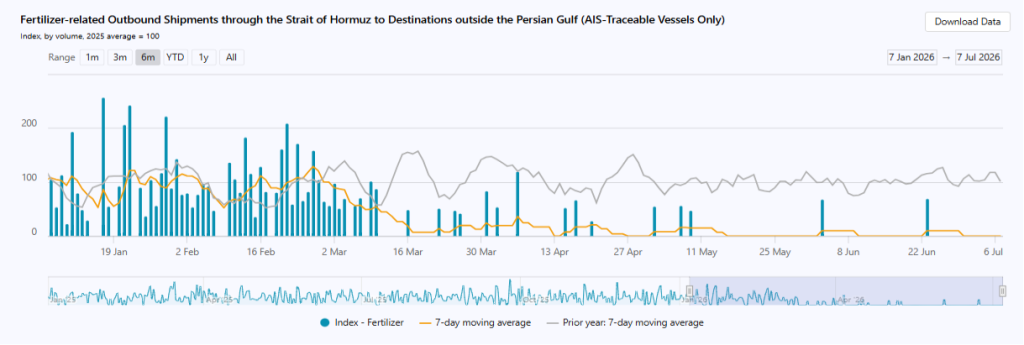
Source: World Trade Organization (WTO) Data Blog, “Fertilizer trade impacted by Strait of Hormuz conflict”, July 10, 2026; Data Lab WTO.
The organisation said fertilisers remain critical to maintaining crop yields, warning that prolonged supply disruptions could reduce agricultural productivity, drive up food prices and deepen food insecurity, particularly in countries that rely heavily on imported fertilisers.
The WTO reported that nitrogen fertiliser prices more than doubled in the immediate aftermath of the conflict. Urea prices climbed from about $400 per metric tonne to more than $850 before easing to around $453 by June 2026, while diammonium phosphate (DAP) prices also recorded sharp increases.
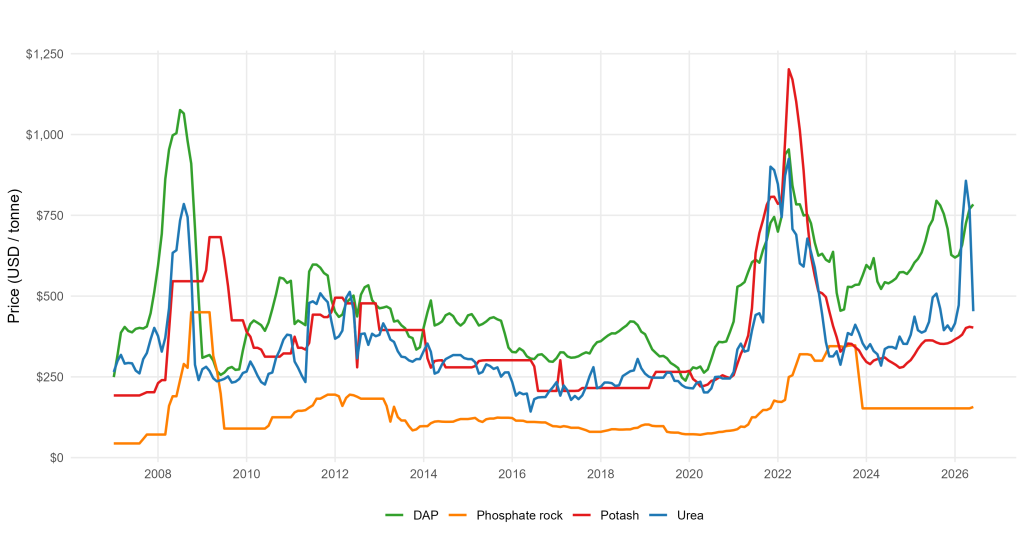
Source: WTO Data Blog (2026), based on World Bank fertilizer price data.
It noted that although prices have moderated, future market stability will largely depend on uninterrupted shipping through the Strait of Hormuz.
According to the report, Gulf economies account for almost one-quarter of global nitrogen fertiliser exports and more than 11 per cent of phosphatic fertiliser exports, making the region indispensable to global agricultural supply chains.
The WTO identified Kenya, Malawi, Mozambique, Rwanda, South Africa, Tanzania, Uganda and Zimbabwe among the countries most exposed to supply disruptions because of their heavy dependence on imported fertilisers sourced from the Gulf.
It added that seven of the 18 economies classified as highly vulnerable are least-developed countries.
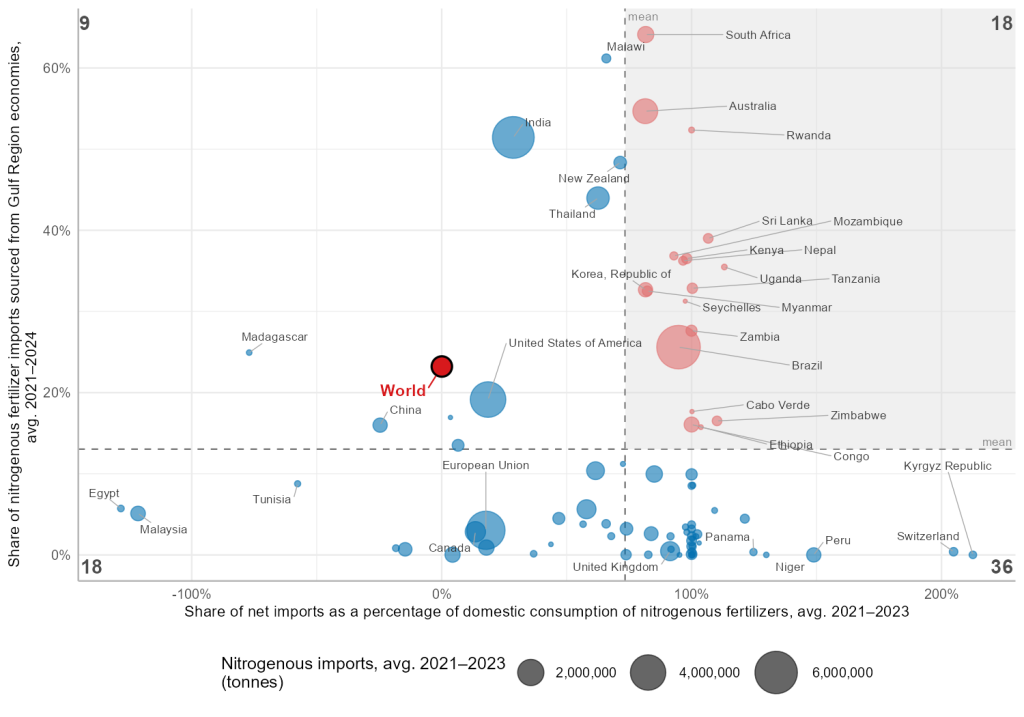
Source: WTO Data Blog (2026), based on WTO and FAOSTAT data.
The report also noted that export licences, quotas and outright bans introduced since the conflict began have further tightened global fertiliser markets.
According to the WTO, these restrictions could potentially affect up to 15 per cent of global fertiliser exports. When the disruption to Gulf exports is included, the share of affected trade rises to 23.3 per cent, although some shipments continue through alternative routes.
To cushion the impact, several governments have introduced emergency measures, including import tariff reductions and expanded fertiliser subsidy programmes.
The WTO said nearly 60 per cent of its members already apply zero tariffs on fertiliser products, while the European Union and Türkiye have temporarily reduced duties on selected fertiliser imports.
Countries including India, Kenya, Ghana, Sri Lanka and Thailand have also expanded fertiliser subsidy programmes to support farmers, while the United States is increasing domestic fertiliser production.
The issues
Africa remains heavily dependent on imported fertilisers, with many countries sourcing significant volumes from Gulf producers. Prolonged disruptions could reduce fertiliser availability, increase production costs for farmers, lower crop yields and intensify food inflation across vulnerable economies.
What’s being said
“Prolonged supply disruptions could reduce agricultural productivity, increase food prices and worsen food security, particularly in developing economies that depend heavily on imported fertilisers.” — World Trade Organisation
What’s next
The WTO said restoring normal shipping through the Strait of Hormuz remains critical to stabilising fertiliser markets. It also urged governments to ensure policy responses reflect the vulnerability of developing countries, particularly in Africa and Asia, which remain most exposed to future supply disruptions.
Bottom line
The Gulf conflict has highlighted how geopolitical tensions can quickly disrupt global agricultural supply chains, with Africa facing some of the greatest risks because of its dependence on imported fertilisers.




 has warned that prolonged disruption to shipping through the Strait of Hormuz could trigger ...)