





Key points
- Asian stock markets mostly closed higher after reports that the United States and Iran agreed to halt military attacks following renewed weekend hostilities.
- Oil prices edged higher as investors monitored developments surrounding the Strait of Hormuz and upcoming US-Iran talks.
- Investor sentiment remained fragile amid geopolitical uncertainty and mounting concerns over elevated valuations in artificial intelligence (AI)-related stocks.
- South Korean technology stocks remained under pressure despite the government’s announcement of a massive investment programme for semiconductors and AI infrastructure.
- Investors are awaiting key US labour market data that could influence the Federal Reserve’s next monetary policy decision.
Main Story
Global financial markets traded cautiously on Monday as most Asian equities posted gains and oil prices edged higher following reports that the United States and Iran had agreed to suspend military attacks after a fresh round of weekend hostilities threatened an already fragile ceasefire.
The reported breakthrough helped ease fears of a broader regional conflict that had unsettled investors in recent weeks and raised concerns over global energy supplies through the strategically important Strait of Hormuz.
Although market sentiment improved, investors remained cautious as negotiations between Washington and Tehran continue amid lingering geopolitical tensions.
According to US media reports citing senior American officials, both countries have agreed to halt further military action and are expected to continue negotiations during a new round of talks scheduled to take place in Qatar on Tuesday.
The latest development follows several days of escalating military exchanges.
The United States Central Command announced on Saturday that it had carried out strikes against 10 Iranian military targets in response to what it described as continued Iranian attacks on commercial shipping.
Iran subsequently launched retaliatory strikes targeting US military installations in Kuwait and Bahrain, prompting condemnation from both Gulf states.
The dispute has intensified concerns over navigation through the Strait of Hormuz, one of the world’s most critical energy shipping routes.
Iran has also expressed dissatisfaction with Oman’s proposal for an alternative shipping corridor along Omani territorial waters, insisting on maintaining control over its preferred navigation route through the strait.
According to US officials, both countries have agreed to temporarily de-escalate hostilities while technical discussions continue, allowing commercial vessels to move through the waterway without further disruption.
Iran’s Foreign Ministry also confirmed that officials had begun discussions with Oman regarding the management of maritime traffic through the strategic passage.
Oil prices, which had retreated to pre-conflict levels during the previous week, recorded modest gains as traders assessed the implications of the reported ceasefire and ongoing diplomatic engagements.
Across Asia, equity markets responded positively to the easing geopolitical tensions.
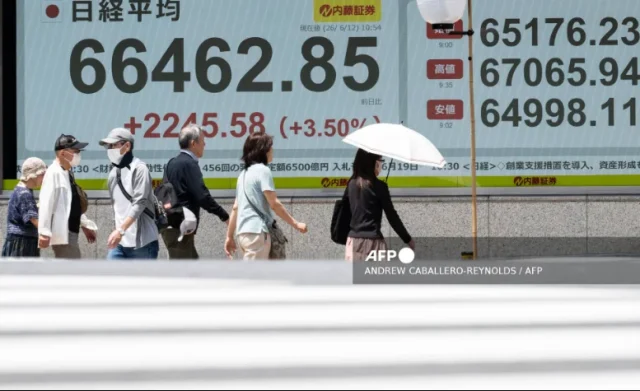
Major indices in Tokyo, Hong Kong, Shanghai, Sydney, Singapore, Wellington, Taipei, Manila and Bangkok all recorded gains, while markets in Mumbai and Jakarta closed lower.
Technology stocks, however, remained under pressure following heavy losses recorded last week.
South Korean semiconductor giants SK hynix and Samsung Electronics extended their recent declines before recovering part of their losses after the government unveiled an ambitious long-term investment programme aimed at strengthening the country’s semiconductor and artificial intelligence industries.
Under the initiative, South Korea plans to invest nearly $1.2 trillion over several years in semiconductor manufacturing facilities and AI data centres through a public-private partnership.
Government officials also announced that Samsung and SK hynix will jointly commit more than $500 billion to establish a new semiconductor fabrication hub in the country’s southwest region.
Despite the announcement, concerns persist over whether massive investments in artificial intelligence will generate sufficient financial returns to justify current market valuations.
The Bank for International Settlements (BIS), often referred to as the central bank for central banks, warned in its latest annual report that prolonged investment enthusiasm surrounding AI could eventually result in a significant market correction.
The institution cautioned that weaker-than-expected returns could trigger a prolonged decline in capital expenditure, tighten financial conditions and weigh on global economic growth.
Investors are now turning their attention to upcoming US employment data, which could provide fresh clues about the Federal Reserve’s interest rate outlook.
Recent stronger-than-expected economic data have reinforced expectations that the US central bank may maintain higher interest rates for longer as policymakers continue to monitor inflationary pressures linked to geopolitical developments.
The Issues
Financial markets continue to balance improving geopolitical developments against persistent macroeconomic risks.
While the temporary suspension of military action between the United States and Iran has eased immediate concerns over energy supply disruptions, uncertainty surrounding negotiations and the future of the Strait of Hormuz remains a significant risk for global markets.
At the same time, growing concerns over elevated valuations in AI-related technology stocks have prompted warnings from policymakers and international financial institutions about the possibility of a sharp market correction if investment returns fail to meet expectations.
The combination of geopolitical uncertainty, monetary policy risks and technology sector valuations continues to shape investor sentiment across global financial markets.
What’s Being Said
According to a US official:
“Technical talks are slated to continue. Both sides will stand down for now and vessels can move freely.”
The Bank for International Settlements warned in its annual report:
“Disappointment in returns could trigger a sudden pullback in financing and turn the capex boom into a protracted investment bust, with potential knock-on effects on financial conditions.”
The institution added:
“A major equity-market correction could have larger macroeconomic consequences today than in the past.”
IG market analyst Fabien Yip said:
“A repeat beat on Thursday could trigger a similar rotation; a miss, by contrast, may dampen hike expectations and lift rates-sensitive equities.”
What’s Next
Investors will closely monitor the scheduled US-Iran talks in Qatar for further signs of diplomatic progress and the potential restoration of stability around the Strait of Hormuz.
Market participants are also awaiting the release of key US labour market data, which could influence expectations for future Federal Reserve interest rate decisions and determine the near-term direction of global equity and bond markets.
Attention will also remain focused on developments within the technology sector as investors assess whether continued investment in artificial intelligence can justify elevated market valuations.
Bottom Line
Global markets began the week on a cautiously positive note after reports of a temporary halt in hostilities between the United States and Iran eased immediate concerns over energy supplies. However, geopolitical uncertainty, questions surrounding AI-driven market valuations and expectations for US monetary policy continue to pose significant risks for investors navigating an increasingly complex global economic environment.