








Key points
- Dangote Petroleum Refinery imported about 1.46 billion litres of gasoline blendstock between January and May 2026, according to NMDPRA data.
- The refinery reportedly operated at an average capacity utilisation of 101.25 per cent in May, producing 44.7 million litres of petrol daily.
- Experts say the imported intermediates are used to boost output and fuel quality, but raise concerns about foreign exchange outflows.
Main story
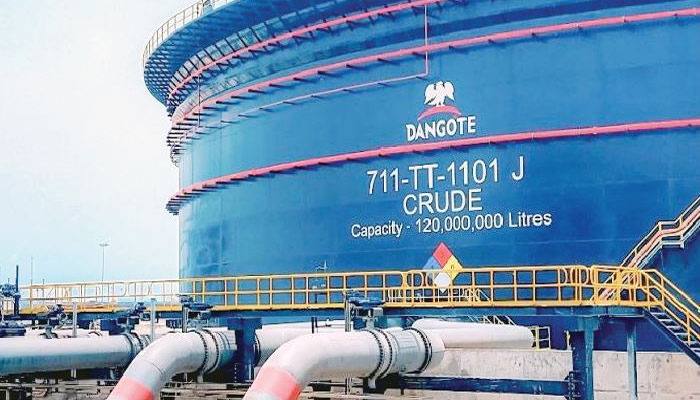
The Nigerian Midstream and Downstream Petroleum Regulatory Authority (NMDPRA) has disclosed that the Dangote Petroleum Refinery imported approximately 1.46 billion litres of gasoline blendstock between January and May 2026 to support its refining operations.
Industry data contained in the NMDPRA’s Midstream and Downstream Petroleum Statistics for May 2026 showed that the 650,000 barrels-per-day facility imported significant volumes of intermediate petroleum products despite receiving both domestic and imported crude oil feedstock during the period.
The refinery, operated by Dangote Petroleum Refinery, reportedly maintained an average capacity utilisation of 101.25 per cent in May, producing about 44.7 million litres of Premium Motor Spirit (petrol) daily.
According to the report, the facility supplemented crude processing with imported gasoline blendstock to sustain production levels and optimise output.
The data showed monthly imports fluctuated during the period under review: 658.31 million litres in January, 306.89 million litres in February, 102.35 million litres in March, 147.37 million litres in April, and 240.59 million litres in May.
The cumulative figure of 1.46 billion litres reflects a resurgence in imports in April and May after a decline in the first quarter of the year.
The refinery also recorded strong output across other petroleum products, including diesel and aviation fuel, while supplying a significant portion of its production to the domestic market and exporting surplus volumes.
The issues
The figures highlight the continued reliance on imported intermediate products, even as Nigeria seeks to deepen domestic refining capacity and reduce dependence on imported refined fuel.
Although crude oil availability improved during the period—rising to 20.92 million barrels in March before moderating to 17.92 million barrels in May—the refinery still relied on imported blendstocks to maintain and exceed its installed capacity.
Analysts note that the refinery’s production performance above 100 per cent capacity utilisation raises questions about the balance between crude feedstock and imported intermediates in driving output levels.
Another concern is the cost implication of sustained imports, particularly in terms of foreign exchange outflows at a time Nigeria is seeking to stabilise its external reserves.
What’s being said
Energy experts argue that the importation of gasoline blendstock is a standard global refining practice used to improve fuel quality and optimise refinery efficiency.
A Professor of Energy at the University of Lagos, Dayo Ayoade, explained that blendstocks such as naphtha, reformate and alkylate are essential components used to meet regulatory fuel standards.
According to him, the practice helps refiners achieve higher-quality petrol, including cleaner Euro-standard fuels, while maximising operational efficiency.
He said: “Gasoline feedstocks are unfinished petroleum streams … blended to meet regulatory standards of Premium Motor Spirit.”
Ayoade added that such inputs allow refineries to optimise secondary processing units and maintain steady output even when crude supply is inconsistent.
However, he cautioned that continued importation could have broader economic implications.
“The only issue is the production impact in terms of cost. The refinery is at capacity, but importation means we are leaking foreign exchange,” he said.
He also warned that misconceptions could arise about the refinery’s operations, despite the technical legitimacy of using blendstocks.
What’s next
Industry watchers expect continued scrutiny of the refinery’s feedstock structure as Nigeria pushes toward full domestic refining independence.
The NMDPRA is likely to maintain monitoring of crude intake, blendstock imports, and production efficiency to assess compliance with national energy objectives.
Policy discussions may also intensify around foreign exchange management, refinery feedstock sourcing, and long-term energy security strategy.
Bottom line
While Dangote Refinery continues to significantly boost Nigeria’s domestic fuel supply and operate at near-record capacity levels, NMDPRA data shows that imported gasoline blendstocks remain a critical part of its production process. The development underscores both the technical realities of modern refining and ongoing debates around foreign exchange exposure and energy self-sufficiency.










 has disclosed that the Dangote Petroleum Refinery imported ...)