




Key points
- Former Minister of Power, Saleh Mamman, has been convicted on all 12 counts bordering on money laundering, conspiracy, and criminal breach of trust.
- The Federal High Court in Abuja sentenced him to 75 years imprisonment over the diversion of ₦33.8 billion linked to major power projects.
- The funds were allegedly siphoned from the Mambilla and Zungeru Hydroelectric Power projects.
- The EFCC secured the conviction after presenting 17 witnesses and 43 exhibits before the court.
- The judgment is being viewed as one of the most significant anti-corruption victories in Nigeria’s power sector in recent years.
Main story
In what many observers have described as a watershed moment in Nigeria’s anti-corruption campaign, the Economic and Financial Crimes Commission (EFCC) has secured the conviction of former Minister of Power, Saleh Mamman, over a multi-billion naira fraud scandal tied to critical national infrastructure projects.
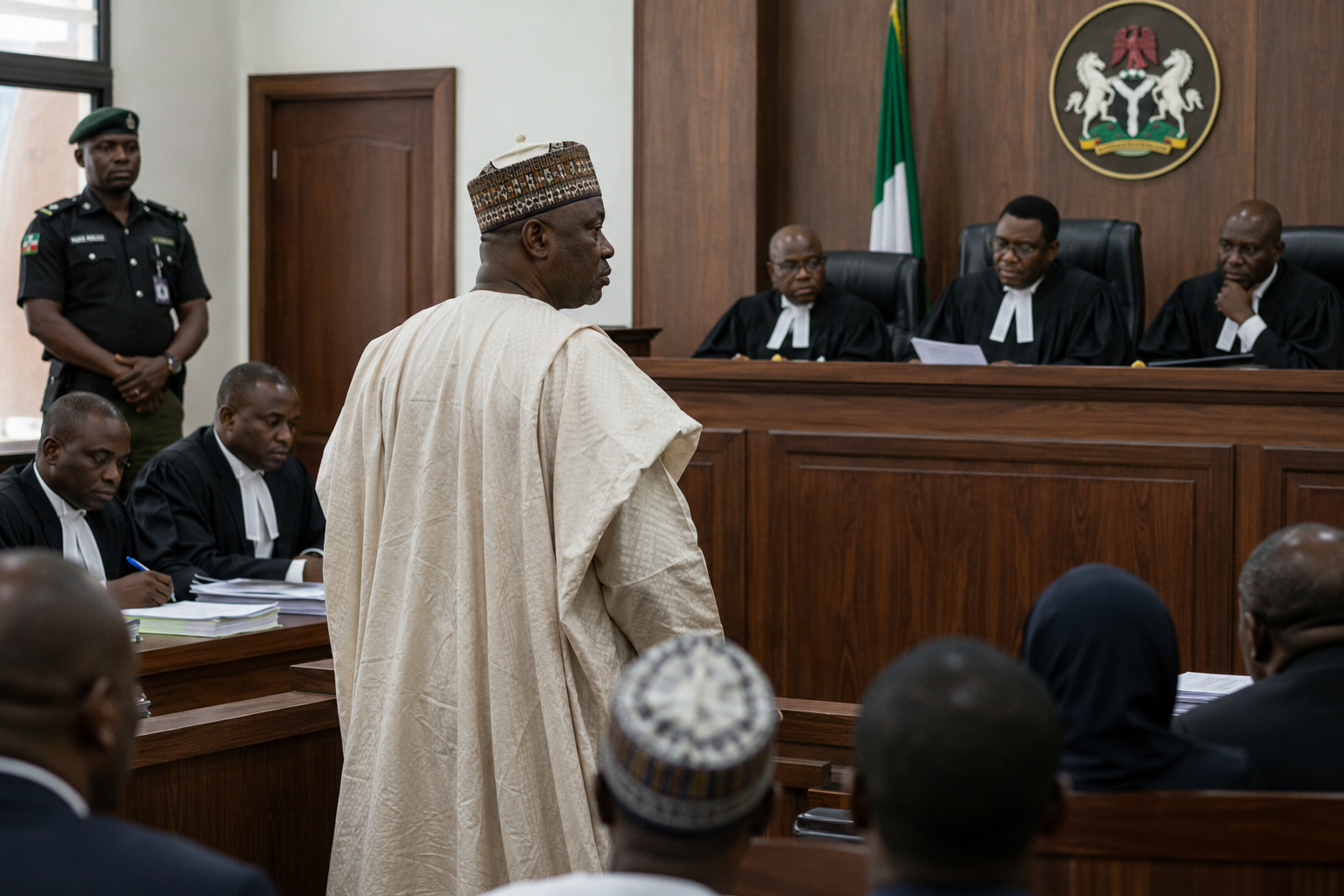
Justice James Omotosho of the Federal High Court in Abuja handed down the judgment, finding Mamman guilty on all 12 amended charges relating to money laundering and diversion of public funds amounting to ₦33.8 billion.
Mamman, who served under former President Muhammadu Buhari between 2019 and 2021, was subsequently sentenced to a cumulative 75 years behind bars.
The case centred on funds allocated to the Mambilla and Zungeru Hydroelectric Power projects — two major electricity initiatives expected to improve Nigeria’s troubled power supply.
According to court proceedings, the former minister allegedly diverted huge sums through cash transactions, proxy accounts, and Bureau de Change operators. One of the transactions presented before the court involved a cash payment of $655,700 for a property in Abuja.
The court held that the prosecution established its case beyond reasonable doubt, describing the evidence presented by the EFCC as compelling and largely uncontested by the defense.
Mamman’s conviction follows months of legal proceedings that drew national attention, especially after his absence during an earlier court session forced the judge to issue a bench warrant to compel his appearance for sentencing.
The ruling has sparked widespread reaction across political and civil society circles, particularly in Taraba State, where the former minister remains an influential political figure reportedly linked to permutations ahead of the 2027 governorship race.
While supporters insist the case was politically motivated, many Nigerians have hailed the judgment as a long-awaited sign that high-ranking public officials can finally be held accountable for corruption.
What’s being said
The judge stated that rather than confronting the country’s worsening power crisis, Mamman chose to “live large at the expense of ordinary citizens.”
Analysts and public affairs commentators have also described the conviction as a major warning to corrupt public office holders.
“This should serve as a warning to public officials. Nigerians have suffered enough from corruption, especially in critical sectors like power,” one commentator noted.
EFCC officials, reacting to the verdict, reiterated their commitment to pursuing high-profile corruption cases across government institutions.
According to the commission, “public office is a trust,” stressing that anti-graft agencies would continue to intensify efforts against financial crimes in the public sector.
The issues
Nigeria’s power sector has long been synonymous with massive budget allocations, abandoned projects, and recurring corruption allegations despite decades of reform promises.
The alleged diversion of funds meant for flagship projects like the Mambilla Hydroelectric Power Plant — one of Africa’s biggest proposed hydroelectric schemes — has once again exposed deep-rooted institutional failures and weak accountability systems.
For years, inadequate electricity supply has crippled businesses, discouraged investment, and worsened living conditions for millions of Nigerians forced to rely on costly alternatives such as generators and inverters.
The case has also reignited concerns over political influence in corruption trials, enforcement of bail conditions, and the slow pace of justice in high-profile financial crime cases.
Mamman’s earlier failure to appear in court further fueled public skepticism about whether politically exposed persons are truly held to the same standards as ordinary citizens.
What’s next
The former minister is expected to begin serving his prison sentence immediately, although legal observers anticipate that his defence team may challenge the judgment at the appellate court.
Meanwhile, the EFCC has indicated that investigations into alleged corruption within the power sector and other government ministries will continue.
Anti-corruption advocates believe the conviction could strengthen public confidence in the EFCC and signal a tougher stance against financial crimes under the current administration.
There are also growing calls for the government to go beyond convictions by ensuring the recovery of looted funds and the completion of abandoned power projects tied to corruption scandals.
Bottom line
The conviction and 75-year jail sentence handed to Saleh Mamman marks one of the strongest judicial statements yet against corruption in Nigeria’s public sector.
Beyond the courtroom victory, the case reflects the devastating human and economic consequences of corruption in critical sectors like electricity — where billions meant for national development allegedly disappeared while millions of Nigerians remained trapped in darkness.
For many Nigerians, the ruling is more than just a sentence; it is a test of whether accountability can finally take root at the highest levels of government.