KEY POINTS
- Chinese President Xi Jinping and Botswana’s President Duma Boko have upgraded bilateral relations to a comprehensive strategic cooperative partnership.
- The countries signed cooperation agreements covering green mining, healthcare, human resources, the Belt and Road Initiative and the Global Security Initiative.
- China identified agriculture, livestock development, digital technology, education and mineral processing as priority areas for deeper cooperation.
MAIN STORY
China and Botswana have elevated their bilateral relations to a comprehensive strategic cooperative partnership, signalling plans to deepen economic cooperation, expand investment and strengthen political ties.
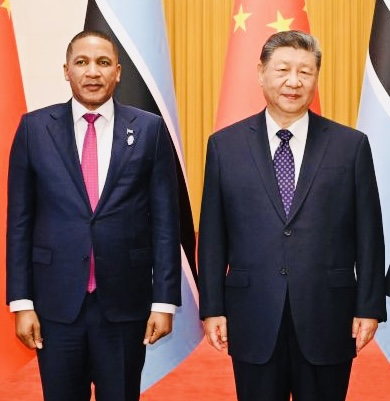
The upgrade followed talks between Chinese President Xi Jinping and Botswana’s President Duma Boko at the Great Hall of the People in Beijing during Boko’s state visit to China.
According to a joint statement issued on Thursday, the two countries signed cooperation agreements covering the Global Security Initiative, the Belt and Road Initiative, green mining, healthcare and human resources.
Xi described the relationship between the two countries as a longstanding friendship that should “shine bright and endure like diamonds”, referencing the importance of diamonds to Botswana’s economy.
He recalled Botswana’s support in the 1970s for restoring the People’s Republic of China’s lawful seat at the United Nations, before the two countries established diplomatic relations.
Xi said both countries were “advancing side by side towards modernisation, creating opportunities to strengthen their longstanding friendship and contribute to global development.”
He also noted that 2026 marked the 105th anniversary of the founding of the Communist Party of China and the 60th anniversary of Botswana’s independence.
The Chinese president called for stronger cooperation between the countries’ governing parties, including exchanges on state governance and closer alignment of development priorities. He reaffirmed Beijing’s support for Botswana’s pursuit of a development path suited to its national circumstances.
On trade and investment, Xi encouraged Botswana to take advantage of China’s zero-tariff treatment for African countries that maintain diplomatic relations with Beijing.
He identified the digital economy, agriculture, livestock development and the Smart Education Project as priority areas for cooperation to support Botswana’s economic and social development.
Mining also featured prominently in the discussions. Xi proposed a four-point framework centred on African ownership of natural resources, mutual benefit, high-quality development and a fair, open investment environment.
He said African countries should determine how their mineral resources were developed, while China remained ready to share expertise and support mining strategies suited to individual countries.
Xi also urged Chinese companies operating in Africa to strengthen their capabilities, transfer environmentally friendly technologies and promote South-South cooperation in mining.
He advocated greater mineral processing and industrial value addition on the continent, alongside affordable and sustainable financing models to accelerate economic development.
The Chinese leader cautioned against turning Africa’s natural resources into instruments of geopolitical rivalry, urging international partners to support development and create favourable conditions for responsible investment.
Boko, in his remarks, commended China’s development achievements under Xi’s leadership, highlighting its poverty reduction experience and development pathway as useful examples for Botswana.
He reaffirmed Botswana’s commitment to the one-China principle, opposition to Taiwan independence and rejection of interference in China’s internal affairs.
The Botswana president also welcomed increased Chinese investment and deeper cooperation under the Belt and Road Initiative, particularly in agriculture, mining, industrial development, innovation and digital transformation.
Boko expressed Botswana’s readiness to work with China on multilateralism, solidarity among developing countries and reforms aimed at making global governance more inclusive and representative.
THE ISSUES
The upgraded partnership provides a framework for expanding China’s economic engagement with Botswana beyond existing trade and mining relationships. Agriculture, digital services, education and industrial development could offer additional channels for investment and technology transfer.
Mineral processing is particularly significant because it could help Botswana capture more value from its natural resources instead of relying predominantly on the extraction and export of raw materials. However, achieving that objective will require investment in infrastructure, technical skills, energy supply and local industrial capacity.
China’s zero-tariff treatment for eligible African countries could also create opportunities for Botswana’s exporters. The practical benefits will depend on the products covered, exporters’ ability to meet market requirements and their capacity to supply Chinese buyers competitively.
The partnership also has a diplomatic dimension. Botswana’s reaffirmation of the one-China principle aligns with Beijing’s position on Taiwan, while both governments have expressed interest in closer cooperation on international governance and developing-country priorities.
WHAT’S BEING SAID
- “shine bright and endure like diamonds” – Xi Jinping, President of China, describing China-Botswana friendship
- “advancing side by side towards modernisation, creating opportunities to strengthen their longstanding friendship and contribute to global development.” – Xi Jinping, President of China
WHAT’S NEXT
The practical outcome of the partnership will depend on how the signed cooperation documents translate into investment, projects and commercial opportunities.
Implementation in mining, agriculture, digital technology, education and healthcare will be important to determining whether the agreements generate jobs, improve productivity and strengthen Botswana’s industrial capacity.
The proposed emphasis on mineral processing and technology transfer will also be a key test of whether the relationship supports greater local value addition alongside continued Chinese investment.
BOTTOM LINE
China and Botswana have upgraded their relationship with an emphasis on investment, technology, mining and broader economic cooperation. The central question is whether the new framework will translate into tangible development gains for Botswana, particularly through local industrialisation, employment and greater value from its natural resources.