








Key points
- Delta State has set aside $100 million (about N173 billion) as viability gap funding to de-risk investments.
- Governor Sheriff Oborevwori says the initiative is aimed at attracting private capital and accelerating economic growth.
- The state has secured over 12,000 hectares of land for prospective investors across key sectors.
- Stakeholders at the Delta State Economic and Investment Summit urged greater investment in infrastructure, agriculture, maritime development and industrialisation.
- The summit attracted top government officials, global investors and development experts, including Vice President Kashim Shettima and WTO Director-General Dr Ngozi Okonjo-Iweala.
Main Story
Delta State Governor Sheriff Oborevwori has announced that the state government has earmarked $100 million (approximately N173 billion) as viability gap funding to de-risk private investments and position Delta as one of Nigeria’s leading investment destinations.
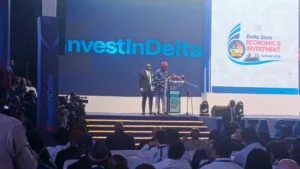
The governor announced on Monday while delivering his keynote address at the Delta State Economic and Investment Summit 2026 in Asaba.
The summit, themed “Harnessing Our Strengths, Unlocking Our Potential,” brought together government officials, development partners, business leaders and international investors to explore opportunities for economic diversification and sustainable growth.
Oborevwori said the investment fund demonstrates his administration’s commitment to building a robust, private sector-driven economy capable of creating jobs, expanding industries and improving the state’s economic competitiveness.
According to him, the summit represents more than a policy dialogue, describing it as a practical commitment to transforming Delta into one of Nigeria’s strongest economies through strategic partnerships with investors.
The governor said Delta remains financially stable despite ongoing investments in infrastructure and other development projects, assuring prospective investors of a conducive business environment.
He noted that the state, with a population of over six million people and an estimated N16 trillion economy, possesses enormous economic potential supported by extensive natural resources, strategic market access and favourable investment conditions.
Oborevwori disclosed that the state government has already secured more than 12,000 hectares of land for investors and identified agriculture, oil and gas, fisheries, oil palm, cassava and rice production as priority sectors for investment.
He also highlighted investments in security infrastructure, stating that the initiatives have made Delta one of Nigeria’s safest states for business and investment.
The governor commended President Bola Tinubu, Vice President Kashim Shettima, investors from China and Brazil, and other stakeholders for supporting the state’s investment drive.
In his remarks, Chairman of the Summit, Augustine Avuru, urged the state to reduce its dependence on oil revenues by expanding investments in agriculture, maritime development, industrialisation and critical infrastructure.
He emphasised that oil-producing economies across the world are strategically investing today’s petroleum revenues in sectors capable of sustaining long-term economic growth after fossil fuels lose their dominance.
Avuru identified Delta’s maritime assets—including the ports in Warri, Sapele, Koko and Burutu, as well as two airports—as strategic advantages that should be leveraged to drive industrial expansion and improve logistics.
He also called for the development of large agricultural land banks, improved transport infrastructure and reliable electricity to stimulate manufacturing, agro-processing and export-oriented industries.
Earlier, Secretary to the State Government and Chairman of the Summit Organising Committee, Dr Kingsley Emu, highlighted Delta’s vast agricultural land, blue economy potential and strategic location as key attractions for investors.
The summit was attended by Vice President Kashim Shettima, WTO Director-General Dr Ngozi Okonjo-Iweala, Professor Patrick Lumumba, Governor Chukwuma Soludo of Anambra State, as well as investors from China, Brazil and other countries.
The Issues
Delta seeks to reduce its dependence on oil and gas by diversifying into agriculture, manufacturing, maritime and other productive sectors.
Infrastructure development, particularly roads, ports, electricity and waterways, remains essential to attracting long-term investments.
Access to serviced industrial land and investment de-risking mechanisms are critical to boosting investor confidence.
The state must sustain improvements in security and ease of doing business to remain competitive.
Effective implementation of investment commitments will determine the long-term success of the initiative.
What’s Being Said
Sheriff Oborevwori, Governor of Delta State
“Our aim today is to partner with prospective investors, with the overriding objective of building a stronger economy.”
“This summit is not a talk show but a commitment of this administration to build an economy that will be second to none in the country.”
“Delta is an investors’ haven, blessed with vast land and a business-friendly climate waiting to be harnessed.”
“Our aim is to build an economy that is private sector-led, create industries, jobs, while ensuring that our ease of doing business remains top-notch.”
Augustine Avuru, Chairman, Delta State Economic and Investment Summit
“This is not just another talk show. This is the beginning of a movement that will redefine Delta’s economy and position the state for long-term prosperity beyond oil.”
“Oil and gas are finite resources. Wise nations are using today’s revenues to create tomorrow’s prosperity through deliberate investments that will benefit generations yet unborn.”
“Government must provide infrastructure and create an enabling environment. The private sector will always invest where confidence, stability, reliable power and business opportunities exist.”
What’s Next
The Delta State Government is expected to operationalise the $100 million Viability Gap Fund, engage prospective investors and accelerate infrastructure projects that support industrialisation.
Stakeholders will also monitor the implementation of recommendations from the summit, including the development of industrial parks, agricultural land banks, maritime infrastructure and policies aimed at strengthening Delta’s position as a leading investment destination.
Bottom Line
By committing $100 million to de-risk investments, Delta State is signalling its determination to attract private capital and diversify its economy beyond oil. Success will ultimately depend on sustained policy implementation, infrastructure development and effective partnerships with investors.






 ...)