







Key points
- Foreign Affairs Minister Bianca Odumegwu-Ojukwu and EU Ambassador Gautier Mignot met in Abuja to deepen bilateral relations.
- The EU is preparing a €20 million defense support package under the European Peace Facility for counter-drone and counter-IED equipment.
- A proposed €25 million peace and stabilization initiative is currently being finalized for Nigeria’s North-West region.
- Both sides are finalizing arrangements for President Bola Tinubu’s official visit to Brussels in October 2026.
Main story

Nigeria and the European Union have reaffirmed their commitment to deepening trade, security, and diplomatic ties following high-level talks in Abuja.
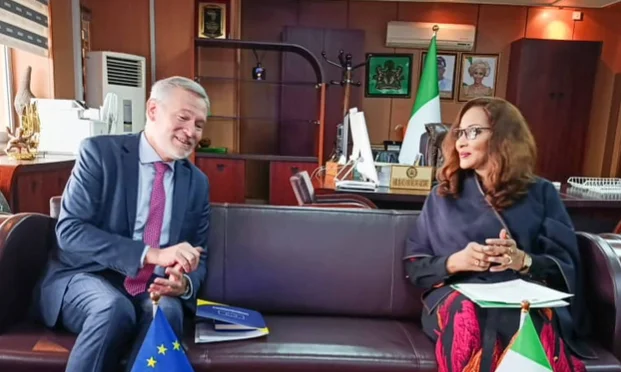
The bilateral engagement took place between Nigeria’s Minister of Foreign Affairs, Ambassador Bianca Odumegwu-Ojukwu, and the EU Ambassador to Nigeria and ECOWAS, Gautier Mignot. The meeting served to review progress made since the Second Nigeria-EU Ministerial Dialogue in March 2026 and evaluate ongoing joint development initiatives.
A major focus of the talks centered on defense assistance, with Mignot disclosing that the EU is finalizing a €20 million military support package. Funded through the European Peace Facility, the package will supply Nigeria with specialized counter-drone and counter-IED hardware to boost counter-terrorism operations. Additionally, the bloc is preparing a separate €25 million peace and stabilization program targeting conflict zones in the North-West.
Odumegwu-Ojukwu commended the EU’s contributions through its Global Gateway Initiative and regional security support for the Multinational Joint Task Force. She acknowledged Brussels’ nuanced stance on Nigeria’s security landscape, noting that the bloc recognizes the complex mix of terrorism, banditry, resource competition, and communal friction driving local conflicts.
On economic cooperation, both envoys highlighted advanced plans for a new €25 million agricultural scheme centered on dairy and cocoa production. Preparations are also underway to formalize a Science, Technology and Innovation Cooperation Agreement, which will integrate Nigerian institutions into the Horizon Europe research network.
The discussions concluded with preparations for President Bola Tinubu’s proposed state visit to Brussels in October 2026, where both parties expect to sign new bilateral frameworks alongside leadership from the European Council and European Commission.
The issues
The expanding security and economic deal highlights Brussels’ reliance on Nigeria as a primary anchor for West African stability. By providing specialized anti-drone hardware and targeted stabilization funds in the North-West, the EU seeks to contain regional insurgencies while securing trade lanes and managing migration flows. For Nigeria, securing EU capital and technical expertise helps cushion economic pressures and modernizes defense capabilities against non-state armed groups.
What’s being said
“The EU is one of Nigeria’s foremost trading and development partners, and this visit will help to enhance economic cooperation, attract greater investment, and strengthen existing strategic initiatives.” — Bianca Odumegwu-Ojukwu, Minister of Foreign Affairs
“The proposed visit will further consolidate the strategic partnership between Nigeria and the EU, and unveil new areas of cooperation.” — Gautier Mignot, EU Ambassador to Nigeria and ECOWAS
What’s next
Diplomats from both sides will finalize dates for President Tinubu’s October visit to Brussels while concluding legal negotiations on the EU Readmission Agreement and the Horizon Europe science partnership.
Bottom line
Nigeria and the EU are ramping up defense and economic cooperation, using upcoming high-level summits to solidify security packages and expand trade access.