




Keypoints
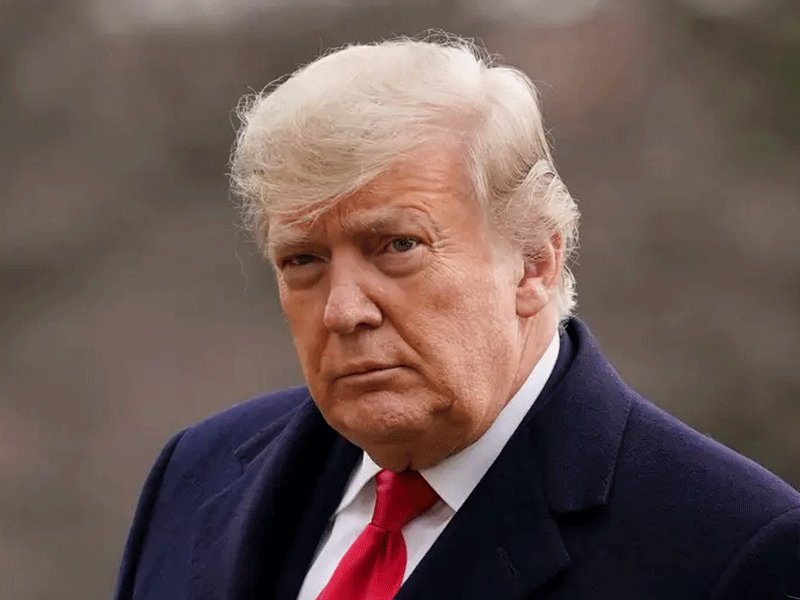
- President Donald Trump has issued a stern warning to Iran on Truth Social, stating that Tehran “better not be” charging fees to tankers passing through the Strait of Hormuz.
- Reports indicate that Iran is demanding tolls of approximately $1 per barrel of oil (roughly $2 million for a full supertanker), with payments required in cryptocurrency or Chinese yuan to bypass sanctions.
- The demand comes during a fragile two-week ceasefire brokered on April 7, 2026, following a devastating six-week war that began with U.S.-Israeli strikes on Iran in February.
- An estimated 300 to 400 ships are currently backlogged in the Persian Gulf, with only 10% of normal traffic volumes resuming as Iran maintains tight control over territorial waters.
Main Story
The fragile peace between the United States and Iran is facing its first major test as a dispute erupts over the control of the world’s most critical energy chokepoint. President Donald Trump used his social media platform to caution Tehran against imposing what he termed “dishonorable” tolls on oil tankers.
This follows statements from Iranian officials, including Hamid Hosseini of the Exporters’ Union, who suggested that Iran must “monitor what goes in and out” to ensure the ceasefire isn’t used for weapon transfers.
The “tollbooth” scheme, reportedly managed by the Islamic Revolutionary Guard Corps (IRGC), requires vessels to detour through a northern corridor around Larak Island. While the U.S. insists the ceasefire was intended to fully reopen the strait, Iran’s leadership has vowed to seek “legal and material accountability” for war damages, effectively using the transit fees as a form of war reparations.
The global economy remains on edge, as the strait handles about 20% of the world’s oil and LNG shipments.
The Issues
The primary challenge is the backlog of 136 million barrels of crude oil stranded in the Gulf. Maritime experts suggest that even if the ceasefire holds, it would take several weeks to clear the bottleneck, as current Iranian procedures allow only 10–15 ships per day. Furthermore, the use of cryptocurrency for toll payments presents a novel threat to international trade norms, as it allows Iran to collect untraceable revenue outside the U.S.-led financial system. If Western leaders refuse to pay, the risk of a “re-closure” of the strait remains high, potentially sending oil prices to new historic peaks.
What’s Being Said
- “There are reports that Iran is charging fees to tankers going through the Hormuz Strait — They better not be and, if they are, they better stop now!” posted President Trump on Truth Social.
- Hamid Hosseini, Iran’s Exporters’ Union spokesperson, told the Financial Times: “Iran is not in a rush… once the assessment is complete, vessels pay in Bitcoin to ensure they can’t be traced.”
- Maersk, the world’s second-biggest shipping line, stated they are taking a “cautious approach” and seeking clarity on Iran’s terms before resuming full-scale operations.
- Maritime Law Experts argue that Iran’s actions violate the “customary right of innocent passage” guaranteed under international law, regardless of whether the Law of the Sea Treaty has been ratified.
What’s Next
- Pakistan Peace Talks: High-level negotiations involving JD Vance and Jared Kushner are scheduled to begin in Islamabad this weekend to finalize the terms of a permanent agreement.
- U.S. Military Action: Trump has threatened “large-scale attacks” if Iran does not comply with the terms of the ceasefire regarding free oil flow.
- Energy Market Volatility: Analysts expect oil prices to remain volatile until “inbound ballast vessels” (empty tankers returning to pick up oil) signal that shipping activity has truly stabilized.
Bottom Line
While the ceasefire has stopped the active bombing campaigns, the “Economic War” in the Strait of Hormuz has entered a new, tech-driven phase. The world’s energy security now depends on whether Washington can force Tehran to drop its crypto-tollbooth without triggering a return to full-scale kinetic conflict.