






By Boluwatife Oshadiya | October 26, 2026
Key Points
- Temi Otedola and Mr Eazi’s $15 million, three-continent wedding is the most expensive Nigerian celebrity wedding ever recorded
- Davido confirmed spending $3.7 million cash on his Miami white wedding alone, bringing total #CHIVIDO celebrations above $5 million
- Eight Nigerian weddings between 2021 and 2026 collectively represent tens of billions of naira in expenditure, reshaping perceptions of elite wealth and cultural celebration
- The surge in mega-weddings coincides with Nigeria’s difficult economic environment, including sustained naira devaluation and high inflation
- Digital creators and entertainment stars now compete with politicians and old-money dynasties in staging the country’s most extravagant ceremonies
Main Story
Nigeria’s wedding industry has never looked quite like this. Between 2021 and 2026, a succession of high-profile ceremonies — staged across private jets, international capitals, and billion-naira venues — has redrawn what it means to celebrate in the country’s elite circles. At the very top sits the Otedola-Ajibade affair: a three-country, three-month extravaganza that reportedly cost $15 million, making it not only the most expensive Nigerian wedding on record but one of the costliest nuptials anywhere in the world in 2025.
From the political grandeur of Yusuf Buhari’s Kano ceremony in 2021, which brought dozens of private jets and Nigeria’s entire political class to one small northern town, to the digital-age fanfare of TikTok stars Peller and Jarvis whose August 2026 wedding drew ₦420 million in announced gifts alone, the arc is unmistakable: Nigerian mega-weddings have become a distinct, competitive, and increasingly globalised phenomenon.
Yet these celebrations are unfolding against a backdrop of economic hardship. Nigeria’s naira has lost significant value since 2021, inflation has eroded purchasing power for ordinary households, and the cost of living has climbed sharply. The weddings documented in this report span a combined estimated expenditure of well over ₦25 billion — a figure that underscores the widening gulf between the country’s ultra-wealthy class and the majority of its citizens.
The Issues
Nigeria’s wealth paradox on full display. Each wedding in this report functions as a highly visible display of concentrated wealth at a time when the country’s macro-economic data paints a far darker picture for most Nigerians. The naira has declined dramatically in value since 2021, with the dollar exchange rate moving from around ₦410 per dollar at the time of the Buhari-Bayero wedding to over ₦1,500 by mid-2026. That means the same dollar-denominated wedding budgets have grown even more staggering in local currency terms, amplifying both the spectacle and the optics.
The internationalisation of Nigerian elite celebrations. Several of the weddings in this report were held partially or wholly outside Nigeria — Monaco, Dubai, Iceland, and Miami all featured as venues. This trend reflects not only the globalised tastes and travel capacity of Nigeria’s elite but also a shift in how Nigerian soft power and celebrity culture project themselves. The Temi Otedola-Mr Eazi union, covered by British Vogue, placed a Nigerian wedding on the world stage in a way that few events have managed before.
Digital creators entering the mega-wedding economy. The appearance of Peller and Jarvis on this list marks a structural shift. For the first time, content creators whose wealth is built entirely on social media engagement and brand partnerships are staging weddings comparable in scale to those of billionaires’ children and music superstars. This signals the maturation of Nigeria’s digital economy and its capacity to generate significant wealth outside traditional sectors.
Social criticism and the limits of display. Not every public voice has celebrated these spectacles. The Yusuf Buhari wedding drew pointed commentary from prominent Islamic cleric Sheikh Ahmad Gumi, who criticised politicians for chartering private jets to attend the ceremony while school children remained in kidnappers’ custody. The tension between celebration and social responsibility has followed nearly every entry on this list.
The List: Nigeria’s Most Expensive Weddings Ranked
The weddings below are ranked by their reported total expenditure. Where exact figures have not been officially confirmed, estimates are drawn from credible media reports and known spending disclosures.
1. Temi Otedola & Mr Eazi — #MrandMrsAjibade (2025)
Estimated Cost: $14 million – $15 million (over ₦18–21 billion)
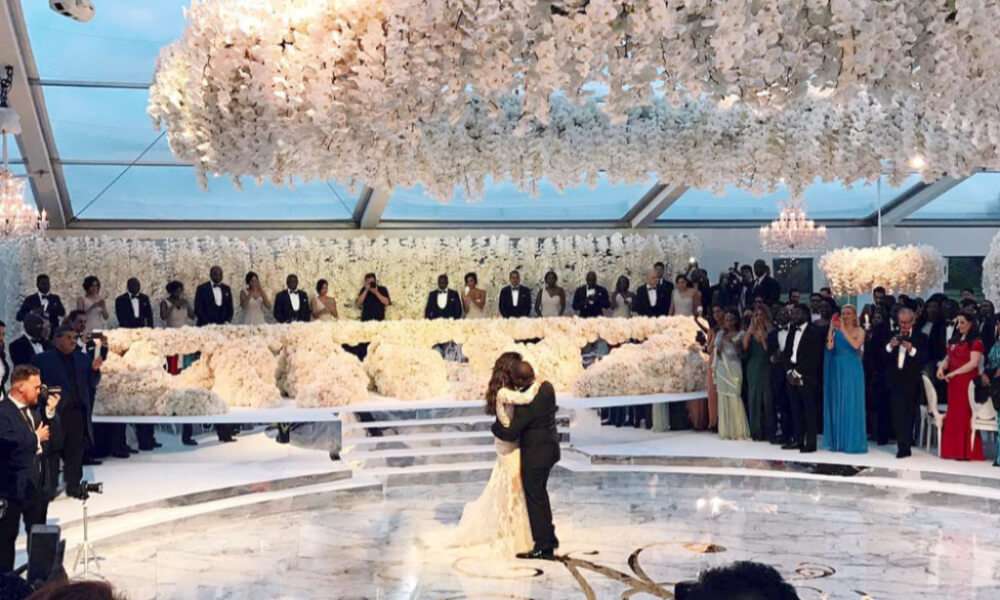
No Nigerian wedding in living memory has been staged at this scale across this many borders. The marriage of actress and fashion icon Temi Otedola to Afrobeats entrepreneur Oluwatosin “Mr Eazi” Ajibade unfolded across three countries and three months in 2025: a civil ceremony at Monaco’s Mairie de Monaco on May 9, chosen because the date fell on Mr Eazi’s late mother’s birthday; a traditional Yoruba ceremony at the Otedola family home in Dubai on July 5, attended by fewer than 100 guests including Aliko Dangote and music producer Diplo; and a grand white wedding on August 9 at Kleif Farm in Mosfellsbær, Iceland, where Temi walked down the aisle in a custom Fendi Haute Couture gown — a dress whose hand embroidery alone required 4,590 hours of work by seven artisans.
The events were kept entirely private until early September 2025, when the couple released 99 exclusive photographs through British Vogue, which also estimated the wedding as the second most expensive in the world in 2025 — behind only the Jeff Bezos and Lauren Sanchez Venice ceremony. Funding came primarily from billionaire Femi Otedola, who was visibly emotional during the Iceland ceremony as he walked his daughter to the altar. Africa’s richest man, Aliko Dangote, delivered a speech at the Iceland reception that quickly went viral. Mr Eazi himself summed up the three ceremonies with characteristic poetry: “From the silence of Monaco, to King Sunny Ade in Dubai, to John Legend in Iceland — each act had its own soundtrack, just like our relationship.” Temi subsequently adopted her husband’s surname, updating her profiles to Temiloluwa Ajibade.
2. Davido & Chioma Rowland Adeleke — #CHIVIDO (2024–2025)
Estimated Cost: $5+ million (Up to ₦7+ billion estimated total)
The love story of David Adeleke, known globally as Davido, and Chioma Rowland is one of the most publicly documented relationships in African entertainment history — and the weddings that formalised it were no less public. The couple had legally married in 2023, but the celebrations came in two spectacular phases: a traditional wedding in Lagos in June 2024 attended by governors, royalty, and a cross-section of Nigeria’s cultural elite; and a white wedding in Miami, Florida on August 10, 2025 — tagged #CHIVIDO2025 — that Davido himself confirmed cost $3.7 million in cash alone.
“We’ve spent $3.7 million cash, so we must know what we’re doing,” Davido said in a video that circulated widely before the Miami ceremony. The black-tie affair was strict about dress code — no white or cream for guests — and featured an emotional vow exchange that left the audience, and much of the internet, in tears. Davido told his new wife: “I’ve been on countless stages, but this is the most nervous I’ve ever been. You are my love, my peace, my home. You’ve seen the real me, the me the world doesn’t see, and you still chose me.” Chioma, in turn, called him her love, best friend, and the calm in her storm. Vogue covered the Miami ceremony. The combined cost of both celebrations, including traditional rites, pre-wedding events, and the Miami ceremony, is estimated to have exceeded $5 million.
3. Zlatan Ibile & Davita Lamai — #DTTheUnion (2026)
Estimated Cost: ₦2.1 billion (~$1.4 million)
Street-pop star Omoniyi Temidayo Raphael — known to the world as Zlatan Ibile — formalised his relationship with longtime partner Davita Lamai in a ceremony that became one of the most talked-about events of 2026. The couple, who share two sons named Shiloh and Benaiah, had quietly held a private civil wedding ceremony before publicly announcing October 24, 2026 as their grand wedding date, under the hashtag #DTTheUnion. The wedding announcement video was narrated by their eldest son, Shiloh, and went viral immediately, drawing congratulations from Davido, Poco Lee, Toke Makinwa, and Broda Shaggi, among others. Super Eagles striker Victor Boniface was reported to have gifted the couple three cows ahead of the ceremony. The wedding pulled out all the stops with ultra-luxurious venues, an extensive celebrity guest list, and the kind of heavy naira spraying that has come to define top-tier Nigerian celebrations.
4. Kenes Glow & Ugo (2025)
Estimated Cost: ₦2 billion (~$1.2 – $1.33 million)
A true display of wealth by Nigeria’s elite class, the union of Kenes Glow and Ugo was a high-profile marriage characterised by magnificent venue design, top-tier Nigerian event planners, and absolute extravagance across every detail. The ceremony drew wide attention for the sheer scale of its production values and the calibre of its guests, cementing it as one of the most visually stunning and financially substantial events of 2025.
5. Priscilla Ojo & Juma Jux — #JP2025 (2025)
Estimated Cost: ₦1.3 billion (~$800,000 – $867,000)
This was the pan-African wedding that the internet simply could not look away from. The marriage of Nigerian actress and influencer Priscilla Ojo, daughter of Nollywood star Iyabo Ojo, to Tanzanian R&B singer Juma Jux unfolded as a multi-part, cross-continental celebration billed as “African Royalty: East Meets West.” It began with a Nikah ceremony in Tanzania on February 7, 2025; was followed by a traditional Yoruba wedding in Lagos on April 17 and a white wedding on April 19; and concluded with a grand finale in Tanzania on May 28. The hashtag #JP2025 trended across every major social media platform for weeks.
Priscilla wore a modern aso-oke gown accented with Tanzanian beadwork; Jux wore a custom agbada tailored from traditional Tanzanian khanga fabric. The cultural fusion aspect of the celebration drew particular praise. When rumours circulated that Jux had borrowed money to fund the ceremony, he moved quickly to shut them down. “I am a businessman, and there is no way I would borrow funds just to conduct a wedding. That is not part of who I am,” he said. Culture analyst Oyindamola Ayeni of iBrand TV described it as “a beautiful display of unity between Nigeria and Tanzania, where Yoruba and Swahili cultures shared the same stage as vibrant traditions and values were exchanged in celebration.” X user @Fatemah captured the public mood: “There’s an inexplicable aura with JP2025, only someone battling with deep sadness won’t smile at the couple.”
6. Yusuf Buhari & Zahra Bayero (2021)
Estimated Cost: $3 million (~₦1.2 – ₦1.5 billion at the time)
Long before the entertainment industry dominated the Nigerian mega-wedding conversation, the political class set the standard — and no ceremony defined that era more than the union of Yusuf Buhari, son of then-President Muhammadu Buhari, and Zahra Bayero, daughter of the Emir of Bichi. Held on August 20, 2021 in Bichi, Kano State, the ceremony was unprecedented in its concentration of political power. Former President Goodluck Jonathan, former Vice President Atiku Abubakar, Vice President Yemi Osinbajo, and dozens of serving governors attended. Reports of between 20 and 70 private jets landing at Malam Aminu Kano International Airport circulated widely, with BBC reporting at least 50 aircraft on the tarmac. One historian told the BBC that a wedding uniting the presidential and a royal family in this fashion was “unprecedented in Nigeria.”
The spectacle drew fierce criticism. Islamic cleric Sheikh Ahmad Gumi delivered a widely reported rebuke: “Some people are in captivity in bushes dying silently as kidnappers are holding unto them until ransom is paid. Others are suffering from hunger, as it’s everywhere. People are facing all manner of problems, yet politicians spend public funds on private jets.” The same weekend, the bride’s father, Nasir Ado Bayero, was formally crowned Emir of Bichi, extending the celebration to a second day.
7. Peller & Jarvis (2026
Estimated Cost: ₦900 million (~$600,000)
The wedding of TikTok stars Habeeb Hamzat (Peller) and Amadou Elizabeth Aminata (Jarvis) was, by any measure, a landmark event for Nigeria’s digital economy. The couple — who had famously met and grown their relationship entirely in public view online — completed their traditional marriage rites in Benin City, Edo State, held a civil wedding in Lagos on July 29, 2026, and celebrated their white wedding on August 1. Peller had earlier disclosed that he purchased a $36,000 TV van so that “the whole of Nigeria” could watch the ceremony live. The event drew ₦420 million in announced gifts, including a ₦400 million mansion gifted by real estate entrepreneur King Ochacho and a ₦10 million ceremonial cheque from another guest. Content creator Hamdalah later revealed she spent ₦2.19 million simply to attend the event — a figure that itself sparked a wider conversation about the social cost of keeping up appearances at elite Nigerian celebrations.
The guest list read like a roll call of Nigeria’s most prominent digital creators: Priscilla Ojo, Purple Speedy, Nons Miraj, Papaya Ex, Isbae U, Kamo State, and Aunty Ramota, among others. Fuji star Sule Alao Malaika performed at the reception.
8. Veekee James & Femi Atere — #LoveUnbeaten24 (2024)
Estimated Cost: ₦800 million (~$533,000)
Nigerian luxury fashion designer Victoria Veekee James did not simply have a wedding — she staged a multi-day fashion masterclass, and the industry took note. The celebrations unfolded across three events in February 2024: a legal ceremony on the 1st; a traditional wedding in Akwa Ibom on the 8th; and a vintage-themed white wedding in Lagos on the 10th. For each ceremony, Veekee wore a different bespoke creation, completing a reported 10 outfit changes across the celebrations. Her white wedding veil alone was reported to be approximately 1,000 yards in length.
The #LoveUnbeaten24 events were attended by a who’s-who of Nigerian entertainment and fashion: Osas Ighodaro, Nancy Isime, Toke Makinwa, Priscilla Ojo, and Enioluwa Adeoluwa were among the guests. One report noted that Veekee’s shoes and bags for the white wedding alone were valued at significant sums — her Valentino shoes reportedly cost $1,930 and her total wedding outfits were estimated at ₦12 million. Fans online captured what the event clearly intended: “I believe she used this wedding to advertise her craft… Veekee knows how to own her spotlight, very intentional lady.”
What’s Being Said
Public reaction to Nigeria’s mega-wedding era has been sharply divided between admiration and unease.
On the celebration of the Temi Otedola-Mr Eazi union, social media commentators were almost universally awed. Comedian and public personality Deeone sparked a broader debate about the relative scale of Nigerian wealth when he compared Mr Eazi’s $14 million wedding to Davido’s Miami ceremony: “Davido can afford Mr Eazi’s type of wedding; Mr Eazi can afford Davido’s type of wedding also” — a remark that neatly illustrated how high the floor of elite celebration has risen.
Temi Otedola herself was candid about the intent behind the multi-country structure: “Eazi and I have always been unconventional. It honoured our rich culture but still made sure everything felt like us.” In a separate interview with BBC Pidgin on her decision to take her husband’s surname, she said: “To be deeply honest with you, it’s not anything I had thought about. It was obvious that when I became a married woman, the obvious thing for me was to take my husband’s name. It’s my choice. I respect everybody’s personal choice. It’s what I’m comfortable and happy doing.”
On the #JP2025 wedding, Tanzanian groom Juma Jux pushed back firmly against the narrative that the lavishness was unsustainable: “This is something that won’t happen again,” he said ahead of the Lagos ceremony, dismissing suggestions that the cost had stretched him financially.
The Yusuf Buhari wedding, arguably the most politically charged on this list, drew the sharpest institutional criticism. Sheikh Ahmad Gumi, one of Nigeria’s most prominent Islamic clerics, used the occasion to challenge the morality of elite excess during a time of national insecurity: “Somebody told me private jets in Nigeria were all hired for the wedding of Buhari’s son… Some people are in captivity in the bushes and cities. People are facing all manner of problems, yet politicians spent public funds on private jets.”
For the digital generation, Jarvis captured a different kind of anxiety about weddings at scale — one felt not only by the couples but by their guests. Ahead of her white wedding with Peller, she said frankly: “We almost postponed our wedding” due to the pressure involved in planning the ceremony, offering a rare moment of transparency about the emotional and financial weight that elaborate Nigerian weddings carry even for those at the centre of them.
What’s Next
- Zlatan Ibile & Davita Lamai — October 24, 2026: The full public celebration of Zlatan and Davita’s union takes place today — making this the most current entry on this list. Details of the final ceremony and its full cost will emerge in the days ahead, with the figure of ₦2.1 billion representing an early reported estimate.
- The Nigerian wedding industry’s continued growth: Nigeria’s events and luxury hospitality sector, already estimated in the billions of naira annually, continues to expand on the back of high-profile celebrity spending. Planners, caterers, fabric vendors, and international fashion houses all benefit from the growing scale of elite celebrations.
- Ongoing conversation on wealth, inequality, and display: Civil society and faith communities have consistently raised questions about the ethics of extreme wedding spending in a country where the majority of citizens face poverty. That conversation is unlikely to be resolved — and, based on the trajectory of recent years, the ceremonies are unlikely to become any smaller.
Bottom Line
The Bottom Line: Nigeria’s mega-wedding era is not simply about excess — it is a mirror. Each ceremony on this list reflects back the state of the country’s wealth distribution, its cultural confidence, its hunger for global recognition, and the persistent tension between celebration and conscience. That a billionaire’s daughter can finance a $15 million wedding across three continents while a TikTok star can draw ₦420 million in gifts in a single afternoon tells us something profound about where wealth is being created and who gets to display it. The question that no hashtag or Vogue cover can fully answer is whether the spectacle is a sign of a thriving nation or a deeply unequal one — and whether, for Nigeria’s elite, that distinction has ever really mattered.