






By Boluwatife Oshadiya | July 10, 2026
KEY POINTS
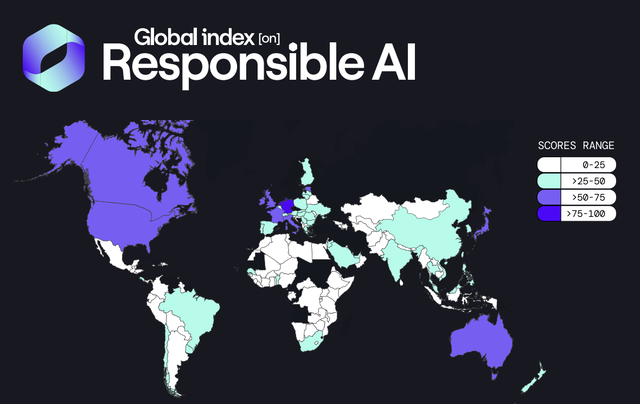
▸ Nigeria ranked 1st in Africa and 38th globally in the GIRAI 2026 out of 135 countries, up 42 places from 80th in 2024
▸ Overall score jumped from 7.21 to 45.93 — a near-sixfold improvement in just two years
▸ Nigeria was named a global ‘Bright Spot’ for AI literacy and child data protections
▸ The 3MTT programme and the National AI Strategy (NAIS) 2025 were singled out as key drivers of the climb
▸ Nigeria outperforms approximately 72% of all 135 countries assessed and sits well above the African regional average of 21.79
MAIN STORY
Nigeria has done something few African governments have managed to pull off in the compressed, high-stakes race to govern artificial intelligence: it has gone from an afterthought on the global stage to its continent’s undisputed leader — in two years flat.
On July 8, 2026, the Global Center on AI Governance released the second edition of the Global Index on Responsible AI (GIRAI 2026) at a launch event in Geneva, Switzerland. The index, described as the world’s most comprehensive evidence-based assessment of responsible AI governance, evaluated 135 countries and jurisdictions across more than 68,000 data points. When the results were published, Nigeria’s name sat at the top of the African column — ranked 1st on the continent and 38th globally, with an overall score of 45.93 out of 100.
In the inaugural 2024 edition, Nigeria had scored just 7.21 and ranked 80th globally. The 42-place leap in a single index cycle is among the most dramatic improvements recorded by any country in the assessment. It positions Nigeria well above the African regional average of 21.79, ahead of second-placed Egypt, and within the top third of all nations assessed worldwide — outperforming roughly 72% of all countries in the index.
The GIRAI evaluates five core dimensions: Inclusion and Diversity; Ethics and Sustainability; Labour and Skills; Trust and Safety; and AI Use in Public Service. It also weighs AI Policy frameworks, Civil Society Engagement, and broader Enabling Conditions such as rule of law and digital infrastructure — all grounded in verifiable evidence sourced from national strategies, legislation, government initiatives, and civil society action.
Below, BizWatch Nigeria breaks down the seven most significant areas of gain — and what they mean for Nigeria’s position in the global AI economy.
THE GAINS: A CLOSER LOOK
#1 — Trust and Safety: Nigeria’s Strongest Pillar, 29th Globally
Score: 63.45 | Global Rank: 29th | African Rank: 1st
Nigeria’s single strongest performance area in the GIRAI 2026 is Trust and Safety — and it is a score that commands global respect. At 63.45 out of 100, Nigeria ranked 29th in the world and first in Africa in this dimension, which assesses a country’s capacity to protect citizens from the harms of AI, including misinformation, cybersecurity failures, inadequate data protection, and the absence of redress mechanisms when AI systems go wrong.
The scores in this category were driven primarily by Nigeria’s legal and regulatory architecture for data protection. The Nigeria Data Protection Act and the General Application and Implementation Directive (GAID) 2025 emerged as landmark instruments — both explicitly addressing children’s personal data, and both prohibiting decisions made solely through automated processing without human oversight. In an era when AI systems are making increasingly consequential decisions about people’s lives — from credit access to health assessments — these legal guardrails matter enormously.
Consumer protection frameworks and redress mechanisms also contributed positively. The index recognises Nigeria as one of the few lower-middle income countries to have built meaningful safety infrastructure that rivals many wealthier nations. At 29th in the world — ahead of dozens of European and Asian economies in this specific pillar — Nigeria is punching significantly above its weight.
#2 — A Near-Sixfold Score Improvement: From 7.21 to 45.93
Overall Score: 45.93 (2026) vs. 7.21 (2024) | Global Jump: +42 positions
Numbers in governance indices rarely move this dramatically. Between the 2024 and 2026 editions of the GIRAI, Nigeria’s overall score increased by more than 38 points — nearly a sixfold multiplication. The country climbed 42 positions, from 80th to 38th, out of 135 countries. That kind of movement is not accidental. It reflects a concentrated, policy-driven effort to convert commitments on paper into verifiable action.
The GIRAI methodology is deliberately designed to reward implementation over aspiration. It does not simply count whether a country has published an AI strategy — it evaluates whether that strategy has led to concrete initiatives, measurable actions, and institutional capacity. Nigeria’s score jump signals that between 2024 and 2026, the country moved decisively from policy declaration to policy delivery.
To put this in context: the global average score in GIRAI 2026 sits at approximately 35 out of 100 — meaning Nigeria, at 45.93, now sits above the world average. The continent’s average hovers around 21.79, which Nigeria more than doubles. For a country that less than two years ago was a lower-quartile performer on this same index, the trajectory is remarkable.
#3 — Inclusion and Diversity: 35th in the World, 1st in Africa
Score: 52.06 | Global Rank: 35th | African Rank: 1st
One of the central critiques of AI globally — and particularly of AI developed in the Global North — is that it tends to reflect and reinforce existing inequalities, systematically disadvantaging women, minorities, people with disabilities, and non-English-speaking populations. The GIRAI’s Inclusion and Diversity dimension measures how actively countries are working against these tendencies.
Nigeria’s score of 52.06 — ranking 35th globally and first in Africa — reflects notable performance in gender equality frameworks applied to AI, cultural and linguistic diversity considerations in AI policy, and protections against algorithmic bias and discrimination. These are not trivial achievements for a country navigating significant internal inequalities of its own.
The National Artificial Intelligence Strategy (NAIS) 2025 explicitly incorporates inclusivity mandates — a deliberate design choice that the GIRAI’s researchers flagged positively. A country of Nigeria’s demographic complexity and linguistic diversity achieving a top-35 global score on inclusion represents a genuine policy achievement, and one that has direct implications for how AI systems built or deployed within the country will serve its 220 million people.
#4 — Named a Global ‘Bright Spot’ for AI Literacy and Child Protections
Recognition: Global Bright Spot | Focus Areas: AI Literacy, Child Data Protection
Beyond the raw rankings, the GIRAI 2026 report singled out Nigeria for special recognition as a global ‘Bright Spot’ — a designation reserved for countries demonstrating exemplary practice in specific areas that other nations would do well to study. Nigeria earned this designation for its dual focus on building AI literacy at scale while simultaneously strengthening legal protections for children in the digital environment.
On the AI literacy front, the index highlighted the National Artificial Intelligence Strategy’s explicit mandate for broad-based skills development, including structured teacher training programmes designed to embed AI literacy into formal education. On the child protection side, the Nigeria Data Protection Act and GAID 2025 were cited as providing enhanced safeguards for children’s personal data and explicitly banning automated decision-making processes where children are the subjects.
According to the index, Nigeria is among a small number of African countries to have simultaneously invested in preparing its citizens for an AI-driven economy while also protecting its most vulnerable populations from the risks that AI systems can introduce. The combination of both, codified in law and backed by active government programmes, is what earned the Bright Spot designation — a recognition that will carry weight in international policy circles.
#5 — The 3MTT Programme: Putting AI Skills in 3 Million Hands
Labour and Skills Score: 40.85 | Global Rank: 62nd | African Rank: 10th
One of the Federal Government’s most prominently cited initiatives in the GIRAI report is the 3 Million Technical Talent (3MTT) programme — a hybrid training initiative designed to equip three million Nigerians with practical skills in artificial intelligence, machine learning, and other digital technologies. The index explicitly highlighted the programme as a significant, scalable effort that directly contributed to Nigeria’s improved Labour and Skills scores.
Nigeria’s Labour and Skills score of 40.85 placed it 62nd globally and 10th in Africa — a solid position, though it also identifies the dimension as one where room for further growth remains. The GIRAI evaluates this dimension by measuring the extent to which governments are investing in AI reskilling and upskilling for workers, building AI literacy across the population, and creating protections for workers whose jobs are being transformed or displaced by AI systems.
The 3MTT programme’s hybrid model — combining in-person training with digital learning — is designed precisely to address the access challenge that makes skills development programmes fail in large, geographically diverse countries. By reaching young Nigerians across all geopolitical zones, the programme goes beyond urban tech hubs and attempts the harder task of democratising AI skills nationally.
#6 — The National AI Strategy (NAIS) 2025: A Framework That Translated Into Action
AI Policy Score: 51.18 | Civil Society Engagement: 26.94 | Enabling Conditions: 41.76
At the structural heart of Nigeria’s GIRAI 2026 performance is the National Artificial Intelligence Strategy (NAIS) 2025 — a comprehensive national framework developed by the Federal Ministry of Communications, Innovation and Digital Economy under Minister Dr. Bosun Tijani. With an AI Policy score of 51.18, the NAIS emerged as one of the most substantive policy documents among Global South nations assessed by the index.
What distinguished the NAIS in the index’s evaluation was not just its existence — many countries have published AI strategies — but its specificity and its linkage to implementation. The strategy covers ethics, skills development, inclusion mandates, international partnership objectives, and governance frameworks. It also ties AI development explicitly to Nigeria’s broader economic ambition, framing responsible AI as a pillar of the country’s path toward a $1 trillion economy.
The Enabling Conditions score of 41.76 presents a more mixed picture. Nigeria performs well on data protection and digital infrastructure relative to its income group, but the index notes challenges in broader metrics such as rule of law and overall infrastructure coverage. These are the areas where the gap between policy intent and on-the-ground reality remains largest — and where future index editions will be watching most closely.
#7 — Ethics and Sustainability: 37th Globally, With Room to Build
Score: 49.63 | Global Rank: 37th | African Rank: 2nd
Nigeria’s Ethics and Sustainability score of 49.63 — ranking 37th globally and 2nd in Africa in this dimension — reflects strong performance in fairness, non-discrimination frameworks, and transparency requirements for AI systems. The dimension assesses how robustly a country’s governance architecture compels AI actors to be accountable, transparent, and fair in their deployment of AI technologies.
Fairness and non-discrimination provisions in Nigeria’s data protection legislation, combined with requirements for transparency in automated decision-making embedded in the GAID 2025, contributed meaningfully to this score. However, the index also flags environmental impact as an area where Nigeria — like most developing nations — has yet to build sufficient governance frameworks. The energy and water consumption implications of large-scale AI infrastructure remain under-addressed in Nigeria’s policy architecture.
At 2nd in Africa on this dimension, Nigeria trails only in the precise area where Egypt edges ahead — a reminder that the continental competition in responsible AI governance is genuinely competitive at the top, and that complacency is not an option.
WHAT’S BEING SAID
The Federal Government has been vocal about the significance of the ranking. In a statement released on Thursday through Isime Esene, media aide in the Office of the Minister of Communications, Innovation and Digital Economy, Minister Dr. Bosun Tijani placed the achievement in the context of Nigeria’s broader development aspirations:
“This recognition is a testament to Nigeria’s deliberate efforts to build an AI ecosystem that is inclusive, responsible, and aligned with our development priorities. We believe that Africa must not only participate in the AI revolution but also contribute meaningfully to shaping how these technologies are governed and deployed globally. Our focus remains on creating the infrastructure, talent, and policy environment that will enable AI to deliver real value for our people and support President Bola Ahmed Tinubu’s vision of building a $1 trillion economy.”
— Dr. Bosun Tijani, Minister of Communications, Innovation and Digital Economy, Federal Republic of Nigeria
The government’s official statement further noted that Nigeria’s performance reflects what it described as ‘deliberate and strategic efforts’ to position the country ‘not only as an adopter of emerging technologies, but also as a leader in shaping inclusive and ethical AI governance globally.’ It specifically referenced sustained work under President Bola Ahmed Tinubu’s administration across digital public infrastructure, talent investment, international partnerships, and governance frameworks for emerging technologies.
The GIRAI 2026 launch event in Geneva was attended by key stakeholders including representatives from UNESCO, the UNDP, and Microsoft — underscoring the index’s positioning as a globally authoritative tool informing multilateral policy. The Global Center on AI Governance, the body behind the index, noted that the 2026 edition was built with the contributions of more than 130 researchers globally, with the Sub-Saharan Africa component coordinated by the Local Development Research Institute (LDRI).
THE ISSUES
The Gap Between Policy and Public Sector Delivery
Nigeria’s lowest-scoring dimension in the GIRAI 2026 is AI Use in Public Service, with a score of 23.65 placing the country 79th globally and 10th in Africa. This is the dimension that evaluates how effectively governments are actually deploying AI in public services — and doing so transparently, with proper procurement processes and trained personnel. It is here that the gap between Nigeria’s impressive policy frameworks and its on-the-ground implementation reality is most visible.
The index specifically flags weaknesses in public disclosure of AI systems used by government, procurement transparency, and skills development within the civil service for AI adoption. These are structural issues: many governments globally score poorly on AI in Public Service, and it tends to be the last frontier in responsible AI governance — requiring not just policy, but institutional reform, budget commitment, and cultural change within public sector agencies. Nigeria’s 79th global ranking in this dimension is a signal that the policy architecture exists, but the translation into government operations remains work-in-progress.
Enabling Conditions: The Infrastructure and Rule of Law Ceiling
With an Enabling Conditions score of 41.76, Nigeria’s broader operating environment presents a mixed picture. The index acknowledges Nigeria’s genuine strengths in data protection legislation and the growing digital economy. But it also incorporates secondary indicators including rule of law, equality metrics, cybersecurity posture, environmental performance, workers’ rights frameworks, and digital access — areas where Nigeria continues to face structural headwinds. Until these broader enabling conditions improve consistently, Nigeria’s AI governance achievements will remain vulnerable to implementation gaps that policy frameworks alone cannot solve.
WHAT’S NEXT
▸ The full GIRAI 2026 report and Nigeria’s detailed country profile are publicly available at global-index.ai, where policymakers, investors, and researchers can access the complete scoring breakdown across all 38 indicators.
▸ The Federal Ministry of Communications, Innovation and Digital Economy is expected to continue expanding the 3MTT programme, with capacity targets for AI/ML training likely to be revised upward in light of the international recognition the programme has received.
▸ Nigeria’s weaker performance in AI Use in Public Service — 79th globally — represents the clearest policy mandate for the next phase: scaling AI adoption within federal and state government operations, strengthening procurement transparency, and building AI capacity within the civil service.
▸ The next edition of the Oxford Insights Government AI Readiness Index — in which Nigeria moved 31 places to 72nd globally earlier in 2026 — is expected to track whether the momentum demonstrated in the GIRAI continues to translate across multiple governance benchmarks.
BOTTOM LINE
The Bottom Line: Nigeria’s 42-position climb in the GIRAI is not a soft victory — it is a governance achievement backed by 68,000 data points verified by an independent global research network. The country has demonstrated that rapid, evidence-based improvement in responsible AI governance is achievable in the Global South. But the index also makes clear that the hardest work lies ahead: translating world-class policy frameworks into transparent, accountable, and measurable AI deployment inside the very government institutions that wrote the frameworks in the first place. The world is watching to see if Nigeria can make that final leap.
Sources: GIRAI 2026 official report (global-index.ai); Leadership Newspaper; The Sun Nigeria; Global Center on AI Governance press release; Federal Ministry of Communications, Innovation and Digital Economy official statement. July 9, 2026.