






KEY POINTS
- Sterling Bank and French development finance institution Proparco have signed a $30m credit facility to support renewable energy projects and agricultural SMEs in Nigeria.
- Renewable energy will receive $24m, representing 80 per cent of the facility, while $6m is allocated to agricultural businesses.
- The financing is expected to expand access to decentralised clean energy and address credit constraints across agricultural value chains.
- The agreement supports Sterling Bank’s HEART strategy, which prioritises health, education, agriculture, renewable energy and transportation.
MAIN STORY
Sterling Bank and French development finance institution Proparco have signed a $30m senior credit facility to finance renewable energy projects and small and medium-sized enterprises (SMEs) operating along Nigeria’s agricultural value chains.
The agreement allocates $24m, or 80 per cent of the facility, to renewable energy financing, while the remaining $6m will support agricultural SMEs. The funding is expected to improve access to reliable electricity for households and businesses while strengthening local agricultural production and food security.
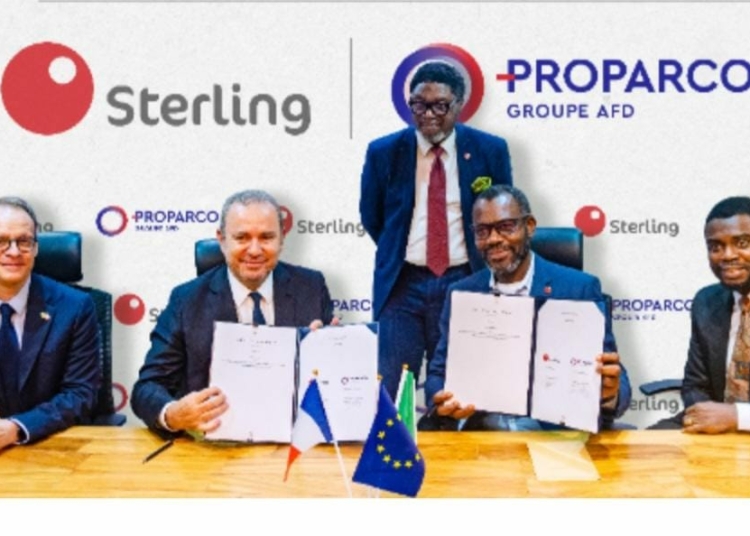
The agreement was signed in Lagos by Sterling Bank’s Managing Director and Chief Executive Officer, Abubakar Suleiman, and the Chief Executive Officer of the Agence Française de Développement (AFD), Christophe Lecourtier.
The renewable energy component will support decentralised power solutions, particularly solar installations, as households and businesses continue to contend with limited electricity access and dependence on generators. The agricultural component will address financing constraints facing businesses across the value chain, where access to credit can determine their ability to sustain production and expand operations.
THE ISSUES
The financing comes against the backdrop of Nigeria’s electricity access challenges, with more than one-third of the population still lacking access to electricity. For many households and businesses, generators remain an alternative, adding to operating costs and dependence on fossil fuels.
Suleiman said the power challenge increasingly required financing that could help consumers move towards decentralised electricity solutions rather than relying entirely on expansion of the national grid.
He argued that many households and businesses already spend money generating their own electricity but lack the capital to switch to cleaner alternatives.
The agricultural allocation addresses a different but related financing gap. Businesses operating across agricultural value chains require credit to support activities ranging from production to other stages of the supply chain. The bank expects the facility to strengthen local production capacity, create economic opportunities and improve the resilience of agricultural businesses.
WHAT’S BEING SAID
“We have long treated Nigeria’s power problem as a generation problem waiting for the grid to solve it. Increasingly, it is a financing problem with a distributed solution. Millions of households and businesses already pay for power through generators. What they lack is the capital to switch to something cleaner and, over time, cheaper. That is the gap this facility helps us close.”
- Abubakar Suleiman, Managing Director and Chief Executive Officer, Sterling Bank.
“Agriculture has the same problem because demand is rarely what holds farmers back; the cost and availability of credit along the value chain is. Sterling’s HEART strategy rests on a simple view: a bank does its best work where finance changes outcomes. Our partnership with Proparco extends that work.”
- Abubakar Suleiman, Managing Director and Chief Executive Officer, Sterling Bank.
“In Nigeria, as throughout Africa, the energy transition must be a driver for sustainable transformation, at the intersection of climate, economic, and social challenges.”
- Christophe Lecourtier, Chief Executive Officer, Agence Française de Développement.
WHAT’S NEXT
Sterling Bank said the facility aligns with its HEART strategy, which focuses on financing health, education, agriculture, renewable energy and transportation.
The bank has also set a target of achieving carbon neutrality by 2050. Its environmental initiatives include installing solar power systems at its headquarters and nearly half of its branches and automated teller machines.
Other renewable energy activities include its Imperium platform, which provides access to renewable energy equipment and services, and an electric mobility initiative intended to promote cleaner transportation and create career opportunities, particularly for women.
Lecourtier said the partnership reflected the AFD Group’s approach of working with local banks and private businesses to extend the impact of development financing. He said the facility would support clean energy access, agricultural value chains and job creation.
The partnership also forms part of Sterling Bank’s efforts to promote women’s economic inclusion through initiatives aimed at helping women entrepreneurs build skills and grow their businesses.
BOTTOM LINE
The $30m facility directs most of its funding towards renewable energy, while also providing credit for agricultural SMEs. Its impact will depend on how effectively the financing reaches businesses and households that need it, and whether the supported projects deliver more reliable power, stronger agricultural production and sustainable economic opportunities.