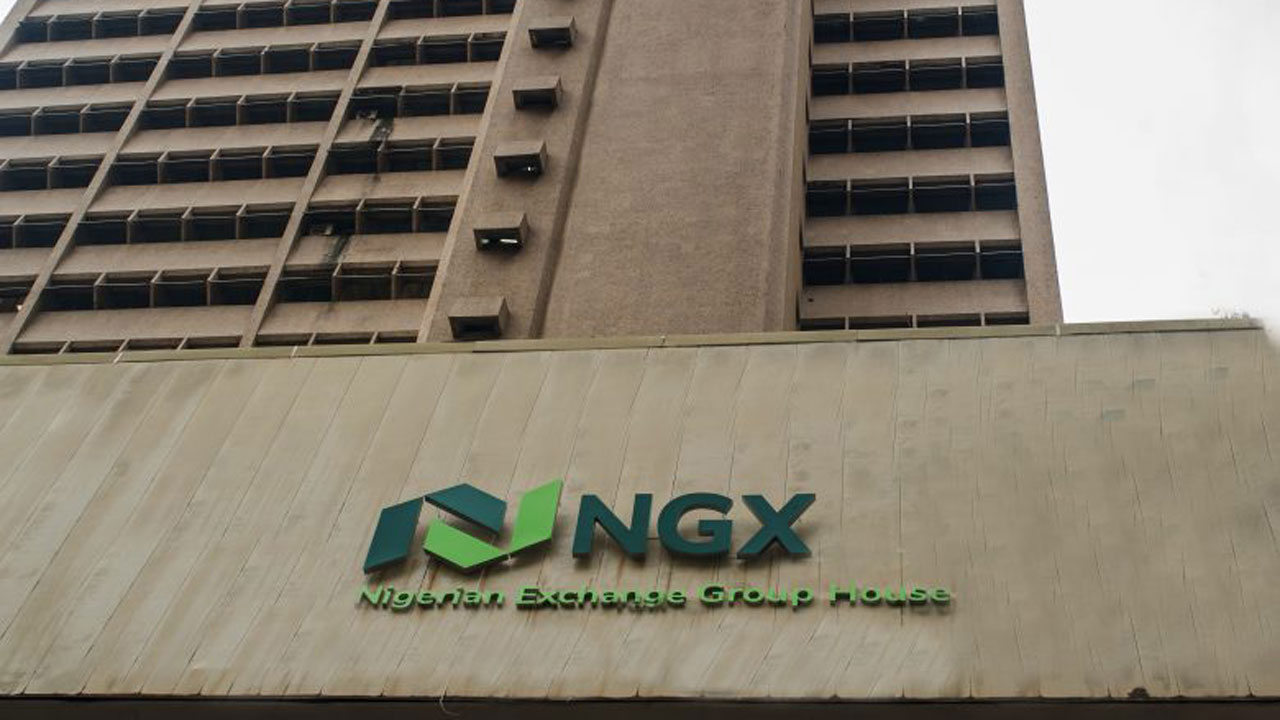
Trading activities on the Nigerian Stock Exchange, NSE, closed in the red zone as the All Share Index dropped by 1.36% on Tuesday, February 23, to close at 24,090.98 points.
Year-to-date (YTD), it depreciated by 15.89%.
Likewise, the Market Capitalization dropped by 1.36% to close at N8.29trn, compared with the marginal depreciation of 0.04% recorded yesterday to close at N8.40trn.
The depreciation recorded in the share prices of Dangote Cement, FBN Holdings, ETI, Oando, and Transcorp were mainly responsible for the loss recorded in the Index.
The total value of stocks traded on the floors of The NSE today was N1.26bn, down by 78.92% from N5.99bn traded yesterday. The total volume of stocks traded was 201.72mn in 2,559 deals.
The three most actively traded stocks were: FBN Holdings (66.62mn), Beco Petroleum (25.00mn) and GT Bank (15.92mn). The most actively traded sectors were: Financial Services (144.92mn), Oil and Gas (28.72mn) and Consumer Goods (13.49mn).
The International Monetary Fund, IMF, has said that Oil-exporting countries in the Middle East and Africa lost more than $340 billion in oil revenue from their budget in 2015, amounting to 20 per cent of their combined gross domestic product.
IMF Managing Director,Christine Lagarde, on Monday, February 22, said that supply and demand factors in the oil market suggest that oil prices are “likely to stay low for an extended period.”
This will mean that all oil exporters will have to reduce spending and work on raising revenues. At the same time, these economies need to strengthen their fiscal frameworks and reengineer their tax systems – by reducing their heavy reliance on oil revenues and boosting non-hydrocarbon sources of revenues,” Lagarde said.
The slump in prices led Nigeria to loss of over $62.8 million revenue between November and December last year. President Muhammadu Buhari left Nigeria Sunday for the Gulf in what Presidency officials said is an ongoing efforts by Nigeria and other members of the Organisation of Petroleum Exporting Countries to achieve greater stability in the price of crude oil exports.
Speaking at the Arab Fiscal Forum in Abu Dhabi, Lagarde added that such adjustments will help bolster growth and job creation and help maintain debt sustainability.
The US oil and gas industry has lost about 100,000 jobs over the past 16 months, according to the US Bureau of Labour Statistics. Employment losses worldwide are probably at least double that figure. And these are only people employed directly by oil and gas producers, drilling contractors and other oilfield services firms.
Nigeria spends a total of $2 billion annually to import agricultural products into the country, the Minister of Transportation, Rotimi Amaechi, revealed.
The Minister made this known during an inspection tour from Rigasa rail station in Kaduna to Idu Station in Abuja last Friday.
He said agriculture is an exceptionally important element of Nigeria’s economy. Amaechi went to say that the large import of food products include wheat, rice, flour, fish, tomato paste, eggs, textile and sugar.
The Minister however, stressed the need to diversify the mono-cultural tendencies of the Nigerian economy by developing other sectors of the economy especially agriculture.
“Major agricultural imports are wheat, rice and sugar. Most agricultural imports come from the US and the EU. The country’s main agricultural exports are cocoa beans, rubber, sesame seeds and cocoa butter. Key agricultural export destinations are the UK, the US, Canada, France and Germany.”
“We were known to be exporters of cocoa beans, gum Arabic, groundnuts, cotton, palm oil and many other agricultural commodities, but now, we import most of the agricultural commodities that we can produce because of the neglect of the sector.
“About 30 percent of live animals slaughtered in Nigeria are imported from neighbouring countries. Like other subsectors, livestock industry development is constrained by low productive breeds, inadequate access to feeds and grazing lands, frequent farmer – pastoralist conflicts, lack of processing facilities and low value addition and low technical inputs in the management of the animals, including diseases.”
However, industry watchers said the country could increase its agricultural sector output to $227 billion by 2030, thus, raising the annual growth rate to 4.2 per cent. But achieving the feat would require a four-pronged approach which boosting yields, shifting more production into high value crops, reducing post-harvest and distribution losses, and increasing scale production. The biggest opportunity in agriculture is improving crop yields, which accounts for 39 per cent of the upside potential.
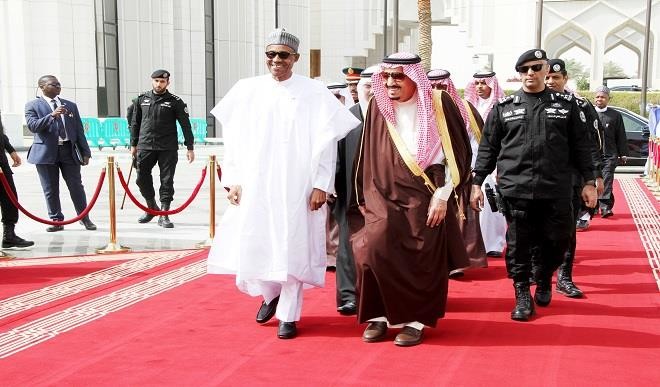
President Muhammadu Buhari and King Salman Bin Abdul-Aziz of Saudi Arabia have expressed their commitment to finding a lasting solution to the lingering crash in the prices of oil.
President Buhari and Abdul-Aziz expressed this commitment in Riyadh on Tuesday, February 23, at a bilateral meeting hosted by the latter.
A statement by President Buhari’s Senior Special Assistant on Media and Publicity, Mallam Garba Shehu, said both leaders accepted the fact that their countries’ economies are tied to oil and that all cannot be well with both countries when the world oil market is unstable.
Shehu said both leaders therefore committed themselves to doing all that was possible to stabilise the market and rebound the oil price.
He said both leaders who also engaged in extensive discussions on regional and global issues, agreed that terrorism posed a common threat to their countries and would require close cooperation to prevail over the threats.
Shehu said Buhari, while making his first pronouncement on the invitation to join the coalition of Islamic states against terror spearheaded by the Saudis, congratulated the Kingdom on its formation.
“Even if we are not a part of it, we support you. I must thank the Kingdom of Saudi Arabia for the recent creation of a coalition to address the menace of international terrorism. Nigeria will support your efforts in keeping peace and stopping the spread of terror in your region.”
“This is in consonance with our own commitment and on-going efforts in seeking to stamp out Boko Haram terrorists from the West African sub-region and Lake Chad Basin Commission (LCBC)”, Buhari said.
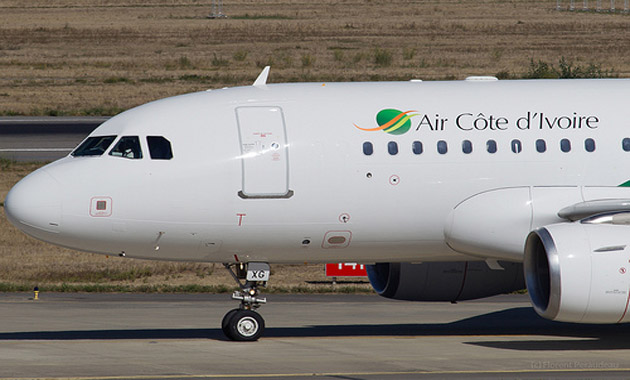
Air Côte d’Ivoire, has announce plans to increase its fleet of seven aircraft to nine by April 2016.
The African carrier stated this recently in Abidjan, Cote D’Ivoire when its received its third new Bombardier Dash Q400 NextGen aircraft, which increases its fleet to seven.
The airline also said that it hoped to increase the cities it flies into to 22 from its present 18 by 2016 and estimated a capital increment of 65 billion to over 100 billion FCFA before the end of next year.
The statement issued in Lagos by the media consultant to the airline quoted its Managing Director, Mr. Rene Decurey as saying that the airline was achieving its target with the delivery of Bombardier Dash Q400 Aircraft, which had enabled it increase regional and domestic routes and frequencies.
Decurey explained that its new aircraft was as fast as a jet, flexible, silent, comfortable and energy efficient, adding that it’s an idle aircraft that could operates both domestically and regionally.
Decurey emphasised that by 2018, the airline would have been profitable, but noted that to achieve this, new route must be opened and new planes must be acquired. With such growth and prospect, he said the airline has invested in training its own pilots and airplane mechanic with the partnership of INPHB and the Aeronautic institute Amaury of Grange (IAAG) and is currently training 15 pilots, and by 2018 would have 20 airplanes mechanics.
Law Union & Rock Insurance plc, has announced the payment of a total of N1.64 billion claims in 2015.
Managing Director of the company, Jide Orimolade, in a statement, said a breakdown of the above figure, showed that claims paid by the company in 2015, ranged from Fire, General Accident Motor, Marine & Aviation, Engineering, Bond and Oil & Energy.
He also said that fire & motor insurance claims, accounted for almost 73% of the overall claims paid during the year.
He said that the statistics show that the number of accidents that emanate as a result of fire and motor accidents in the country was on the increase during the period and that the company is determined to stand like a “rock” behind its customers and also keep its promise of delivering prompt claims payment to its customers.
The Law Union& Rock Insurance boss, also said the astronomical rise by 28 to 38 percent in claims payment between 2014 and 2015 experienced by the company, indicates the level of awareness and exposure of the customers.
He said despite the dwindling & harsh economic condition in the country, the company, was able to meet up N1.64 billion in claims obligation.
“This singular act demonstrates that the company is committed to putting its customers first, and always make them satisfied”, Orimade stated.
Equities value dropped by N114 billion on Tuesday, February 23, as the Nigerian Stock Market remained in the bear domain.
Market turnover closes negative as volume declined by 94.16 per cent against 1902.92 per cent uptick recorded in the previous session. FBN Holdings, Beco Petroleum and Guaranty Trust Bank were the most active to boost market turnover. FBN Holdings topped market value list.
Tiger Brands leads the list of active stocks that recorded impressive volume spike at the end of the trading session.
Market watcher believed that investors would continue to favor as short term approach to equities which will likely see a blend of profit taking and cherry picking this week.
Market breadth closed negative as Lafarge Africa Plc led 13 gainers against 26 losers topped by Dangote Cement at the end of the trading session which was an unimproved performance when compared with previous outlook.
The Naira regained more strength at the Bureau De Change market as it exchanged at N310 to the dollar on Tuesday, February 23.
Findings showed that Abuja bureau de change market operators were buying at N310 to one dollar from walk-in customers as against the about N400 last week.
However the BDCs were still selling at N360 to customers willing to buy, while the Central Bank of Nigeria (CBN) official rate remains N199.50 to the dollar.
The president of the association, Aminu Gwadabe in a news briefing yesterday in Lagos said: “with the intense scarcity of the dollar in the market, the rate is largely determined by sellers and not by Bureau de change (BDCs), we are largely resellers and what we get as margin is a function of the rate we buy”
The free fall of the naira against the dollar hit an all-time high by exchanging for N400/ $ last week but appreciated to N375/ $ by Monday following the president’s defiance on the devaluation of the currency.
Gwadabe said: “the stance of the President Buhari is helping to clear the doubt in the forex market. What we are experiencing is not a realistic rate but a passive rate brought about as a result of rush by people to stock the dollar for long term activities to avoid the effect of further depreciation.
Allocation from the Federation Account to be shared by the three tiers of government in February, plunged by N17.38 billion compared to what was shared in January.
The allocation for December 2015, distributed last month was N387.77 billion compared to the N370.38 billion distributed yesterday for January.
The drop in the allocation was attributed to the fall in oil prices from $43.4 to $39.04 which resulted in revenue loss amounting to $22.55 million.
Finance Minister Mrs Kemi Adeosun told reporters at the end of the monthly Federation Account Allocation Committee (FAAC) meeting in Abuja on Tuesday night, February 23, that the drop in the funds distributed was caused by several reasons including oil production shut- in and shut downs; continued drop in oil price and the diversion of Federation Account revenue to fund the Joint Venture Cash (JVC) call commitment to oil majors in the production of crude minerals.
She confirmed that as a result of the continued oil price plunge and inability of government to meet the JVC cash call commitment, government was working a modified carrier strategy to raise funds from the debt market to fund the commitments as it could no longer be guaranteed from oil proceeds.
Transactions recorded across Point of Sale, PoS terminals in January 2016 plunged by N7billion in Nigeria.
The transactions volume by various merchants across the country in January was valued at N46 billion in some 3.6 million number of transactions compared to N53 billion in December 2015.
The December figure was attributed to festive activities at that time when people made lots of purchases.
Executive Drector, Business Development, Nigeria InterBank Settlement System (NIBSS), Christabel Onyejekwe in a presentation at Remittance conference said non deployment of more PoS machines affected value and volume of PoS transactions.
She said, “There is dilemma in the deployment of PoS terminal in that space, which has remained at 62, 000 for the past one year because of high exchange rate of the naira to the dollar which makes the cost of a terminal high to go for as much as N80, 000 per terminal.”
The Managing Director, Global Accelerex, Tunde Ogungbade said the surge in foreign exchange in the last four months makes it difficult to acquire PoS terminals like other products are manufactured abroad and imported into Nigeria.
The Central Bank of Nigeria, CBN, said it had granted N14.7 trillion total credit to the economy as of June 30th, 2015.
Of the aforementioned amount, N760.8 billion representing five per cent, was contributed by collective Development Financial Institutions (DFIs), in the country.
The apex bank boss, Godwin Emefiele, made this disclosure on Tuesday, February 23, in Abuja while presenting key note address at the maiden edition of the bi- annual forum for stakeholders of DFIs.
Represented at the occasion by Deputy Governor, Financial System Stability, Joseph Nnanna, Emefiele revealed that given the limitation in the resources available at the disposal of DFIs, “government was considering a plan that would make it possible for DFIs to access the capital market for fund to finance critical sectors of the economy.
According to Emefiele, “the Nigerian experience has shown that government resources have been the main source of long term fund for these institutions, which is not sustainable.”
“It is therefore, envisaged that with time, the DFIs would be capable of accessing the capital market for funds to finance the critical sectors of the economy.”
Findings have revealed that Nigerians in the diaspora are avoiding sending cash to Nigeria through the regular money transfer agencies in the country as they seek to take advantage of the wide gap between the official naira exchange rate and that of the parallel market.
While the official naira exchange rate to a dollar is N197 to a dollar, it is sold at about N370 to a dollar on the parallel market.
Nigerians that live abroad now prefer to send dollar cash and other foreign currencies to the country, so that the beneficiary would be able to convert it at the black market rate at higher value, THISDAY findings show.
With about $21 billion sent home by Nigerians in diaspora in 2015, the country was the sixth largest receiver of remittances in the world in 2015.
This was revealed by the Migration and Remittances Factbook 2016. The country was also by far the largest receiver of remittances in the continent, which was said to have received a total of $34.8 billion last year.
The report, which relied on data gathered from January to December 1, 2015, was compiled by the Global Knowledge Partnership on Migration and Development with support from the World Bank, German, Swedish and Swiss governments
Tony Ehiguese Digital Marketing Specialist tony.e@digicraft.ng | @tehiguese
I’ve often wondered what brands do to keep consumers coming back for only their products. I listen to brand owners talk about the high level of consumer insights and behavioral patterns at their fingertips. However, I was taken quite aback when the series of competitive value propositions flooded the beverage market.
You see, I’ve held on to this notion that a customer is capable of staying glued to your brand if you deploy the right marketing campaigns. Well, that changed quickly with FMCG brands and I think the brand managers think the same way.
It all started with the introduction of the Big Cola drinks by AJEAST. This was a smart move as AJEAST had a plan to enter the Nigerian market as quickly as possible. Hence they offered 65CL pet size of their drink for N90. Up till now, I haven’t seen an ad on the Big Cola but I see it in every shop I go.
In terms of awareness, Pepsi and Coca cola probably have the highest top of mind for any beverage company not just in Nigeria, but worldwide. It was surprising to see that Pepsi also introduced more value by increasing the size of their pet bottles to 60CL for the same price. This was cleverly done via their somewhat successful online ‘Long Throat’ campaign. It insinuated that revenue was under threat from the AJEAST brands and they had to act fast.
Coca Cola recently followed suit by also introducing 60CL pet bottles at the same price. For a company that owns the second most common word in the world to feel threatened by competition is something to think about. Could it be that we as Nigerians, don’t care about brands and we just want more value for less or are brands not doing enough to bond with their consumers? Both questions have the capability of painting the right picture. I recently was exposed to campaigns executed by brands (Especially Coca Cola) abroad and I was impressed. There is this conscious effort in their campaigns to generate emotions from consumers and this is key. Little wonder why we have coke and pepsi addicts over there. I recently had a chat with a friend on this issue and these were his exact words:
‘Nigeria is still a poor country. We think of the price and the value first. The quality can come after’.
While this represents his opinion, he may not be far from the truth. There was the case of Cowbell milk to Peak milk and Tecno mobile phones to the likes of Iphone and Samsung to buttress his point. Value proposition is beginning to move to the telecoms industry as GLO is constantly gaining the highest amount of internet subscribers – due to their ridiculously cheap data plans. Spectranet is also dominating the ISP market due to their low data offerings. Whether or not their product or service is top notch is a different case.
So if this is the case, do we need to step up our marketing campaigns to retain customers or simply throw quality out the window and offer consumers more value for lesser price? That’s left for the brand custodians to decide.
World Health Organization (WHO) has promised to support Nigeria and other countries that have recently suffered outbreaks of meningitis C.
WHO Regional Director for Africa, Dr. Matshidiso Moeti, stressed the need to introduce the vaccine MenAfriVac into the routine immunization schedule for Nigeria and 25 other meningitis belt countries.
Moeti said Meningococcal meningitis A epidemics had been nearly eliminated from Africa. “We now need to urgently make progress in our fight against other strains of meningococcal meningitis, learning from the spectacular success of MenAfriVac. The price of MenAfriVac, at less than $0.50 per dose, ensured that this vaccine is a sustainable public health solution.
“In the past year, both Niger and Nigeria have suffered outbreaks of meningitis C, and meningitis W135 is responsible for the current outbreak in Togo. Meningitis X also remains a threat.
After a successful two-week of exciting polo, music, fashion, champagnes and cocktails, the 2016 NPA Lagos International Polo Tournament finally came to a grand close on Sunday 21st February 2016 at the Lagos Polo Club, Ikoyi, Lagos.
From thrilling performances by players and music stars, to the dazzling GTBank Lounge where guests were treated to epicurean cuisine and vintage wine, the 2016 NPA Lagos International Polo Tournament lived up to its billing as the best tournament ever. Elite, stylish and extravagant are few words that describe this year’s event, as the social scene at the annual Lagos polo tournament was as much of a show as the game on the pitch.
Following a 2-year hiatus, the organizers set out to host an event second to none and unparallel on every front. The game attracted everyone from big name politicians, aristocrats, traditional leaders, sport lovers and the full panoply of professional players from Argentina, Syria and South Africa.
An exciting first stage of the high-class tournament came to a close on Valentine’s Day with Lagos Shoreline emerging the biggest winner by clinching the Open Cup at the expense of Lagos Caverton while Lagos dominance of the first stage was highlighted once again by Sao Polo’s win of the Dansa Cup against STL in an all-Lagos final. Lagos Shoreline defeated Lagos Caverton 9-8 to emerge champions of the Open Cup while Lagos Sao Polo beat STL 5-4 1/2 to win the Dansa Cup. The Kola Karim-led Shoreline also added the Oba of Lagos Cup, which they won by beating Lagos Ashbert.
The second stage of the tournament kicked-off on February 16th with three matches in the Low Cup. However, the highlight of this stage was the prestigious Majekodunmi Cup, which is the most-lucrative trophy in Nigerian sports, as it worth N25m for the winners. Fifth Chukker Polo emerged winners of the prestigious Majekodunmi cup having defeated Ironclad/Trojan in the final. In the Low Cup final, Aerovote defeated Lagos Zippy while the last match of the day saw Kano Titans beat Kano Keffi Ponys in the Majekodunmi Subsidiary final to clinch the Governor’s Cup.
Commenting on the GTBank sponsored NPA 2016 Lagos Polo tournament, Mr Segun Agbaje, Managing Director of Guaranty Trust Bank plc stated that “We are proud to partner one of Nigeria’s oldest and most reputable Polo Clubs in delivering an event that is second to none on the Country’s social and sporting calendar, and one that provides a platform for us to connect with our customer segment that play and enjoy the “Sport of Kings”. Segun Agbaje further stated that, from its profound origins rooted in noble values to the naturally evolving symbiosis between player and horse; Polo reflects pure passion, quality, competitiveness and fair play.
Guaranty Trust Bank plc is one of the few Nigerian financial institutions that have maintained a defined Corporate Social Responsibility (CSR) strategy, most especially in sports education. The GTBank Masters Cup as well as the Principals Cup tournaments in Lagos and Ogun states are some of the projects the bank has taken up in this regard.
The Economic and Financial Crimes Commission (EFCC) has arrested a former Minister of Interior, Abba moro, who is being quizzed for his alleged role in the immigration recruitment which led to the death of about 20 young graduates.
A source from the anti-graft agency magde this known on Monday evening that Mr Moro will soon be arraigned in court of competent jurisdiction as soon as it finalises its investigation.
In 2014, the immigration service under his watch organised a recruitment exercise nationwide on the same day and due to the massive crowd, officials of the immigration were unable to effectively control the crowd.
This error led to the death of the young graduates and the former President, Goodluck Jonathan, ordered an investigation into the situation, a report which is yet to be made public.
President Muhammadu Buhari has appointed a visually impaired man, Dr. Samuel Ankeli, as his Senior Special Assistant with responsibility for his dealings with persons living with disability.
Dr. Ankeli headed the Directorate of Persons with Disability at the Buhari/Osinbajo APC presidential campaign headquarters, the first of any such department in a political party in Nigeria.
He led a team that successfully mobilised a large number from the more than 24 million disabled persons in the country to support the All Progressives Congress candidate and his running mate during the 2015 presidential election campaign.
Dr. Ankeli, who hails from Benue State, went to school in Giwa, near Zaria and Kaduna, afterwards headed to the Ahmadu Bello University to study veterinary medicine.
He worked with the Benue State government before quitting to give time to his activist role in the promotion of the well-being of the blind and people with all kinds of disability.
Dr. Samuel Inalegwu Ode Ankeli is married with children as well as leads a very active religious and sporting life.
The Federal Government has said that many of the heads of agencies in the nation’s maritime sector will be sacked if the sector does not meet a target of N500 billion revenue set for it by the end of 2016.
Speaking on Monday at a two days Maritime Summit sponsored by the Nigerian Shippers Council (NSC) and Tell Magazine, the Honourable Minster of Transportation, Rotimi Amaechi stated that he has already informed all Heads of agencies in the maritime sector to generate N500billion by end of the year or get sacked.
He said that the only way the N500 billion target can be acheived is to put in place the proper reform. He also added that if they don’t achieve that target other hands who are capable will be employed.
According to him, “If you think that the corruption in the maritime sector has stopped by the emergence of the new government, the answer is no. If you think corruption in the transportation sector has stopped with the emergence of the new government, the answer is again no.
“We all need to sit together to agree on the right things to do. The right people must come into the industry to make the industry much more productive. The days where because somebody knows Rotimi Amaechi, the Managing Director of the Nigerian Shippers Council (NSC) will give him contract is gone.
“I have told the Managing Directors under my Ministry that I don’t want to know them, I don’t want to award contracts.
The Retail Council of Nigeria (RCN) has appealed to the CBN to relax its foreign exchange policy on imported items to sustain the growth of the retail sector.
The Secretary of the council, Alhaji Kunle Hamzat, said that sustainability of the retail sector was being threatened by stringent policies of the apex bank.
“We understand that forex is not available and you cannot give what you do not have but in apportioning what is available, the retail sector is neglected. The suppliers of goods that we sell are not given the desired attention by the CBN.
“The low supply and fluctuation in the exchange rate have made it impossible for our suppliers to give us sufficient goods and whatever is supplied is always at very high prices,” Hamzat said.
According to the Governor of the CBN, Mr Godwin Emefiele, the action became necessary to stimulate domestic production. He, however, explained that the apex bank would be vigilant and do a periodic review of the restricted items until it was satisfied that the excluded items were produced locally. It is estimated that Nigerians spend $1.3 trillion every year importing items like rice, fish, sugar, wheat and toothpick.
Hamzat urged government to strengthen and sustain the growth of the retail sector through the formulation of positive economic policies.
According to the Federal Ministry of Industry, Trade and Investment, N205.4 billion ($1.26bn) worth of investment was attracted into the retail sector of the country between 2012 and 2013.
Members of the Enugu State House of Assembly have called on the Federal Government to reimburse the State Government 25.9 billion Naira used to rehabilitate federal roads across the state.
The legislatures moved the motion in a plenary session at the Legislative Complex in Enugu on Monday.
A member representing Nsukka East Constituency, Honourable Chinedu Nwamba, moved the motion explaining that the immediate past administration of Governor Sullivan Chime, two years ago, carried out reconstruction and rehabilitation of over 10 federal roads.
He said the decision to reconstruct the road was taken due to the daily loss of lives, decreasing economic activities and untold hardship citizens faced plying the route.
Mr Nwamba said that the reimbursement would go a long way in assisting the present administration to enhance development in several other sectors of development including agriculture, commerce, education and tourism.
Other members of the House also contributed in the appeal, explaining that the state needed the money to remain afloat in developmental activities.
The lawmakers believe urgent reimbursement of the money owed the State Government would help keep hope alive in the various communities of the state.
Key points
Federal Government asks petroleum engineers and industry professionals to support Nigeria’s target of three million barrels per day by 2030.
NUPRC’s latest bid round...