






Manufacturers spent about N1.35 trillion on alternative power in 2025. At the 3 November summit in Lagos, MAN unveiled a programme to cut that bill through solar, storage and structured finance.
Nigerian manufacturers have long run a second power system alongside the national grid. At the second Manufacturers Energy Security and Energy Efficiency Summit, held on 3rd and 4th November at the Legend Hotel, Lagos Airport, they explored smart, innovative alternatives that cut the cost of manufacturing, and brought financiers into the conversation.
The summit was convened by the Manufacturers Power Development Company Limited (MPDCL), the energy vehicle of the Manufacturers Association of Nigeria (MAN). It ran under the theme “Innovative Energy for Cost-Effective Smart Manufacturing with Structured Financing” and drew manufacturers, technology providers, regulators and government officials. Government and regulators answered with grid repairs, new rules and a pitch to draw factories into rural power projects.
The cost of a second power system
Chief John Aluya, chairman of MPDCL’s board, opened by stressing that industrialisation depends on cheaper, smarter ways to power factories. Dr Ulf Brackmann, CEO of Ikapital.eu, urged participants to use the B2B matchmaking sessions to find investors and technical partners. Sponsors included Huawei, Ernst & Young, Cutix Cables, Ecowatt Nigeria, NNPC Gas Marketing Limited and Shell Gas Nigeria.
MAN President Dr Ifeanyi Okoye described an industry kept alive by resilience that cannot last indefinitely. Even under Band A, he said, distribution companies fail to deliver the guaranteed hours of supply, and manufacturers fill the gap with alternative fuels that drain their balance sheets.
Lady Dr (Mrs) Adaora Ogochukwu Chukwudozie, chairman of Keystone Bank and South-east regional chairman of MAN, supplied the numbers. She said energy now accounts for over 40 per cent of manufacturing costs. Manufacturers spent about N1.11 trillion on alternative power in 2024, and the 2025 bill was higher still.
She also set out the arithmetic of self-generation. With diesel above N2,000 per litre and a generator burning about 0.28 litres per kilowatt-hour, fuel alone costs more than N560 per kWh. Grid power costs roughly N209 to N225 per kWh.
Chukwudozie named five pain points: cost, reliability, the burden of having become power companies, financing and trust. She cautioned that diagnosis must come before prescription. Engineers, she stressed, must measure a factory’s load before recommending solar, gas or a hybrid, so that each solution fits that plant’s specific power needs.
A pilot that tests the model
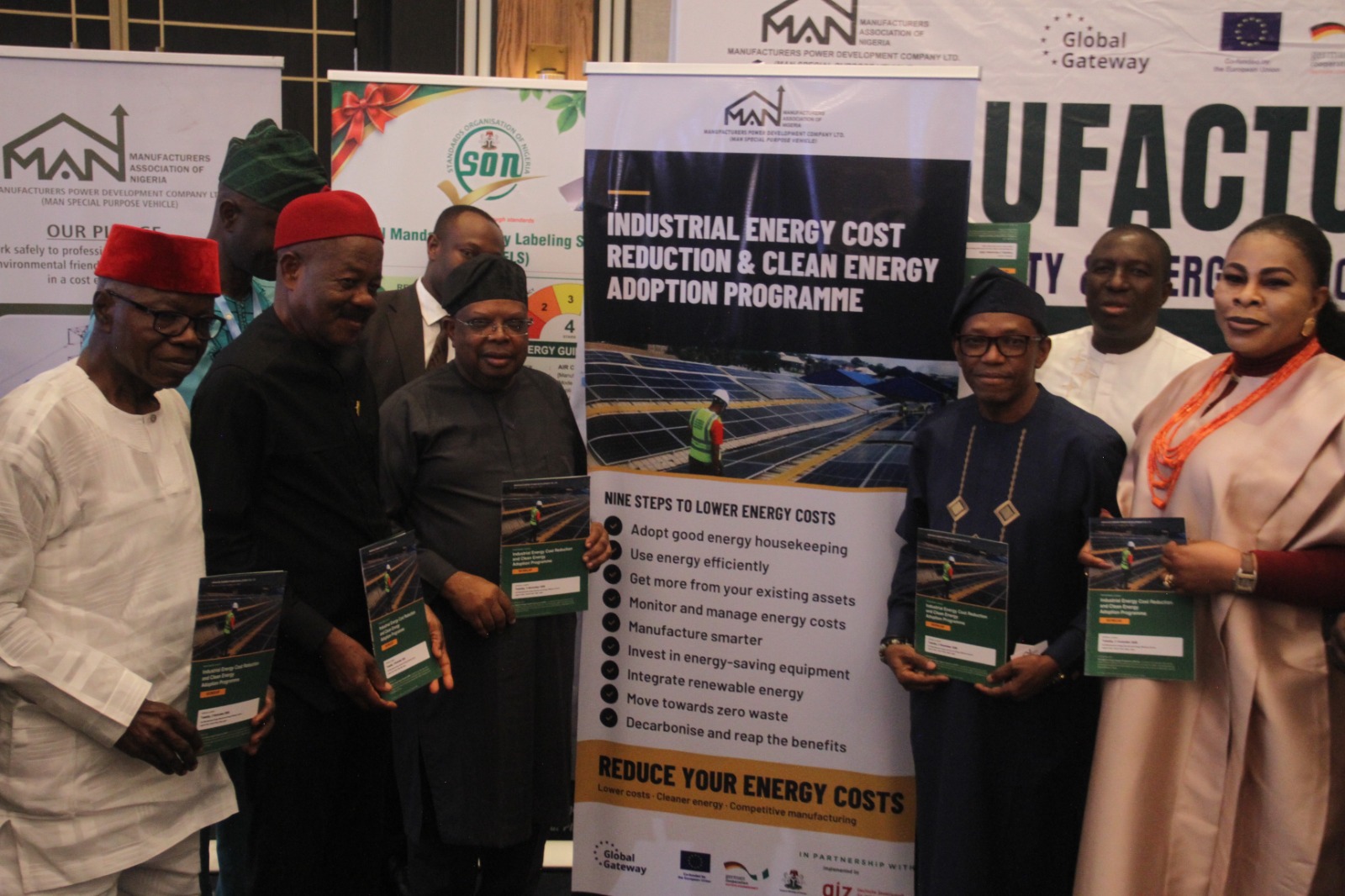
The proof offered at the summit was the Juddy-Bolema project in the South-east, the first test of MAN’s industrial energy cost reduction and adoption programme. MPDCL is rolling the programme out with GIZ and the Nigerian Energy Support Programme (NESP), and it has also engaged Innoson Vehicle Manufacturing and Boulos PLC.
The proposed installation is about 1.5 megawatts, with projected savings of more than 50 per cent. Chukwudozie stressed that “projected” is the operative word and that metered results will be the real test. Under the proposed structure, a long-term financing partner funds the infrastructure, so the manufacturer keeps its working capital. Smart meters and an energy dashboard would show consumption, output and actual savings, giving lenders the confidence to fund more projects. MPDCL is also exploring carbon credits and green finance.
To scale up, MAN plans to use its 13 branches to aggregate members’ energy needs by location and load profile, creating a pipeline of bankable projects. The South-east would serve as the demonstration platform before a national rollout.
Government promises grid fixes
Minister of Power Joseph Tegbe acknowledged the sector’s problems: a national control centre built 54 years ago, gas supply constraints, network bottlenecks, weak payment chains, vandalism and energy theft. His response is a four-prong roadmap covering grid stabilisation, sector liquidity, asset optimisation and grid expansion, focused on major load centres.
The first priority corridor runs through Lagos, Ikorodu, Sagamu, Ota and Alaba, which he said accounts for half of national electricity demand. Benin-Edo-Port Harcourt and Abuja-Kaduna-Kano follow. A nationwide technical audit, four weeks old, is meant to show where the faults lie, and distribution companies are now publishing their supply gaps.
On finance, he said a bond programme has raised over N1.27 trillion across two tranches toward about N3.3 trillion in legacy debts to power and gas companies. He also reported over 1,300 MW of transmission capacity added in the past two months. Separately, he said an investigation found unauthorised connections by about 14 industrial customers, with unpaid bills above N400 billion over three years, and he asked MAN to help enforce compliance. His long-term target is 270 gigawatts by 2060.
Regulators open the grid to factories
The Nigerian Electricity Regulatory Commission (NERC) was represented by Abba Terab, director of economic regulation, on behalf of its chairman, Dr Musiliu Olalekan Oseni. Terab focused on bankability. Under the World Bank-backed Distribution Sector Recovery Programme, distribution companies can access about $250 million for network investment. NERC wants some of it spent on industrial feeders, including battery storage.
NERC’s other contribution is its net billing regulation, issued under the Electricity Act 2023. It lets eligible customers export surplus renewable power to the distribution network and receive credits under a transparent settlement process. For manufacturers, surplus solar becomes revenue, and lenders can price the risk more easily.
Taking power to the factory gate
Abba Abubakar Aliyu, managing director of the Rural Electrification Agency (REA), turned to future factories. He cited National Bureau of Statistics figures showing 72 per cent of rural Nigerians are poor, against 14 per cent in towns and cities. He also argued that supply security matters: long transmission lines through hard-to-reach terrain are vulnerable, as the 2021 attack on the Abuja line and the October 2024 Shiroro-Kaduna tower collapse showed.
Three changes, he said, make local generation practical. The Electricity Act 2023 lets states run their own markets, and 17 have done so. NERC has raised the interconnected mini-grid ceiling from 1 MW to 10 MW, enough for an industrial estate. And the model works: in Jos, Plateau State, rice processors that had been shut out by diesel costs cut production costs by half after connecting to a mini-grid. The REA is now adding a 2 MW interconnected mini-grid to power all 38 processors.
The agency is building 48 interconnected mini-grids that will add 288 MW, with more than 1,000 mini-grids in the pipeline and a roughly 30 MW floating solar plant planned for Lagos. Aliyu said the agency has mapped over 750,000 communities and can match factories to feeders, promising 100 per cent daytime supply at lower cost.
What’s being said
Okoye framed the stakes in his opening address. “Energy is the oxygen of manufacturing,” he said, adding that Nigerian factories have been starved of it for decades.
Chukwudozie said the squeeze is double. “The Nigerian manufacturer is often financing two expansions at the same time,” she said, “the expansion of the factory and the expansion of its power infrastructure.”
Tegbe urged distribution companies to be open about their failures. “When you know the problem, you solve it halfway,” he said.
Terab said manufacturers should not have to divert scarce working capital into power. “Members of MAN are not in the power business,” he said.
Aliyu pitched the mini-grid model as a meeting of two needs. “Across rural Nigeria, we have power looking for customers,” he said. “In this room, you have factories looking for power.”
What’s next
All eyes now turn to Juddy-Bolema, the South-east factory that MAN has made its proof of concept. The proposed system is about 1.5 megawatts, with projected energy cost savings of more than 50 per cent. A long-term financing partner is expected to carry the upfront investment, so the manufacturer keeps its working capital. Smart meters, remote monitoring and an energy dashboard are meant to show what the factory consumed, what the system produced and how much conventional energy it displaced. Carbon credit opportunities are also being explored on the project.
The savings are projections, and MAN says only measured results will count. The test is whether metered savings hold month after month in a working factory. Chukwudozie framed four questions the pilot must answer: whether costs came down, how the projected savings were achieved, whether reliability improved, and whether the model can be replicated. The data matters beyond this one plant, because it is what lenders will use to judge risk on later projects.
If the results hold, the plan is to scale from the South-east. MAN’s 13 branches would pool members’ energy requirements by location and load profile, giving MPDCL a pipeline of projects and financiers bankable opportunities. MPDCL and its partners, GIZ and NESP, would roll the programme out branch by branch. Chukwudozie argued that ten successful factories build confidence, and that a hundred achieving measurable cuts would begin to change Nigerian manufacturing.
Bottom line
The summit’s central moment was MAN’s official unveiling of its flagship industrial energy cost reduction and adoption programme, a deliberate move from advocacy to implementation. It aims to hand power back to manufacturers through factory rooftop solar, battery storage, captive natural gas and smart energy management, shielding them from fuel shocks. The pitch rests on projections, though, and the grid repairs, net billing rules and mini-grid framework are still new. Until the numbers arrive, manufacturers keep paying for two power systems.