









Nigeria’s cinemas took in ₦15.64 billion in 2025, up 35% on 2024 and more than triple the 2021 figure, but nearly all of that growth came from higher ticket prices rather than more people through the door. The average ticket cost ₦5,596, up 29% in a year and about 270% since 2021. Admissions reached 2.8 million, still roughly 15% below 2021 and well under the 5 million a year recorded before the pandemic.
At the exchange rate implied by the report’s own dollar conversions, about ₦1,360 to the dollar, the whole theatrical market is worth roughly US$11.5 million a year. That is the revenue base beneath a sector that the Nigeria Country Report, commissioned by GIZ and Afreximbank’s Creative Africa Nexus (CANEX) and produced with research firm Dalberg, treats as an asset class in its own right.
The numbers beyond the box office are less flattering. Producers typically keep 25% to 30% of ticket gross, free ad-supported viewing earns about US$1 per viewer a year, there is no formal film tax incentive, and a currency that moves overnight can make a budget obsolete before a film is delivered. The sections below take the financials first, then the audience data behind them, and close with what the report says must change. Figures come from the report unless marked as BizWatch calculations.
Box office growth is a pricing story
Higher prices, not bigger audiences, explain almost all of the box office gain. BizWatch calculations from the report’s table show that of the ₦4.06 billion added in 2025, about ₦3.5 billion came from the rise in the average ticket price and about ₦0.55 billion from the 127,000 extra tickets sold.
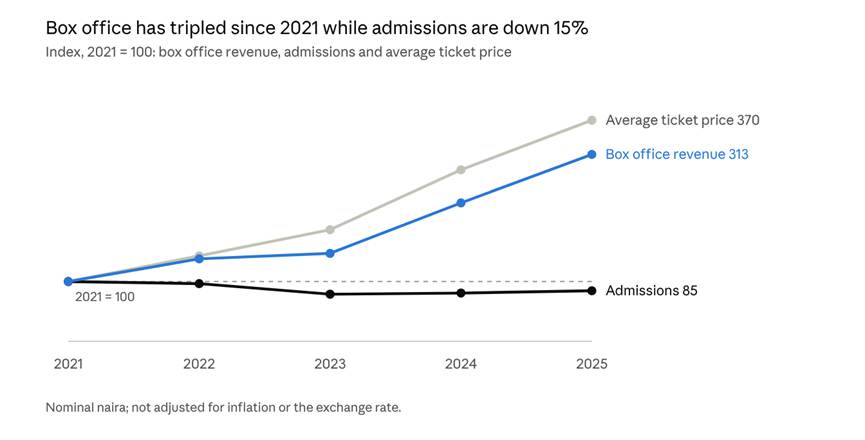
FilmOne and Comscore data as reported in the Nigeria Country Report, Table 1 · BizWatch calculation of indices
The pattern runs through all five years. Admissions fell as far as 2.6 million in 2023 and have recovered only to 2.8 million, 4.8% up on 2024, while the average ticket price has risen 270% since 2021. The report reads this as a shift to premium, event-driven cinema: exhibitors passed higher costs to an audience that goes less often but pays more when it does.
The gains are in naira. The report does not adjust for inflation or the currency’s slide, so growth in real terms and in dollars is lower than the headline, by an amount it does not quantify. A distributor interviewed for the study makes the same point from the other side, arguing that a ₦7,000 ticket is still under US$5 and so below the usual global price. For investors counting returns in dollars, the naira price rise overstates what has happened to the value of a ticket.
Revenue is also concentrated. Lagos generates more than half of box office revenue and 45.9% of admissions from 41 of the country’s 118 cinema locations. Three chains, Filmhouse (26% of gross), Genesis (19.3%) and Silverbird (19%), take about 64% between them, a BizWatch calculation. Edo, helped by Genesis’s Benin City site, and Rivers post high yields per location, which the report reads as the next growth hubs.
Local films win December, but producers keep a sliver
Nigerian films took about half of 2025 ticket sales and one comedy set an all-time record, yet the mechanics of a theatrical release leave producers with roughly a quarter to a third of the gross. Nigerian titles accounted for about 1.5 million tickets, from 83 releases among the 248 films that reached cinemas, which is a third of titles (a BizWatch calculation). Fourteen cleared ₦100 million. Behind The Scenes, produced by Funke Akindele, became the highest-grossing Nigerian film at ₦2.76 billion and reached ₦1 billion in 19 days. Hollywood’s leading titles, Sinners and Superman, earned ₦775 million and ₦493 million.
December is the market’s pay window. The month delivered ₦2.95 billion from 487,608 admissions at an average ticket of ₦6,055, and Nigerian titles took ₦2.03 billion of it. The next-best month, January, brought in ₦1.74 billion. The report notes that returning diaspora visitors pay premium prices in the festive season, which has made year-round attendance among naira earners thinner and more seasonal.
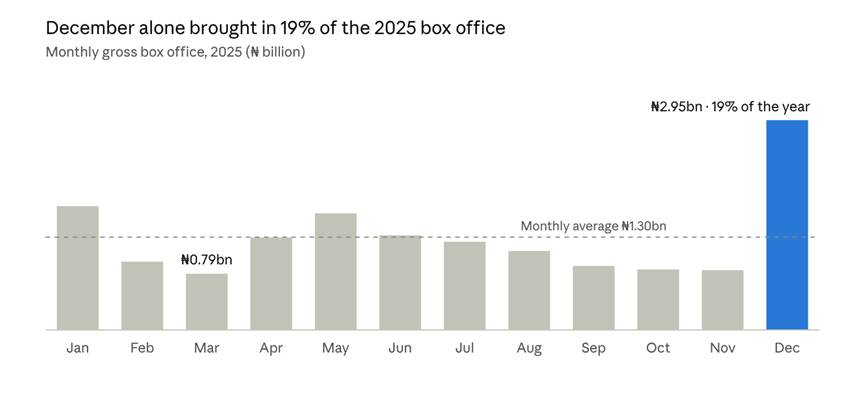
FilmOne and Comscore data as reported in the Nigeria Country Report, Table 2
The record needs a caveat. Behind The Scenes opened in mid-December and took 45% of December’s gross, about ₦1.3 billion (a BizWatch calculation). That implies more than half of its ₦2.76 billion was earned in 2026, so the 2025 total of ₦15.64 billion contains only part of the run.
Box office is also not producer income. In a financier’s case study in the report, after withholding tax, exhibitor fees of 40% to 60% of the remainder and distributor commissions, a producer keeps about 25% to 30% of gross. On that arithmetic a film budgeted at US$1 million that grosses US$2 million returns about US$600,000 to its maker, a loss. Applied to the roughly ₦7.7 billion that Nigerian films grossed in 2025 (49.4% of the total), the same range would put ₦1.9 billion to ₦2.3 billion in producers’ hands. That is a BizWatch illustration resting on one financier’s estimate, not a figure from the report.
That is why the financiers the report cites insist on stacking airline licences, streaming deals in several territories and other windows on top of the cinema run, and why a pre-signed streaming contract changes the risk profile of an investment more than any single box office result.
Pay TV pays the bills, but streaming holds the growth
Pay TV and streaming together were worth US$1.24 billion in 2025, against a theatrical market of roughly US$11.5 million, which makes the box office about 1% of the total (a BizWatch comparison). The larger figure covers all video, including sport and international content, so it is not a film-only market. Pay TV still accounts for 84% of it, at US$1.04 billion, but its growth is about 3% a year. Streaming revenue is projected to rise from US$198 million in 2025 to US$347 million in 2030, lifting its share of a US$1.52 billion market to 23%.
The Pay TV base is shifting. MultiChoice’s DStv lost about 200,000 satellite subscribers in 2025, to 5.6 million, while GOtv, StarTimes and Canal+ each added subscribers and the four together rose to 15.2 million from 14.7 million. Prepaid access, in daily and weekly passes and monthly vouchers, accounts for about 69% of 2025 spending (US$856 million, a BizWatch calculation). The report calls Nigeria a high-volume, low-margin attention economy, and one-off licences capture little of it.
The streaming audience is local, but the streamers are not. The report puts unique OTT users at about 4.3 million, and Nigerian-first services such as NdaniTV, Kava and Accelerate TV account for roughly 73% of them. Yet Nigerian titles make up 0.4% of Netflix’s catalogue hours in the report’s data, 0.2% of Prime Video’s and 6.5% of Showmax’s, against 60% to 100% on local platforms.
Scale and money are not the same thing. Ad-supported video, mostly channels on YouTube, reaches about 30.5 million viewers but earned about US$33 million in 2025, roughly US$1 per viewer a year. Subscription video earned US$158 million from about 1.2 million subscribers, around US$130 each (BizWatch calculations from the report’s tables).
Licence fees have fallen. Netflix and Amazon now pay about US$200,000 to US$400,000 for a Nigerian film, down from offers of up to US$1 million, according to a filmmaker interviewed, and both have cut local commissioning. Showmax licenses in naira at about ₦10 million to ₦15 million for a series, and one producer reported an offer of €30,000 for a 22-episode series from a local broadcaster. YouTube pays ₦300 to ₦6,000 per 1,000 views, released only once earnings pass US$100. Circuits TV, a pay-per-view platform for independents, says some producers now earn millions monthly, a company claim the report does not verify.
Capital exists, but not on bankable terms
Money for Nigerian film comes from several sources, but the report finds little of it on terms a lender can underwrite. Private capital dominates: self-funding, family money, high-net-worth equity and actor-led co-productions such as Gingerrr, backed by four actors. The report says some asset managers are eyeing returns of 25% to 40% from Nollywood, without naming a source for the range. A better-documented example is MBO Capital, which financed about 20 films by taking temporary ownership of each film’s intellectual property as collateral and handing the rights back once the streamer had paid and the loan was repaid. Its returns were 19% to 20% in dollar terms. When Netflix and Prime Video cut commissioning, MBO added an equity stake alongside its debt wherever no streaming contract was in place.
Two headline funding figures are stated inconsistently. The report describes the CANEX facility as US$1 billion in its background section and as US$2 billion after an expansion in the financing chapter. It also gives the Federal Government’s Creative Economy Development Fund as ₦200 million in one place and as roughly US$200 million in another, a gap of more than a thousandfold at about ₦1,360 to the dollar.
Other support is thin. The Bank of Industry has lent to the sector, but interest rates are a barrier. Nigeria has no film tax incentive: a 25% rebate is proposed, against 35% in South Africa, and a two-year tax waiver for community cinema investors has been announced but not implemented. Tony Elumelu Foundation grants of US$5,000 and development-agency awards of US$10,000 to US$40,000, mostly for short films and documentaries, are accessible but small. Stakeholders told researchers that access to government funds depends on paperwork and personal connections.
The naira is the largest operating risk. Cameras and lenses are priced in dollars, a budget set in naira can fall short within days, and independents have none of the cash buffers of larger studios. Output reflects the squeeze: titles licensed and approved fell from 1,923 in 2022 to 1,185 in 2025, a drop of 38% (a BizWatch calculation from the report’s chart).
Viewers say they would pay more, from a small sample
Surveyed viewers say they would pay more for a cinema ticket than the average price today, but the evidence is a survey of 304 people, and the report’s annex lists Lagos and Abuja as the Nigerian survey cities. The sample splits into four segments. Nollywood loyalists are the largest at 43%, female-led and mobile-first, with a median streaming spend of about US$7 a month, yet they say they would pay about US$11 for a cinema ticket. African story seekers make up 24%, Hollywood-first streamers 19% and global action streamers 15%.
Weighted by segment size, stated willingness to pay is about US$8.60 a ticket (a BizWatch calculation), against an average price of about US$4.10 at the exchange rate implied by the report. Stated willingness usually overstates behaviour, and the spending data is more cautious: the median viewer spends ₦8,335 (US$6.12) a month on streaming and holds one paid subscription.
Price is not the main reason people stay away from cinemas. Among non-attenders, 54% prefer to wait and watch elsewhere, 35% cite lack of time, 23% distance and only 12% ticket cost. Cinema is now an occasional event: 83% of respondents watch on phones or tablets, 81% mostly through video on demand, and cinema is the main way to watch for only 6%.
Marketing money should follow word of mouth. Some 82% of respondents learn about films from friends and family and 60% from social media, against 14% for outdoor advertising and 3% each for cinema and media advertising. The net promoter score for Nigerian films is 29, with 53% promoters and 24% detractors, ranging from 78 among Nollywood loyalists to minus 65 among Hollywood-first streamers.
The youngest viewers are the least served. Animation is the most-watched genre for 81% of children and 78% of teenagers surveyed, but American films make up 72% of what children watch and Nigerian films 38%. The samples are small, 74 children and 60 teenagers, but stakeholders repeatedly named children’s programming and animation as the biggest gap in local output.
Piracy, missing data and too few screens
Nigeria has one cinema screen for every 653,000 people, against a global benchmark of 20 to 40 screens per million, which puts the country at about 1.5 per million (a BizWatch calculation). The country has 118 cinema locations and 352 screens. On the year-end count, the average screen earned ₦44 million in 2025, about US$33,000, and sold roughly 22 tickets a day (BizWatch calculations). Locations grew 16% in 2025 but screens only 5.7%, from 333 to 352.
The report estimates that piracy drains 50% to 75% of potential revenue but gives no source for the range. Its survey evidence rests on a very small base: 15 respondents, about 6% of those who stream, use pirate sites, and most call it their main method. Their reasons point to price and availability: 63% cite expensive subscriptions, 58% limited variety on mainstream platforms and 42% films not yet on legal services. Stakeholders describe films reaching Telegram and WhatsApp groups within hours of release, and one platform has recruited former pirates as paid marketers.
No single source records the market. Comscore, FilmOne and the Cinema Exhibitors Association of Nigeria publish box office figures, and Genesis pioneered releasing gross numbers, but there is no mandate and exhibitors’ fuller data is largely proprietary. Streaming viewership is opaque, and funders interviewed distrust some of the figures they are shown. Without reliable data, investors cannot price risk, which the report treats as a barrier to financing in its own right.
The regulatory frame is fragmented. The National Film and Video Censors Board has moved from censorship to classification, but films on sensitive subjects can still face delays or rejection. The enabling law has not been amended in nearly 50 years, and there is no unified practitioners’ council to register producers, vet grant applicants or enforce guild rules.
What’s being said
Stakeholders interviewed for the report are quoted by role rather than by name, and they describe a sector that is commercially proven and structurally weak. A filmmaker said currency swings can leave producers unable to go back to investors because the money they asked for “is not working again”. A film distributor defended ticket prices, noting that ₦7,000 is under US$5 and saying “I don’t think it’s expensive pricing.” Another filmmaker complained that cinemas give producers “ridiculous percentages”, citing a 60% cut, and leave them to pay for publicity from what remains. A third described being offered “30,000 EUR” for a 22-episode series by a local broadcaster.
On data, a government official told researchers that “one of the problems we have in this country is to have a central data system”, while a funder said industry figures are often “cooked”. A Circuits TV executive said “we have producers now who are earning millions on a monthly basis” through pay-per-view, a claim the report does not verify. Asked what he would change, a filmmaker said: “If I could change one thing about the Nollywood ecosystem, it would be structure.” On the youngest audience, a filmmaker called children’s content “the future of Nollywood”. The report’s foreword, by Motunrayo Ojo of African Media, puts the warning plainly: “scale without strategy does not equal sustainability.”
What to watch
The report names three government priorities it says are achievable within 6 to 24 months with modest public money. The first is to pass the Motion Picture Practitioners’ Council and Nigerian Film Commission bills, creating a practitioner registry, a central data system and a single point of coordination for investors. The second is to de-risk community cinema through a blended finance fund combining government loan guarantees, private equity and development bank loans at single-digit interest. The third is faster enforcement of intellectual property rights, through specialised film courts or fast-track arbitration, internet-provider blocking of pirate sites and a whistleblower reward scheme.
It also proposes making grants and tax incentives conditional on submitting verifiable performance data, offering matching or low-interest loans to distributors that move into production, and independently evaluating the US$50 million Benue State creative fund with Circuits TV before extending it to Enugu and Lagos. The report notes that the fund’s source, governance and accessibility are undocumented. For private investors, the case study’s lessons are to finance slates rather than single films, add equity where no streaming offtake is signed, use IP assignment as collateral and agree not to interfere creatively.
The next test is the 2026 festive season. With the average ticket up 29% in a year, a repeat of December’s ₦2.95 billion would show whether audiences will keep paying more for fewer visits. The other thing to track is whether the 25% rebate, the community cinema tax waiver and the two bills move from proposal to law.
Bottom line
Nollywood’s theatrical market is growing in naira and stalling in people. Producers keep a quarter to a third of a ₦15.64 billion gross, streaming’s scale pays about a dollar per viewer a year, and the routes to better returns, rights retention, stacked windows and trustworthy data, depend on policy that is still only proposed. The money in Nigerian film will be made in the system around the films, not in the next box office record.