






Key points
- Stakeholders have stressed the importance of documenting institutional reforms to preserve history and guide future policymaking.
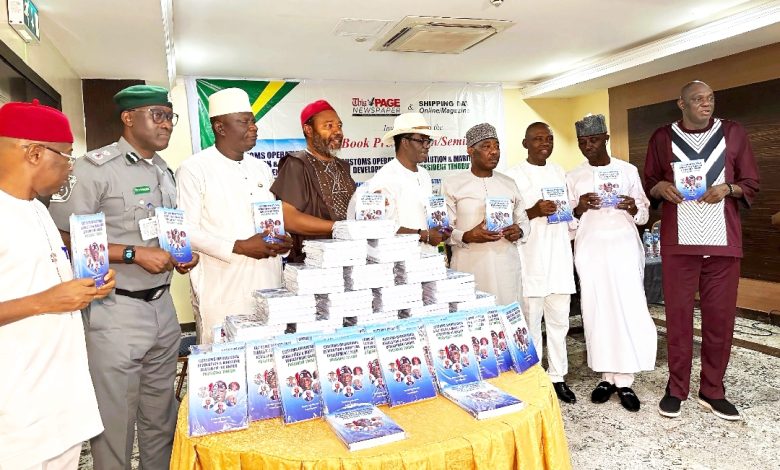
- A new book on Customs and maritime sector reforms under President Bola Tinubu was unveiled in Lagos amid commendations from industry leaders.
- The publication chronicles the transformation of the Nigeria Customs Service (NCS), while examining challenges and opportunities within the maritime industry.
Main story
Stakeholders across Nigeria’s Customs and maritime sectors have underscored the importance of documenting institutional reforms and policy milestones as a means of preserving national memory, strengthening governance, and guiding future development.
The call was made in Lagos during the launch of the book, “Customs Operational Revolution and the Development of the Maritime Industry Under President Tinubu,” authored by veteran maritime journalists Chief Timothy Okorocha and Mr. Francis Ugwoke.
The event, which attracted regulators, industry leaders, freight forwarders, maritime professionals and policymakers, served as a platform to review the progress of ongoing reforms within the Nigeria Customs Service (NCS) and the wider maritime sector.
Representing the Comptroller-General of Customs, Bashir Adewale Adeniyi, Comptroller Chidi Nwokorie, Customs Area Controller of the Murtala Muhammed International Airport (MMIA) Command, described documentation as a critical pillar of institutional growth and continuity.
According to him, reforms can only achieve lasting impact when their successes, challenges and lessons are properly recorded for future generations.
“Documentation is critical to institutional growth. When reforms are properly documented, future generations can learn from them, policymakers can build upon them, and stakeholders can objectively assess their impact,” he said.
Nwokorie noted that the significant gains recorded by the Nigeria Customs Service in revenue generation, trade facilitation and anti-smuggling operations under Adeniyi’s leadership were driven by six strategic pillars: technology and automation, intelligence-led operations, stakeholder engagement, leadership and accountability, inter-agency collaboration, and trade facilitation reforms.
He added that the Service’s operational successes reflect the impact of visionary leadership and sustained institutional reforms.
“The remarkable revenue growth and anti-smuggling successes recorded by the Nigeria Customs Service under CGC Bashir Adewale Adeniyi can largely be attributed to visionary leadership, technology-driven reforms, intelligence-led enforcement, stakeholder engagement and stronger inter-agency collaboration. Nothing gives energy to strategy like synergy,” he stated.
The issues
The launch highlighted growing concerns over the need to preserve institutional history within Nigeria’s public sector, particularly in strategic sectors such as Customs and maritime administration.
Stakeholders warned that without proper documentation, valuable lessons from policy reforms, leadership decisions and operational experiences could be lost, making it difficult for future administrations to build on previous achievements.
The discussion also focused on the evolving role of the Nigeria Customs Service, which has expanded beyond traditional revenue collection to include border security, trade facilitation, economic regulation and support for national development objectives.
Participants further examined persistent challenges facing the maritime industry, including port congestion, logistics bottlenecks, infrastructure deficits and the need to maximise opportunities presented by the African Continental Free Trade Area (AfCFTA).
What’s being said
Managing Director of the Nigerian Ports Authority (NPA), Dr. Abubakar Dantsoho, represented by the Port Manager of Tin Can Island Port, Alhaji Isa Sanni, commended the authors for providing what he described as a valuable historical record of recent developments in the maritime industry.
He assured that the publication would serve as an important reference material within the Authority and the wider maritime community.
Reviewing the book, retired Deputy Comptroller-General of Customs, DCG Dera Nnadi, Mni (Rtd.), described the publication as a timely and significant contribution to the body of knowledge on Customs administration and maritime development.
He warned that institutions that fail to preserve their history risk losing critical lessons that shaped their evolution.
“Institutions that fail to document their evolution risk historical annihilation. They risk forgetting the reforms, sacrifices, leadership decisions and operational experiences that shaped their journey. This book attempts to preserve that memory,” Nnadi said.
According to him, the publication goes beyond a historical account by offering a comprehensive examination of how the Nigeria Customs Service evolved from a colonial revenue institution into a modern agency central to revenue mobilisation, border security, trade facilitation and economic regulation.
He also noted that the book highlights reforms introduced under Comptroller-General Adeniyi, including merit-based administration, staff welfare initiatives, digital transformation, stakeholder engagement and human capital development.
Chairman of the occasion and Chief Executive Officer of Maritime Media Limited, Elder Asu Beks, praised the authors for leveraging their decades of industry experience to produce a work capable of enriching maritime discourse and policy development.
He urged the Federal Ministry of Marine and Blue Economy and its agencies to support the publication through sponsorship and wider circulation.
Speaking on behalf of the authors, Chief Timothy Okorocha said the book was inspired by the need to preserve important developments within the Customs and maritime sectors beyond daily news reports.
“Today is not merely about launching a book. It is also about reflection, documentation and thoughtful engagement with a sector that remains central to Nigeria’s economic aspirations,” he said.
Okorocha explained that the publication situates Customs reforms within the broader maritime ecosystem, examining the roles and contributions of agencies including the Nigerian Maritime Administration and Safety Agency (NIMASA), Nigerian Ports Authority (NPA), Nigerian Shippers’ Council (NSC), Council for the Regulation of Freight Forwarding in Nigeria (CRFFN), National Inland Waterways Authority (NIWA), and the Maritime Academy of Nigeria.
What’s next
Stakeholders at the event called for sustained documentation of reforms, increased collaboration among maritime institutions, and deeper policy engagement to ensure that ongoing gains in Customs administration and maritime governance are consolidated.
The publication is expected to serve as a reference resource for policymakers, researchers, industry practitioners and future leaders seeking to understand the evolution of Customs operations and maritime sector development in Nigeria.
Participants also expressed optimism that continued reforms under the Ministry of Marine and Blue Economy and the Nigeria Customs Service would further enhance trade competitiveness, revenue generation and economic diversification.
Bottom line
The launch of “Customs Operational Revolution and the Development of the Maritime Industry Under President Tinubu” has reinforced the growing consensus that meaningful reforms must be documented to endure. Beyond celebrating achievements within the Nigeria Customs Service and the maritime sector, the publication provides a historical record, policy resource and roadmap for sustaining institutional transformation in one of Nigeria’s most strategic economic sectors.