










KEY POINTS
- DRC Prime Minister Judith Suminwa warns against sourcing critical minerals through conflict and exploitation.
- She says the country continues to face armed violence and displacement in its resource rich eastern region.
- The DRC wants greater local processing, jobs, technology and value creation from its mineral resources.
- Suminwa says existing peace commitments require implementation rather than additional agreements.
MAIN STORY
The Democratic Republic of Congo (DRC) has warned that the global push towards net zero emissions must not create another cycle of conflict and dependency around critical minerals.
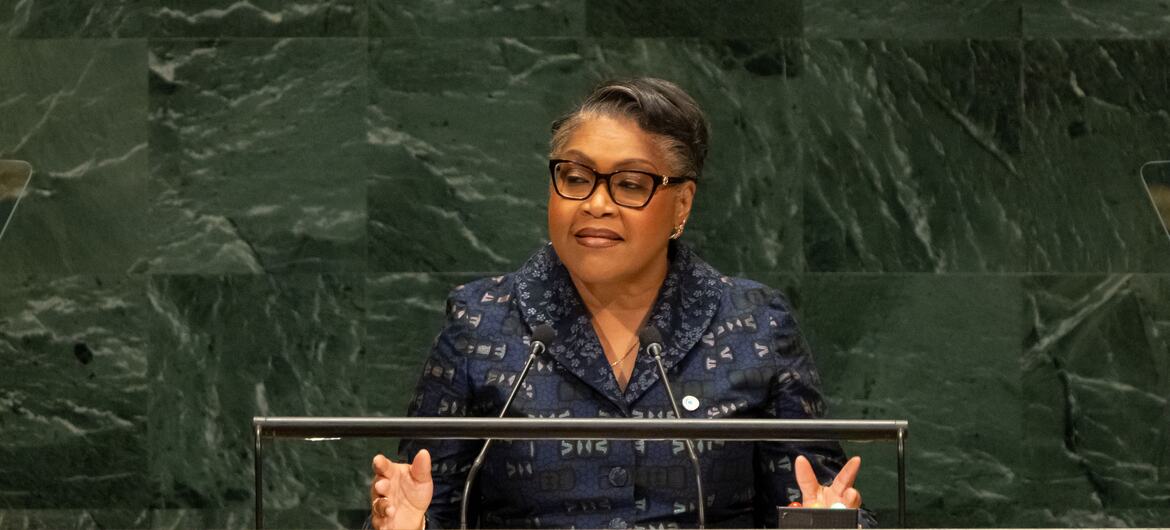
Prime Minister Judith Suminwa, speaking at the 81st session of the United Nations General Assembly in New York, said the transition to a decarbonised economy could not be built on what she described as “blood stained minerals”.

“We will not bring about a just transition by reproducing a greenwashed version of our past dependencies,” she said.
Suminwa said the warning was particularly relevant to the DRC, which is a major source of minerals required for batteries, energy systems and digital technologies.
She said the country remained affected by armed conflict in its eastern region, accusing Rwanda of leading what she described as a war of aggression through its proxy, the AFC/M23.
She also identified the Allied Defense Forces (ADF) and CODECO as armed groups contributing to the humanitarian crisis.
The Prime Minister spoke against the backdrop of prolonged insecurity and displacement in the resource rich eastern region, where a deadly Ebola outbreak was also spreading.
She said the situation exposed the difference between international commitments and the lived experiences of people in the DRC.
Suminwa pointed to the peace agreement signed between the DRC and Rwanda in Washington, DC, in June 2025 as one development that had created prospects for ending the violence.
However, she said the agreement had yet to translate into peace for millions of Congolese.
She also cited UN Security Council Resolution 2773 (2025), which called for an effective cessation of hostilities, withdrawal of Rwandan forces and restoration of State authority.
According to Suminwa, implementing existing commitments was more important than negotiating additional agreements.
“But we don’t need new texts to replace those that have already been adopted,” she said.
She also addressed the situation involving the Democratic Forces for the Freedom of Rwanda (FDLR), recalling a protocol signed in May that provided for the disarmament and demobilisation of its combatants.
Suminwa said continued implementation was needed to turn the agreement into concrete security gains.
Earlier in September, the UN peacekeeping mission in the DRC, MONUSCO, supported the repatriation of 120 people associated with the group.
She described the repatriation as “a first testament to the protocol’s implementation”, saying such measures could help address longstanding security concerns.
Beyond the security crisis, Suminwa focused on the growing international demand for copper, cobalt, lithium, nickel and other critical minerals needed for the energy transition and digital and artificial intelligence infrastructure.
She said the DRC was central to this transition, noting its position as the world’s largest cobalt producer and a major copper producer.
The Prime Minister argued that the economic benefits of the mineral boom should reach the communities and countries supplying the resources.
“It would be both unjust and dangerous for added value, jobs, know-how, and technologies to remain concentrated far away from the communities that are making these changes possible,” she warned.
She said the DRC rejected a model in which producer countries focus on extraction while processing, research, technology and most of the profits remain elsewhere.
Going forward, Suminwa said the country wanted to work with African and international partners to develop competitive regional businesses capable of creating jobs, skills and shared prosperity.
THE ISSUES
- The DRC is linking the global demand for critical minerals to the conditions under which those resources are extracted, arguing that the energy transition should not reproduce economic and security problems associated with the traditional extractive model.
- The country’s mineral resources are increasingly important to the energy transition and digital technologies, while its eastern region continues to experience armed conflict and displacement. Suminwa therefore placed resource development alongside the need for greater security.
- The Prime Minister’s comments also focused on value addition. The DRC wants processing, research, technology, jobs and expertise to be developed closer to the communities and countries where critical minerals are produced.
- On the security front, Suminwa said existing agreements and UN resolutions already provide a framework for addressing the conflict. Her emphasis was on implementation of those commitments rather than negotiating additional texts.
WHAT’S BEING SAID
“We will not bring about a just transition by reproducing a greenwashed version of our past dependencies. – Judith Suminwa, Prime Minister of the DRC
“But we don’t need new texts to replace those that have already been adopted. – Judith Suminwa, Prime Minister of the DRC
“It would be both unjust and dangerous for added value, jobs, know-how, and technologies to remain concentrated far away from the communities that are making these changes possible. – Judith Suminwa, Prime Minister of the DRC
WHAT’S NEXT
Suminwa said the DRC would work with African and international partners to develop competitive regional businesses around its mineral resources, while continued implementation of existing peace and security commitments remains central to addressing conflict in the east.
BOTTOM LINE
The DRC wants the global demand for critical minerals to translate into local jobs, technology, processing and industrial capacity rather than reinforce an extraction based model. Suminwa also called for existing peace commitments to be implemented as the country continues to confront insecurity in its resource rich east.







 has warned that the global push towards net zero emissions must not create another ...)