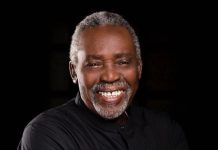







The name Olu Jacobs is familiar to generations of Nigerians. For many younger viewers, he was the authoritative father, king, chief, politician, or elder whose voice could instantly change the mood of a Nollywood film.
But long before he became one of the most recognisable faces in Nigerian cinema, Oludotun Baiyewu Jacobs had already built a career on British stages and television.
Jacobs died on Wednesday, September 16, 2026, at the age of 84. His family confirmed his passing on Instagram and asked bloggers and social media users to respect their privacy. His death closes a career that stretched across theatre, television, international film, and Nigerian cinema.
Here are some things many people may not know about Olu Jacobs.
1. He Did Not Begin With Nollywood
It is easy to associate Olu Jacobs almost exclusively with Nollywood because of the enormous number of Nigerian films in which he appeared. But Nollywood came much later in his career.
Jacobs trained at the Royal Academy of Dramatic Art (RADA) in London, one of Britain’s best-known drama schools. From there, he developed a professional career in British theatre and television before returning to Nigeria. According to his Lufodo Group biography, his work included productions connected to the BBC, National Theatre, Royal Shakespeare Company, and major British film and television organisations. That means his acting career was already established internationally before the Nigerian film industry became the dominant part of his public identity.
2. His Father Did Not Want Him to Become an Actor
One of the more revealing stories about Jacobs’ early life was his struggle to convince his father to let him pursue acting. In an interview with Punch, Jacobs recalled that his father opposed his decision to travel to England and become an actor. He was his father’s favourite child, he said, but his father wanted him to choose another path.
Jacobs eventually went anyway. In another interview, he recalled buying his father’s favourite tobacco as a gesture of goodwill before pursuing his dream. For someone who would eventually become one of Nigeria’s most respected actors, his career began with a family disagreement over whether acting was a viable future.
3. He Worked Ordinary Jobs Before Establishing Himself in Britain
The story of Jacobs’ journey to Britain is not simply one of arriving at RADA and immediately becoming a star. He had to find his way into the profession. Jacobs recalled working as a quality control officer for a holiday company while trying to establish himself.
His breakthrough came through an audition connected to the BBC. He had accompanied a friend to an audition and eventually got an opportunity to audition himself. He recalled arriving late, but the timing worked in his favour because the person in charge had not yet arrived. He eventually got on the final list—a break that could easily have gone the other way.
4. He Featured on British Television Decades Before Nollywood
Jacobs’ British television credits included appearances in classic programmes such as The Goodies, Till Death Us Do Part, Barlow at Large, The Venturers, Angels, The Tomorrow People, The Bill, Dempsey and Makepeace, and The Professionals.
His work was not limited to television. He appeared in stage productions and international films, including Night and Day, a Tom Stoppard production that featured actors including Diana Rigg and John Thaw. Lufodo’s biography also records his involvement with productions connected to Walt Disney, Universal Pictures, MGM, the BBC, the National Theatre, and the Royal Shakespeare Company.
5. He Spent About Two Decades in Britain
Jacobs did not make a brief trip to Britain, train, and immediately return home. He spent about 20 years there building his career. That makes his eventual decision to return to Nigeria particularly significant.
When asked why he would leave Britain after establishing himself there, his response was revealing: he noted that he could not have grown beyond certain boundaries in England due to the “unwritten laws” restricting Black actors at the time. Returning to Nigeria gave him an opportunity to build something in an industry that was still developing.
6. His Return Was About More Than Acting
Jacobs eventually became much more than an actor. Together with his wife, Joke Silva, he built Lufodo, a company involved in production and the performing arts. The organisation developed into a wider creative business with interests including Lufodo Productions and the Lufodo Academy of Performing Arts.
The couple’s work in training young performers was particularly important because their involvement extended beyond appearing in films themselves. The Lufodo Academy was established to train performers and develop professional skills in acting and the performing arts, later partnering with platforms like Netflix to train Nigerian actors and writers.
7. He and Joke Silva Built a Creative Institution
The public knew Olu Jacobs and Joke Silva as one of Nigeria’s best-known acting couples. But their partnership was also professional. They co-founded Lufodo and worked together across production and performing arts. The Lufodo Group describes Jacobs as co-founder and chairman, while Silva’s profile identifies her as co-founder and co-CEO for artistic design and performing arts.
Their marriage also produced one of the more unusual details of their public story. Silva continued to use her professional maiden name, Joke Silva. Jacobs once explained that he saw no reason why marrying him should mean she stopped being Joke Silva, the actress audiences already knew.
8. Lufodo Took Over One of Lagos’ Oldest Theatre Spaces
In 2022, Lagos State handed the management of Glover Memorial Hall to Lufodo after the company won the concession process. That was significant because Glover Memorial Hall is not an ordinary event venue; the heritage building dates back to the colonial era, holds a long connection with Nigerian theatre and film culture, and hosted one of Nigeria’s earliest public film screenings. Lufodo’s involvement extended Jacobs and Silva’s work from making and teaching performance to managing a physical institution associated with Nigeria’s performing arts history.
9. He Had a Life in Theatre That Predates the Nollywood Era
Another part of Jacobs’ career that can disappear beneath the Nollywood label is his commitment to theatre. His professional background was rooted in stage performance. Before the explosion of Nigerian home videos and later Nollywood, theatre and television were the primary platforms through which Nigerian actors developed their craft. Jacobs was part of that older tradition, spanning about five decades across stage, film, and radio in both Britain and Nigeria.
10. Recognised Across Africa and Beyond
Jacobs’ career received widespread recognition:
- 2007: Won the Africa Movie Academy Award (AMAA) for Best Actor in a Leading Role.
- 2011: Conferred with the national honour of Member of the Order of the Federal Republic (MFR) by the Nigerian government.
- 2013: Honoured with the Industry Merit Award at the Africa Magic Viewers’ Choice Awards (AMVCA). Punch Newspapers
- 2016: Received the AMAA Lifetime Achievement Award alongside Joke Silva.
The Legacy Behind the Legend
Olu Jacobs’ career can be understood in three distinct chapters: the young man from Nigeria who pursued acting despite his father’s objections; the professionally trained performer who spent decades working across British theatre and television; and the Nigerian veteran who returned home to become an actor, producer, mentor, and institution builder.
His passing at 84 marks the end of an era for African cinema. The story of Olu Jacobs is not simply that of a famous actor who appeared in hundreds of films, but of a pioneer who mastered his craft abroad, returned home, and helped build the foundation of Nigeria’s performing arts industry.