








Key Points
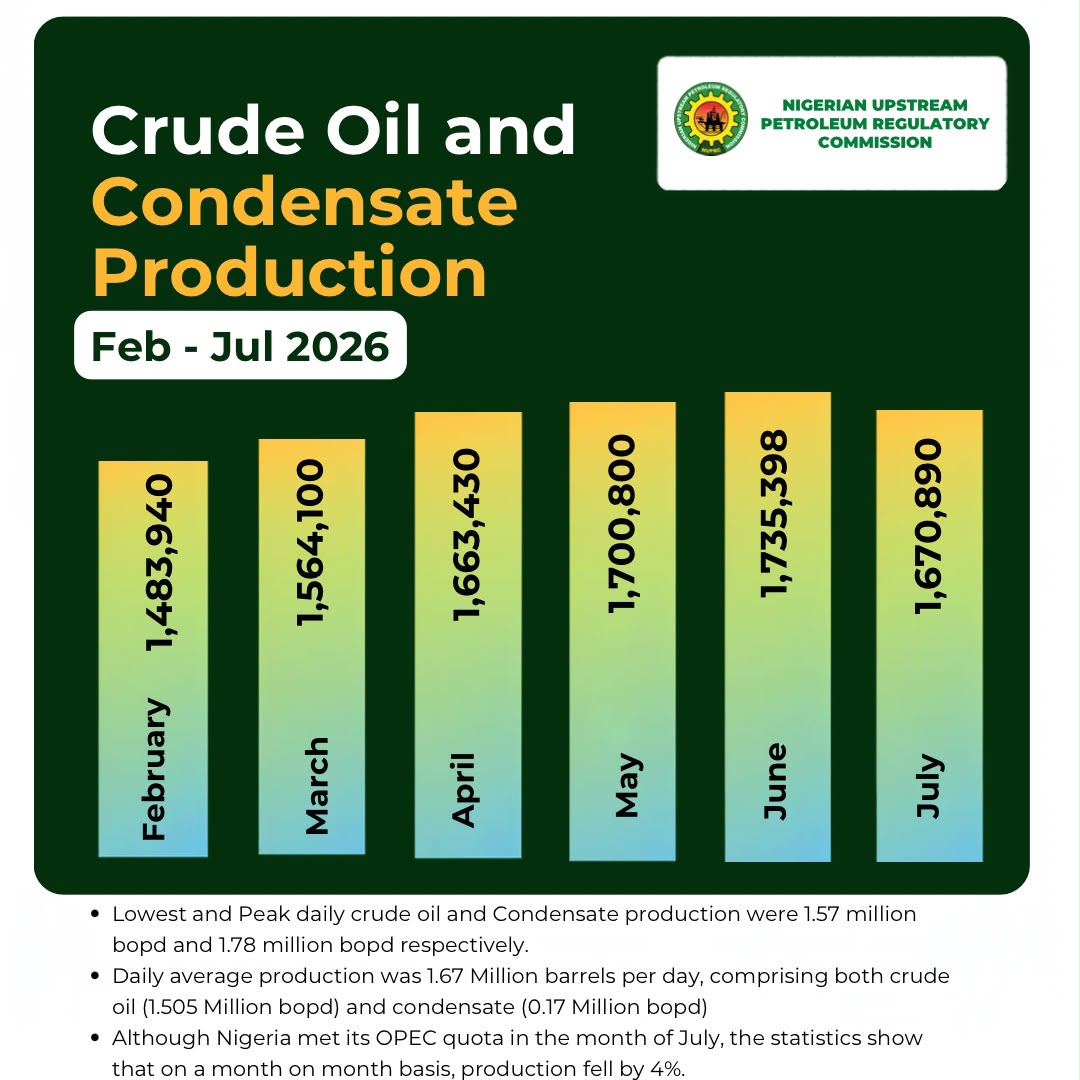
- Nigeria produced 1.67 million barrels of crude and condensate daily in July.
- Output exceeded the country’s 1.5 million barrels per day OPEC quota.
- Production nevertheless fell four per cent from the previous month.
- NUPRC attributed the decline mainly to operational problems at Erha and Akpo fields.
Main Story
Nigeria exceeded its Organisation of Petroleum Exporting Countries (OPEC) crude production quota for the third consecutive month in July, according to data from the Nigerian Upstream Petroleum Regulatory Commission (NUPRC).
The commission, in its July production report released on Wednesday, said the country produced an average of 1.505 million barrels of crude oil per day during the month.
It recorded an additional 170,000 barrels per day of condensate, bringing combined crude and condensate production to 1.67 million barrels daily.
The figure was above Nigeria’s OPEC quota of 1.5 million barrels per day.
NUPRC said daily production peaked at 1.78 million barrels during the month, while the lowest recorded output was 1.57 million barrels per day.
Forcados Terminal recorded the highest average production at 322.34 thousand barrels per day, followed by Bonny Terminal with 303.72 thousand barrels.
Qua Iboe Terminal produced an average of 158.02 thousand barrels daily, while Escravos Oil Terminal recorded 131.41 thousand barrels per day.
Bonga was the fifth-highest producing stream, with average daily crude production of 100.23 thousand barrels.
Despite remaining above its OPEC quota, Nigeria’s overall production declined by four per cent compared with the previous month.
NUPRC attributed the reduction mainly to operational challenges at the Erha and Akpo oil fields, which affected production volumes during the period.
The commission said production across other assets remained relatively stable, with operators taking measures to limit the impact of the disruptions.
It said routine production and crude evacuation activities were largely maintained across the sector.
NUPRC added that industry operators were working to resolve the problems affecting the two fields and restore their production capacity.
The commission said efforts were also being directed at improving asset reliability and preventing operational disruptions from affecting future output.
The Issues
Nigeria has maintained production above its OPEC quota despite a month-on-month decline in July. The latest figures also highlight the effect that operational problems at individual oil fields can have on overall national production.
What’s Being Said
“In the month under review, the daily peak production of crude oil and condensate was 1.78mbpd.” – Nigerian Upstream Petroleum Regulatory Commission
“Routine production activities and crude evacuation operations were largely sustained across the sector.” – Nigerian Upstream Petroleum Regulatory Commission
What’s Next
Operators are expected to address the operational problems affecting the Erha and Akpo fields while efforts continue to improve asset reliability and sustain production levels.
Bottom Line
Nigeria remained above its OPEC production quota in July, but the four per cent monthly decline shows that operational disruptions continue to affect output. Restoring affected production capacity will be important to sustaining the country’s recent production gains.




 crude production quota for the third consecutive ...)