










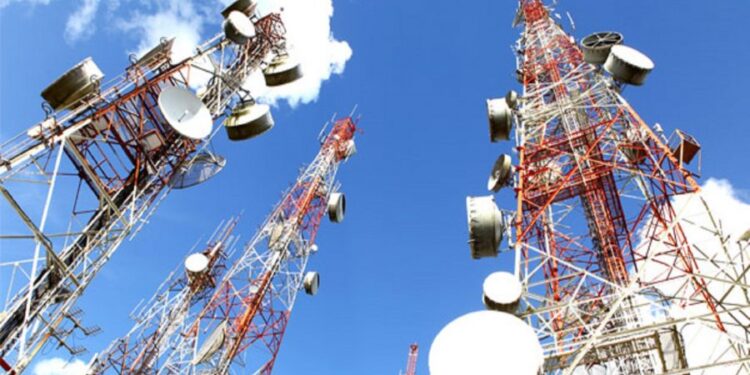
Foreign direct investment (FDI) inflows into Nigeria’s telecommunications sector decline sharply to $80.78 million in the first quarter of 2025, reflecting a 58% decrease compared to $191.57 million recorded in the same period of 2024.
This update comes from the latest capital importation data released by the National Bureau of Statistics (NBS), which also shows that the sector records a 41% quarter-on-quarter decline from the $136.86 million posted in Q4 2024.

Despite a general increase in total capital inflows into Nigeria’s economy for Q1 2025, the telecom industry struggles to attract investors due to ongoing regulatory and structural challenges.
According to the Association of Licensed Telecommunications Operators of Nigeria (ALTON), issues such as multiple taxation and high Right of Way (RoW) charges continue to deter potential investors. The association emphasizes that sustainable growth in foreign investments may remain elusive unless these bottlenecks are addressed.
Commenting on the trend, Engr. Ikechukwu Nnamani, CEO of Digital Reality and former president of the Association of Telecommunications Companies of Nigeria (ATCON), notes that inconsistent government policies and instability in the foreign exchange market are major concerns for investors. However, he expresses optimism that recent improvements in forex stability could support future investment growth in the sector.
While the telecom sector experiences a downturn, total capital inflows into Nigeria rise significantly to $5.6 billion in Q1 2025—marking a 67.12% increase from the $3.4 billion recorded in Q1 2024.
The banking sector leads the surge, accounting for over half of the total investments. According to the NBS, banking attracts $3.13 billion (55.44%), followed by financing with $2.1 billion (37.18%) and production/manufacturing with $129.92 million (2.30%).
Analysts attribute the spike in banking sector investments to the Central Bank of Nigeria’s ongoing recapitalization policy, which prompts banks to seek fresh capital both locally and internationally to meet new regulatory thresholds.










 inflows into Nigeria’s telecommunications sector decline sharply to $80.78 million in the first quarter of 2025, reflecting a 58% decrease compared to $191.57 million recorded in the same period of 2024.)