



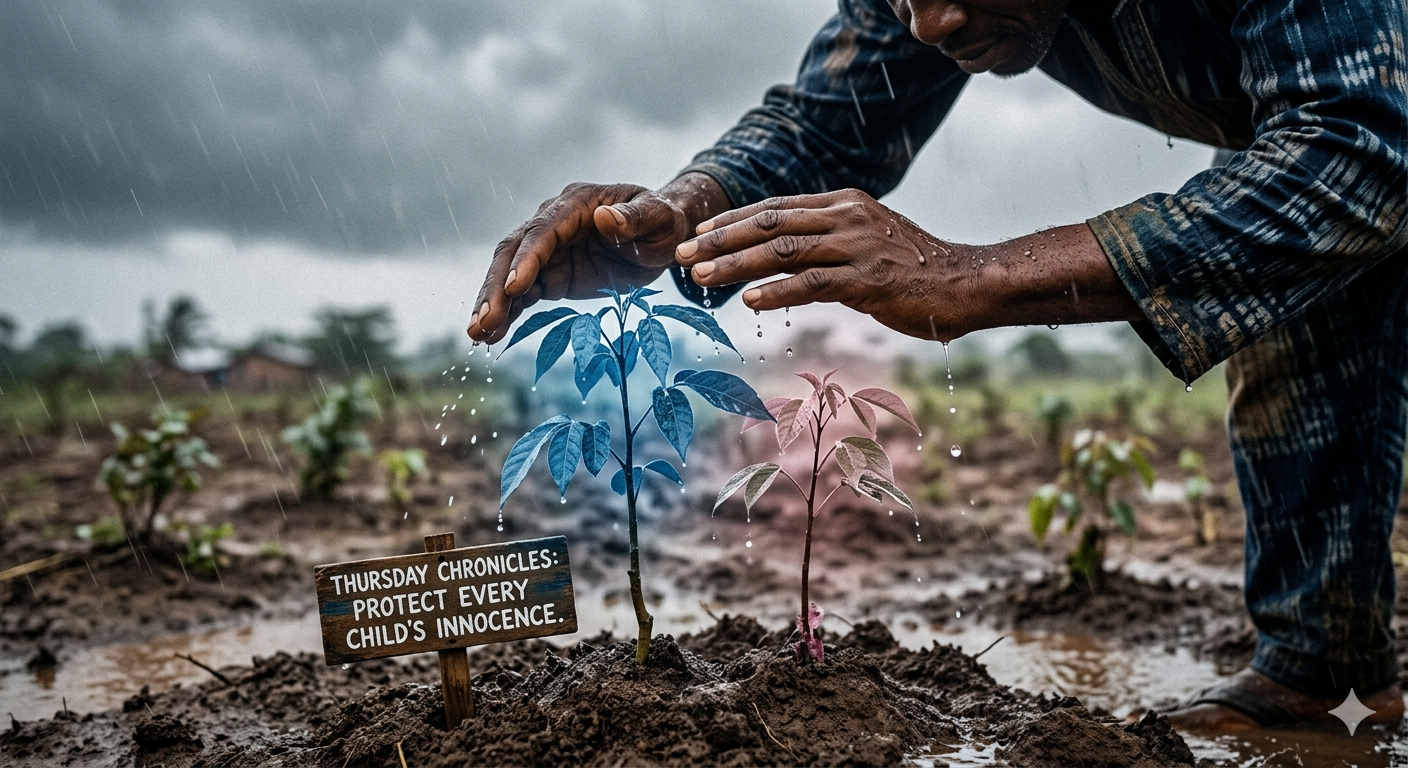
Hello, my Thoughtful People. Welcome back to the Chronicles. Usually, we gather here to find the “ginger” to survive the week, but today, we are holding a vigil. Not for the dead – but for the living who are still waiting for their dawn. We aren’t talking about fuel prices or football boardroom drama. Today, we are talking about the wounds that don’t bleed externally, the ones inflicted by rape and pedophilia.
There are people among us – perhaps even reading this right now, for whom the sun rose this morning but brought no warmth. Dusk arrived at their dawn, and nobody noticed. This is a heavy conversation, but it is also a hopeful one, because we are here, we are talking, and silence has an expiry date. It’s about the girl in a quiet street, the boy in a boarding school, and the adults they become while carrying a mountain of silence. But it is also about the healing they deserve, the justice that is owed, and the world we can still build for them. Pull up a chair, and let’s look at the mirror of our humanity – not to despair at what we see, but to decide that we can do better.
But here is what I know about us – about Nigerians, about humans. We already know how to share our light. We have always known.
We see it in the woman who notices her friend’s stained dress and quietly unknots her own scarf, draping it around her without a word, without a whisper to anyone else in the room. The stain is still there, but the shame is gone. Covered. Protected. Dignity restored in one simple gesture. We see it in the quiet “abeg hold this” – money pressed into a struggling hand without ceremony, without making a production of someone else’s pain. We see it in the compound where nobody asks whose child is crying, because in that yard, every child belongs to every adult. We see it in the Mama Put, who scoops just a little deeper for the customer whose eyes tell a story their mouth hasn’t spoken yet.
We have never needed a government memo to be kind. We have never needed a hashtag to see a neighbour.
So why then, do we look away from the survivor in our street? Why do we suddenly forget how to share our light when the darkness is called rape, when the wound is called abuse, when the child is called “damaged”? The truth is – a survivor doesn’t need your pity. They need what you already gave that friend in the room. They need to be covered. They need someone to scoop a little deeper for them.
We often talk about rape as if it only happens in dark alleys, but the reality is much more chilling. Most violations happen behind closed doors, by people who “know the family,” people who “are highly respected,” or people who “pray the loudest.” Whether it is a young girl in a village or a young boy in a city, the trauma of sexual violence is a universal language of pain and shame.
For a long time, we have ignored the male survivors. We’ve been told “men don’t cry” and “boys can’t be raped,” creating a prison of shame that prevents boys from seeking help. This silence only empowers the predator. Pedophilia is not a “mistake” or a “lapse in judgment” – it is a predatory theft of a child’s soul, regardless of the child’s gender. When we fail to protect any child, we fail the future.
Rape and child molestation are the ultimate “silent wars.” We see the headlines, we feel the temporary “vawulence” on social media, but the survivors carry the weight long after the hashtags disappear. The cries of the vulnerable have reached the heavens, and it’s a reminder that our protection systems – both legal and communal are currently running on “low battery.”
When these tragedies break into the news, the internet usually splits into two angry camps.
The Misogyny Trap: You see the comments – “What was she wearing?” “Why was she out late?” This is the ancient art of victim-blaming. It treats a woman’s body as a commodity that is “lost” if it is violated. It’s a mindset that prioritizes “honour” over “justice.”
The Misandry Trap: On the other side, the deep, justified pain often boils over into a hatred for all men. “Men are scum,” “Every man is a potential rapist.” While the anger is a response to systemic failure, branding half the human race as monsters doesn’t bring a single survivor peace. It just builds a wall where we need a searchlight.
In the middle of this chaos stands Feminism. At its truest heart, feminism in our context isn’t about “hating men.” It’s about the radical belief that Humanity is one. It’s the demand that a girl’s life shouldn’t be a gamble and a boy’s trauma shouldn’t be a secret. It’s the movement that says: “Justice for one is safety for all.”
Justice isn’t just a court ruling; it’s a culture. It’s a world where a survivor doesn’t have to apologize for existing. It’s a world where a pedophile – whether they are a “Big Man,” a “Man of God,” or a “Family Head” – is met with the cold, unyielding iron of the law, not a “family meeting” to “settle it.”
We need the VAPP (Violence Against Persons Prohibition) Act to be more than just a document in a dusty office. We need it to be the shield of the vulnerable. But more than that, we need Empathy. We need to look at survivors not as “broken things,” but as the bravest people in the room.
In Nigeria, feminism is often treated like a “foreign virus,” but at its core, it is simply the radical notion that a girl should be able to walk to a shop without being hunted. It is the demand for a world where “no” is a complete sentence and “protection” isn’t a favor, but a right.
We have to stop the gender war long enough to realize that evil has no gender. A predator is a predator. When we turn these tragedies into an opportunity to hate all men or suppress all women, we lose the plot. The enemy isn’t the opposite gender; the enemy is the culture of silence, the lack of justice, and the “settle it at home” mentality that lets monsters go free to find their next victim.
Key Take-Home Points for the Heart-Broken
• Violence has No Gender: A survivor is a survivor. Whether male or female, the trauma is valid, and the need for support is urgent. Let’s stop gender-coding pain.
• Consent is the Only “Sacred” Rule: There is no tradition, no marriage, and no “vibe” that overrides the word “No.” If it isn’t an enthusiastic “Yes,” it’s a “No.”
• Kill the Culture of Shame: Shame should belong to the predator, not the survivor. We must stop shaming victims into silence; it only helps the next attack happen.
• Justice is a Collective Duty: If you know something, say something. Reporting a predator isn’t “destroying a family”; it’s saving a child.
Lessons to Carry into the Light
• Believe First, Question Never: When someone shares their trauma, your only job is to listen and believe. The “investigation” is for the police; the empathy is for you.
• Educate the Next Generation: Teach your sons about boundaries and your daughters about their power. Teach your children that their bodies belong to them, period.
• Support the Systems: Donate to shelters, support legal aid for survivors, and demand that your local representatives prioritize sexual offense registries.
• Choose Humanity over Hate: Don’t let your anger at a crime turn into hate for a gender. Use that energy to demand better laws and safer streets.
As we wrap up this edition, I want to speak directly to the survivors reading this: You are not what happened to you. The dusk that arrived at your dawn was never your fault, and it was never your forever. You are whole, you are worthy, and you are not alone.
To everyone else: Be the scarf. Be the extra scoop. Be the adult who answers the cry without asking whose child it is. Let’s be the generation that stops the “shush” – the generation that makes our homes, schools, and streets safe again.
Justice isn’t just a dream; it’s a choice we make every time we choose truth over tradition, and light over silence.
See you next Thursday, with a world that feels a little safer for everyone.