





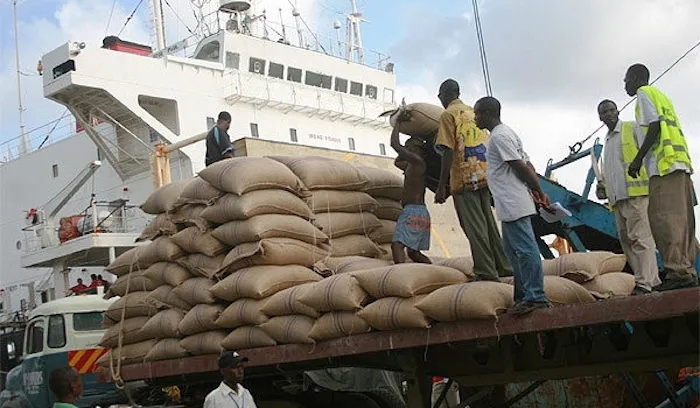
Nigeria spent N1.39 trillion importing food and beverages in the first quarter of 2026, even as the country recorded one of its strongest trade surpluses in years, raising fresh questions about whether the nation’s much-touted “import decline” is a sign of economic resilience or a symptom of shrinking purchasing power and a still-fragile agricultural base.
The latest Foreign Trade Statistics released by the National Bureau of Statistics (NBS) show that the N1.39 trillion food import bill represents a 16.7 per cent drop from the N1.67 trillion recorded in the corresponding period of 2025, and is also lower than the N1.59 trillion spent in Q1 2024; the third consecutive year-on-year moderation in the country’s food import spending for the first quarter.

A sectoral analysis of the food import figures reveals that primary food products accounted for the lion’s share, at N634.05 billion, down from N730.01 billion the previous year. Food and beverages imported mainly for industrial use are largely raw materials for Nigeria’s flour mills, breweries, and packaged food manufacturers, and stood at N353.24 billion, easing from N425.62 billion in Q1 2025. Imports for direct household consumption totaled N280.81 billion, compared with N304.39 billion in the same period last year.
Durum wheat remained the dominant single item on Nigeria’s food import list, with Russia and Canada the leading suppliers feeding the country’s flour-milling and food-processing industries. Despite years of government intervention, rice, sugar, fish, dairy products, malt and vegetable oils continue to fill supply gaps that local producers have yet to close.
The bigger picture: a shrinking trade pie
The food import figures form part of a broader contraction in Nigeria’s agricultural trade. NBS data show that agricultural goods imports, a category that includes the food items above plus farm inputs, fell 20.09 per cent year-on-year to N827.72 billion in Q1 2026, down from N1.04 trillion in Q1 2025, and a steep 42.39 per cent below the N1.44 trillion recorded just one quarter earlier in Q4 2025.
On the other side of the ledger, agricultural exports also declined, falling 31.2 per cent year-on-year to N1.17 trillion from N1.70 trillion in Q1 2025, and down 11.39 per cent from N1.32 trillion in Q4 2025. Analysts say that the agricultural sector is contracting on both the import and export fronts simultaneously, rather than simply substituting foreign goods with local production.
Nigeria’s total merchandise trade for the quarter stood at N34.78 trillion. Total imports fell sharply to N13.62 trillion (39.15 per cent of trade), an 18.17 per cent decline from N16.64 trillion in Q1 2025, while total exports rose modestly to N21.17 trillion (60.85 per cent of trade), up 2.77 per cent year-on-year. The wide gap between the two pushed the trade surplus to N7.55 trillion, a jump of roughly 341 per cent compared with the prior year, driven chiefly by crude oil exports worth N11.20 trillion, or nearly 53 per cent of total exports. Non-oil exports contributed N9.97 trillion.
China retained its position as Nigeria’s largest source of imports, supplying goods worth about N5.1 trillion, followed by the United States, India, the Netherlands/Germany, and the United Arab Emirates. On the export side, India, France, the Netherlands, Spain, and the United States were the top destinations for Nigerian goods, which included crude oil, natural gas, urea and jet fuel alongside agricultural raw materials.
What the government is doing
The figures land against the backdrop of a renewed federal push to cut Nigeria’s wheat import bill, long one of the heaviest contributors to the country’s food import dependence. According to the Central Bank of Nigeria, domestic wheat production currently meets barely 1 per cent of national demand of five to six million metric tonnes, forcing the country to import the balance at a cost the apex bank has previously put at around $2 billion annually, making wheat the second-largest single item on Nigeria’s food import bill after crude inputs.
In response, the Minister of Agriculture and Food Security, Senator Abubakar Kyari, last year flagged off the 2025/2026 dry-season wheat production programme under the National Agricultural Growth and Agro-Pocket Project (NAGS-AP), targeting 80,000 registered farmers across 40,000 hectares with an expected output value of about N160 billion. The minister noted that earlier rounds of the programme had progressively expanded farmer participation, and said the scheme would deploy extension agents and enforce strict quality control on seeds and fertiliser to push the country closer to wheat self-sufficiency.
Agricultural development experts, however, argue that government interventions remain dwarfed by the scale of the problem. Godwin Atser of the Sasakawa Africa Association told a 2026 stakeholders’ workshop in Abuja that Nigeria continues to spend an estimated $10 billion annually importing staples such as wheat, rice, sugar, fish and tomato paste, a situation he attributed to the country’s inability to meet local demand.
He pointed to weak agricultural extension coverage, noting Nigeria has roughly one extension agent for every 10,000 farmers, as a major constraint on productivity gains, particularly for smallholder farmers who dominate the country’s agricultural landscape.
The warnings extend beyond trade statistics to outright food security concerns. The United Nations Food and Agriculture Organisation has projected that about 34.7 million Nigerians could face severe food insecurity during the next lean season, a forecast that farmer groups have cited in calling on the Federal Ministry of Agriculture and Food Security and state governments to prioritise smallholder farmers in their 2026 budget allocations.
The takeaway
Analysts described the Q1 2026 numbers as evidence of a “dual reality” for Africa’s largest economy. On paper, a record trade surplus and a falling import bill point to macroeconomic improvement, helped along by tighter foreign exchange conditions and oil-driven export earnings.
But beneath that headline lies a less comfortable story: food imports are falling not because Nigeria is producing more at home, but partly because shrinking naira purchasing power, scarce foreign exchange and weak local demand are squeezing how much the country can afford to bring in — even as both agricultural imports and exports contract in tandem.
Unless local production of wheat, rice, dairy, fish and other staples is scaled up significantly, analysts warn, Nigeria’s food trade numbers will continue to swing with global price cycles, exchange rate movements and foreign exchange availability, a vulnerability that a falling import bill alone cannot fix.