








Key Points
- Nigeria has evacuated its first confirmed imported Bundibugyo Ebola patient to Switzerland for further medical care.
- The 42-year-old woman was reportedly clinically stable and showing significant improvement before her departure from Abuja.
- Her husband accompanied her on Monday and remains asymptomatic.
- Health authorities have identified 53 primary contacts linked to the case and are monitoring them.
- The Federal Government says surveillance, contact tracing and other containment measures remain in place.
Main Story
Nigeria has evacuated its confirmed Ebola patient to Switzerland for further medical care, as health authorities continue efforts to prevent the virus from spreading.
The Minister of Health and Social Welfare, Professor Muhammad Ali Pate, confirmed that the 42-year-old woman departed Abuja on Monday, October 26, 2026, alongside her husband, who has remained free of symptoms.
The woman is Nigeria’s first reported imported case of Bundibugyo virus disease, a form of Ebola virus disease. Her evacuation follows treatment in Nigeria, where medical personnel monitored her condition and implemented strict infection prevention measures.
In a statement shared on X, Pate said the patient was clinically stable and had shown significant improvement before the evacuation. He added that her laboratory results were moving towards baseline, suggesting improvement in her condition.
However, the minister cautioned against interpreting these developments as proof that she could no longer transmit the virus.
“This does not mean she is not still infectious, hence the strict protocols in place,” he said.
According to Pate, the evacuation was approved by the minister and conducted in line with established public health procedures for transferring patients with infectious diseases.
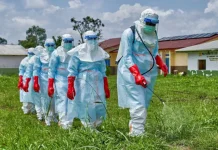
The process required careful coordination to protect the patient, her husband, medical personnel and others involved in the transfer.
Pate commended the clinical team responsible for the woman’s treatment, praising the quality of care provided. He also acknowledged the public health personnel who ensured that the evacuation followed the required safety procedures.
The minister said further information would be provided once the patient and her husband had arrived safely at their destination.
Although the evacuation marks a significant development in the patient’s treatment, Nigerian health authorities continue to focus on preventing additional infections.
The Issues
Ebola outbreaks require swift action because transmission can occur when people come into direct contact with the bodily fluids of an infected person, particularly when appropriate protective measures are not followed.
The patient’s reported improvement is encouraging, but it does not automatically establish that she is no longer infectious. Medical teams must continue to assess her condition and follow the relevant infection prevention protocols.
The case also highlights the importance of identifying people who may have been exposed to the virus. Without effective contact tracing and monitoring, infections can go undetected and potentially lead to further transmission.
What’s Being Said
Pate expressed confidence in the medical and public health teams involved in the patient’s care and evacuation.
His warning that clinical improvement does not necessarily mean the patient is no longer infectious reinforces the government’s position that containment measures must remain in place.
The minister has also urged Nigerians to remain vigilant and obtain information from credible sources rather than rely on rumours or unverified reports.
What’s Next
The Nigeria Centre for Disease Control and Prevention (NCDC) has identified 53 primary contacts linked to the confirmed case. These individuals are being monitored as part of ongoing efforts to detect possible infections early.
Health authorities are continuing surveillance, contact tracing and other containment activities. Updates on the patient’s condition and the outcome of the evacuation are expected from the relevant authorities.
The monitoring of identified contacts will remain important in determining whether further cases emerge.
Bottom Line
Nigeria’s decision to evacuate the Ebola patient to Switzerland provides an opportunity for continued medical care while the country’s public health response remains active.
Her reported improvement is encouraging, but the situation requires caution. Effective contact tracing, transparent communication and strict infection prevention measures will be crucial to protecting the public and preventing further transmission.