






Nigeria’s financial markets opened in November 2025 on a negative footing, as both the naira and domestic equities declined sharply following comments by United States President Donald Trump threatening possible military action against Nigeria over alleged religious persecution.
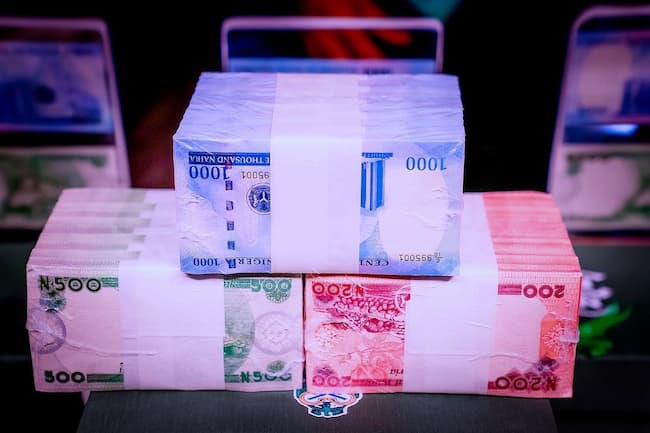
Figures from the Central Bank of Nigeria indicated that the naira, which recently traded at a 2025 peak of N1,421.73/$, depreciated to N1,436.34/$ on Monday — a day-on-day loss of N14.61 or 1.03 per cent. At the parallel market, the currency also weakened to N1,455/$, reflecting heightened anxiety among investors and fresh foreign-exchange demand pressures.
The selloff was triggered by tense geopolitical rhetoric at the weekend, after Trump, via his Truth Social platform, described Nigeria as a “country of particular concern” and asked the US Department of War to prepare for “possible action” if alleged killings of Christians persist. He characterised the situation as “Christian genocide” — a claim that has drawn widespread global criticism and renewed debate about its diplomatic and economic implications for Africa’s largest economy.
The shock swiftly filtered into the capital market. At the Nigerian Exchange, bearish momentum resumed as the All-Share Index fell by 0.25 per cent to close at 153,739.11 points, bringing year-to-date gains down to 49.37 per cent. Market capitalisation dipped by N245.88bn to N97.58tn.
Aradel Holdings (-9.21 per cent) and Access Corporation (-3.07 per cent) led Monday’s decline. Market breadth was negative, with 38 losers against 19 gainers. Union Dicon topped the gainers chart (+9.93 per cent), while Honeywell Flour Mills emerged the worst performer (-10.00 per cent).
Trading sentiment was also weaker as total volume and turnover slumped 87.94 per cent and 44.64 per cent respectively, to 627.5 million units valued at N25bn. United Bank for Africa accounted for the most activity, trading 136.8 million units worth N5.5bn — representing 21.8 per cent of total volume and 22.2 per cent of total value.
Sectoral performance was mixed. Oil & Gas (-3.94 per cent), Commodities (-1.85 per cent), Insurance (-1.48 per cent) and Banking (-0.22 per cent) were down, while Consumer Goods inched higher by 0.49 per cent. Industrial stocks closed flat.
In the fixed-income market, Cowry Assets reported weaker appetite for Nigeria’s Eurobonds, with average yields rising by 5 basis points to 7.70 per cent on Monday amid global risk aversion. Bloomberg also reported that Nigeria’s dollar bonds were the worst performers among emerging-market peers, with all ten notes ranking among global decliners. The 2047 note shed 0.6 cents to 88.26 cents on the dollar before trimming some losses later in the session.
However, some analysts believe the panic may be temporary. Tilewa Adebajo, Chief Executive Officer of CFG Advisory, told The PUNCH that the reaction appeared “not sustainable”.
“This looks like a mere blip,” he said. “Closing prices in global markets already show stabilisation. With Nigeria’s exit from the FATF Grey List, the long-term fundamentals remain strong.”
But Chief Executive of the Centre for the Promotion of Private Enterprise, Dr Muda Yusuf, warned that such geopolitical statements could severely damage confidence.
“The US President’s threat of military intervention in Nigeria is unwarranted, counterproductive, and economically destabilising,” he said. “Remarks of this nature heighten risk perception and undermine investor confidence.”
He stressed that Nigeria must work to deepen governance and internal security, but added that diplomatic engagement “should be cooperative, not coercive”.
“Unilateral military action would destabilise the Nigerian economy, threaten regional stability, and worsen humanitarian pressures,” Yusuf warned.
With markets now watching for clearer signals on Washington’s policy posture and Abuja’s diplomatic response, analysts say medium-term stability will hinge on calm communication, confidence-building measures, and steady macroeconomic policy from the Federal Government and the CBN.